








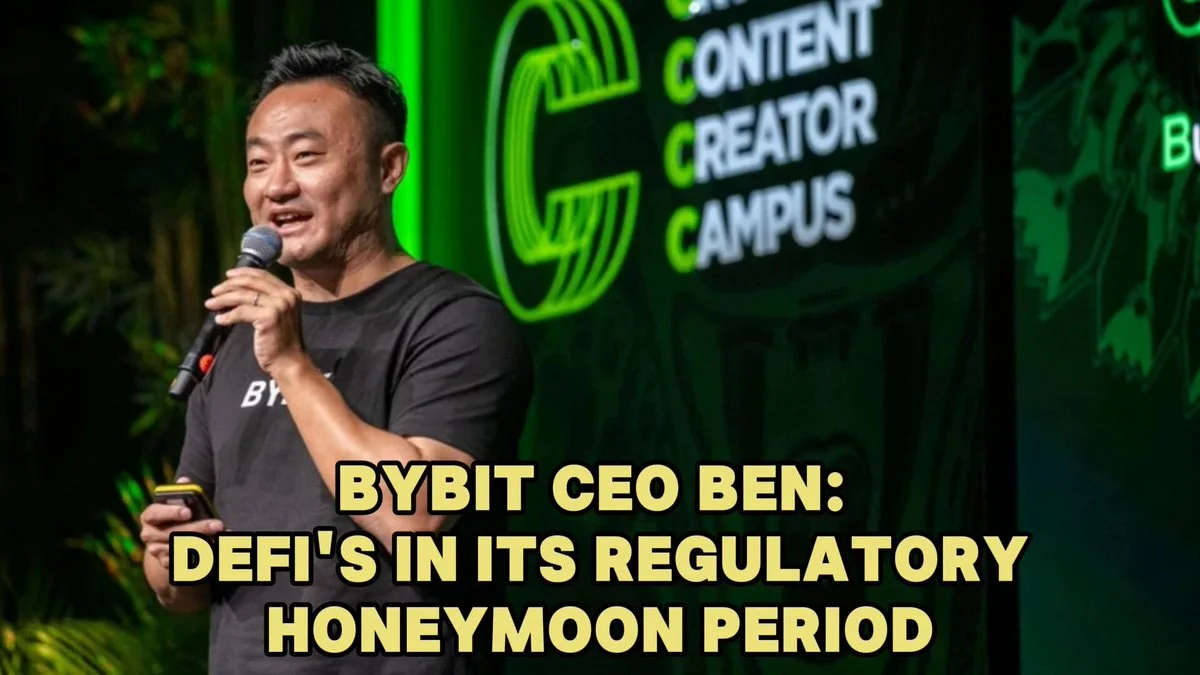
Bybit co-founder and CEO Ben Zhou told Paris Blockchain Week 2026 that decentralized finance remains in a "regulatory honeymoon period," with major frameworks including the EU's MiCA still lacking a working definition of DeFi.
Speaking with BeInCrypto's Brian McGleenon, Zhou argued that the cross-border, decentralized nature of DeFi is structurally incompatible with centralized supervision — and that gap is now the industry's main source of regulatory arbitrage. Centralized exchanges, he noted, have already been pulled into bank-level compliance reviews, a regime with no real parallel on the DEX side.
Why it matters
The asymmetry Zhou flagged is the core of the trade. CEXs are absorbing KYC, sanctions-screening and capital-cost burdens that DEXs do not face, while retail and institutional flow continues to migrate on-chain. Until a regulator names a venue, protocol, or front-end as the regulated entity, the playing field is tilted by enforcement choice rather than by statute.
Market impact
Zhou predicted regulators will move on DEXs first, not lending protocols or token issuers, because DEXs are the most legible on-ramp for retail. For users and builders, the practical read is that the current window of frictionless, anonymous on-chain trading is borrowed time — and that any DEX growth thesis should price in a near-term compliance shock as a base case rather than a tail risk.
Frequently asked questions
-
What did Bybit's CEO mean by a 'regulatory honeymoon period' for DeFi?
Ben Zhou said major frameworks including the EU's MiCA still lack a working definition of DeFi, leaving a gap that lets the industry operate with minimal direct oversight while centralized exchanges absorb bank-level compliance costs.
-
Why does Zhou think DEXs will be regulated first?
He argued DEXs are the most legible on-ramp for retail users, making them the easiest enforcement target for regulators moving into decentralized finance.
-
How are centralized exchanges regulated differently from DEXs today?
According to Zhou, CEXs are now subject to bank-level compliance reviews covering KYC, sanctions screening and capital requirements, while DEXs continue to operate as effectively permissionless venues with no equivalent oversight.
-
What is regulatory arbitrage in DeFi?
It refers to the gap Zhou highlighted: activity migrates to whichever venue — typically a DEX — faces the lightest compliance burden, exploiting the absence of a clear cross-border definition of decentralized finance.
-
When could DeFi regulation actually land?
Zhou stopped short of a timeline but said the asymmetry between CEX and DEX oversight is unsustainable, implying meaningful enforcement action on DEXs is a base-case near-term risk rather than a distant tail event.

 TheBlock
 CoinTelegraph
 Benjamin Cowen
 WatcherGuru
 CoinDesk
 CryptoSlate