








 CoinDesk

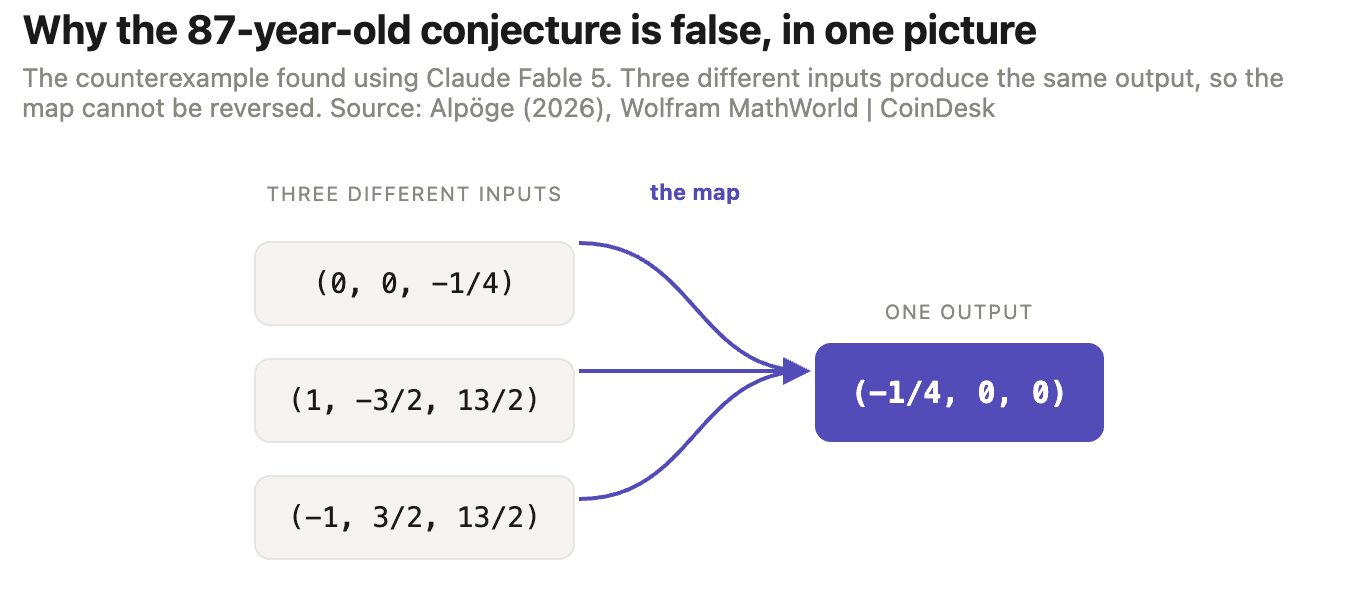


Anthropic's Claude Fable 5 helped disprove the Jacobian conjecture over the weekend, an 87-year-old open problem in mathematics that had resisted proof since 1939 and sits on Stephen Smale's influential list of unsolved problems for the century. Number theorist Levent Alpöge, who works at Anthropic and previously held a Harvard fellowship, posted the result on X on Sunday, crediting the model and naming the counterexample. The finding lands days after the capabilities of China's Kimi AI had moved Bitcoin harder than any of crypto's own catalysts.
Why it matters
The counterexample is concrete: a polynomial machine in three variables that passes the standard Jacobian check yet maps three distinct inputs to the same output, so it cannot be reversed. Mathematicians could verify the case by hand within a day, which is itself the point. Original mathematics at this level of difficulty, produced by an AI and quickly verified by humans, is a new kind of capability milestone, and capability milestones move capital.
For crypto, the read is uncomfortable. Bitcoin has spent months trading as a sidecar to the AI narrative, moving with chipmakers and memory stocks rather than with its own catalysts. It fell hard last Friday when Moonshot AI's release rattled the semiconductor complex, and it bounced this week as those stocks recovered. The link is partly mechanical: the largest publicly traded Bitcoin miners are now AI data-center operators whose revenues rise and fall with demand for compute. But the wider pull is simpler: AI is where speculative dollars and attention are flowing, and every leap like Fable's result makes the compute-and-chips trade look more compelling than holding a token that mainly rides the same wave.
Market impact
The story to watch is capital rotation, not price. Each new demonstration of what frontier models can do narrows the case for owning crypto when an investor can own the vehicle (the chip designer, the hyperscaler, the model lab) that the rest of the market is now pricing. Bitcoin's drawdown on Kimi's release, and its rebound with the chip stocks, is the cleanest recent example of how tightly the trade is now coupled.

Frequently asked questions
-
What did Claude Fable 5 actually prove about the Jacobian conjecture?
It produced a concrete counterexample: a polynomial map in three variables that passes the standard Jacobian check yet maps three distinct inputs to the same output, so it cannot be reversed. Mathematicians were able to verify the case by hand within a day.
-
Who is Levent Alpöge and how was the result announced?
Alpöge is a number theorist at Anthropic who previously held a fellowship at Harvard. He posted the disproof on X on Sunday, crediting the Claude Fable 5 model and naming the counterexample polynomial map.
-
Why does an AI math result matter for Bitcoin's price?
Bitcoin has spent months trading as a sidecar to the AI narrative, moving with chipmakers and memory stocks rather than crypto's own catalysts. Each new frontier-model capability widens the appeal of owning the underlying compute trade over a token that mainly rides the same wave.
-
How are Bitcoin miners tied to the AI compute trade?
Several of the largest publicly traded Bitcoin miners have rebuilt themselves as AI data-center operators, so their revenue now rises and falls with demand for compute power. That makes their stock and, by association, Bitcoin tightly coupled to the AI cycle.
-
What was the Jacobian conjecture, in plain terms?
First asked in 1939, it asked whether any polynomial map built only from addition and multiplication can always be inverted. Mathematicians had a quick test for whether such a map looked reversible; the conjecture said passing the test implied true reversibility until Fable 5 produced one map that passed yet collapsed…
 CoinTelegraph
 CryptoSlate
 TheBlock
 Crypto News
 WuBlockchain