


 WuBlockchain
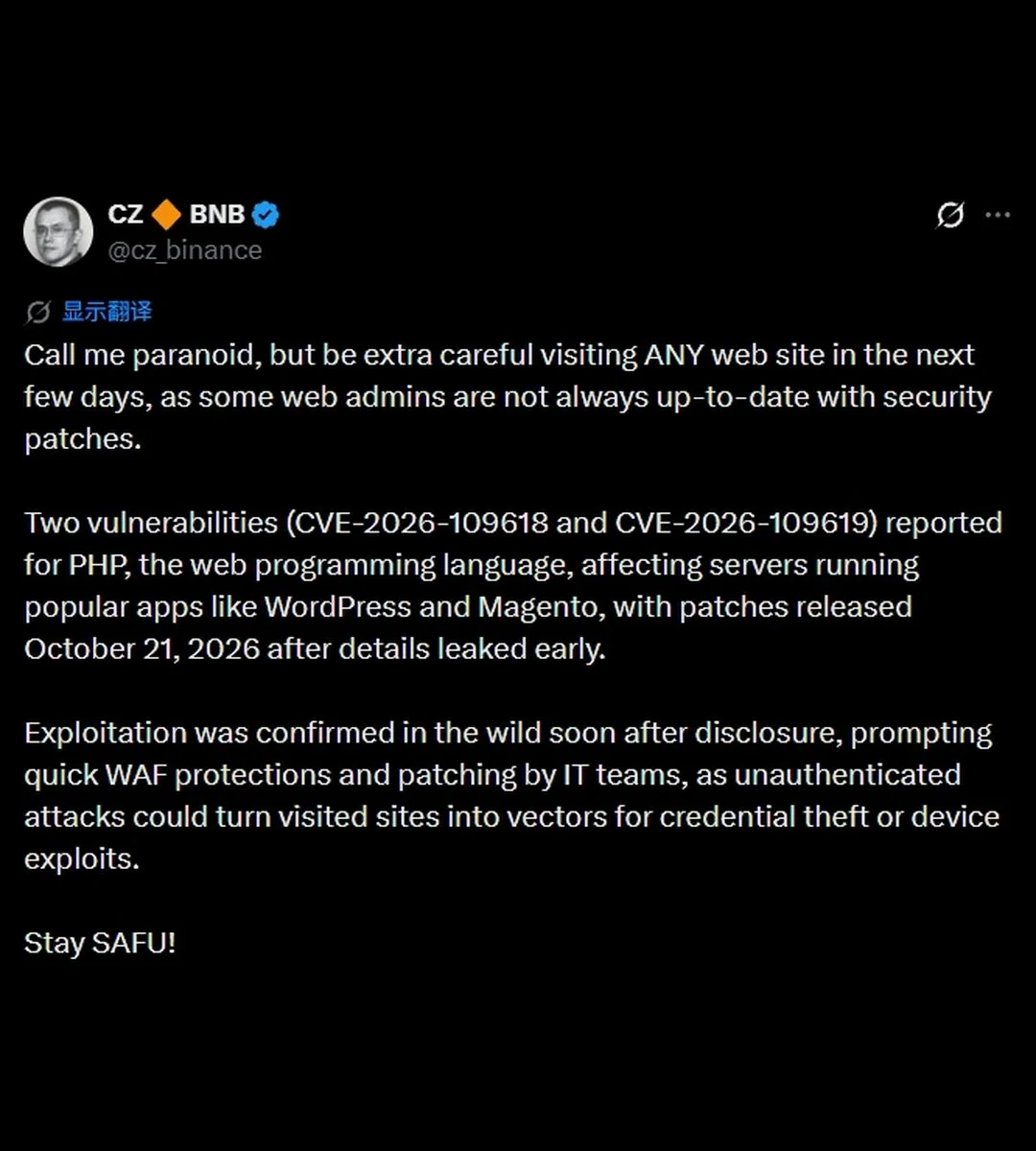

Binance founder Changpeng Zhao (CZ) issued a public warning urging users to exercise heightened caution when browsing websites over the coming days, pointing to two critical PHP vulnerabilities, CVE-2026-109618 and CVE-2026-109619, that affect servers running widely deployed applications including WordPress and Magento. The flaws were patched on October 21 after technical details leaked ahead of the official disclosure window, compressing the time operators had to respond.
Why it matters
The vulnerabilities allow unauthenticated attackers to execute arbitrary code on vulnerable servers, meaning no login or prior access is required to compromise a site. Visitors to unpatched sites can be exposed to credential theft through injected scripts or redirects, making this a supply-chain style risk that extends well beyond the site operators themselves. Exploitation attempts have already been detected in the wild, and a meaningful share of WordPress and Magento installations are estimated to still be running unpatched versions.
Market impact
For the crypto community specifically, the threat surface is significant: phishing pages, fake wallet-connect prompts, and session-hijacking scripts are common payloads in web-based exploits targeting this demographic. CZ's warning carries weight precisely because the attack vector is passive, a user simply visiting a compromised site can have credentials stolen without clicking anything suspicious. Users should avoid logging into non-essential accounts, use hardware wallets where possible, and verify that any crypto-related site they visit has applied the October 21 patch before interacting.
Frequently asked questions
-
What are CVE-2026-109618 and CVE-2026-109619, and why are they dangerous?
They are critical PHP vulnerabilities that allow unauthenticated attackers to execute arbitrary code on vulnerable servers running WordPress or Magento, meaning no login is required to compromise a site or expose its visitors to credential theft.
-
When were these PHP vulnerabilities patched and why does the timing matter?
The flaws were patched on October 21, but technical details leaked before the official disclosure, giving attackers a head start. Exploitation attempts were already detected before many site operators had time to apply the update.
-
How can a crypto user be affected just by visiting a website?
Compromised servers can inject malicious scripts or redirects that steal session credentials or serve fake wallet-connect prompts without requiring the visitor to click anything suspicious, making passive browsing a genuine attack vector.
-
Why did CZ specifically warn the crypto community about these PHP exploits?
Crypto users are a high-value target for credential theft and phishing. Web-based exploits that silently hijack sessions or serve fake wallet prompts are a common tactic against this demographic, amplifying the risk of these particular vulnerabilities.
-
What steps should users take to protect themselves while the patching wave continues?
Users should avoid logging into non-essential accounts, use hardware wallets where possible, and verify that any crypto-related site they visit has applied the October 21 PHP security patch before interacting with it.
 Crypto News
 CoinDesk
 CryptoSlate
 Lookonchain
 CoinTelegraph
 TheBlock
 WatcherGuru