








 WuBlockchain
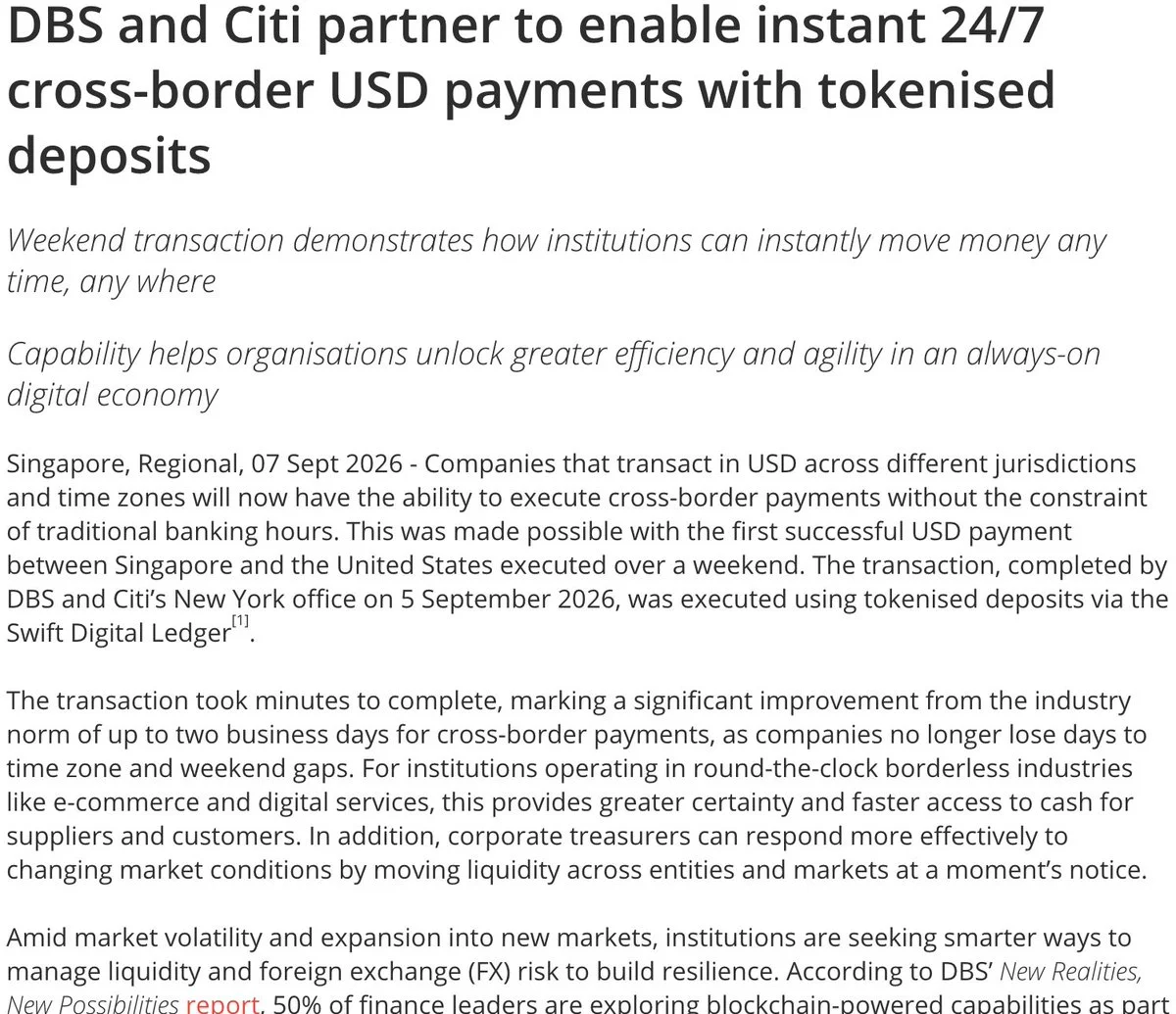

DBS and Citi completed a live cross-border USD payment between Singapore and the United States on September 5, processing the transaction in minutes over a weekend using tokenized deposits on Swift's blockchain-based Digital Ledger. The milestone is the first time two major banks have demonstrated 24/7 cross-border payment capability outside traditional banking hours on Swift infrastructure.
Why it matters
The transaction signals that tokenized deposits are moving from proof-of-concept into production-grade interbank plumbing. Swift's Digital Ledger synchronizes interbank payment commitments on-chain while settlement remains off-ledger through existing banking infrastructure, meaning the upgrade does not require banks to overhaul their back-end systems. That design choice is deliberate: it lowers the adoption barrier for the thousands of financial institutions already connected to Swift's network, and it positions tokenized deposits as a credible bridge between traditional finance and blockchain-native settlement rails.
Market impact
For the real-world asset tokenization sector, a live DBS-Citi transaction on Swift infrastructure is a significant legitimacy signal. It demonstrates that RWA tokenization is not confined to permissioned DeFi experiments but is being integrated into the highest-volume, most regulated corridor in global finance. Institutions watching the cross-border payments space should note that weekend settlement, long a structural gap in correspondent banking, now has a working technical answer. The next question is how quickly other Swift-connected banks replicate the model.
Frequently asked questions
-
What made the DBS-Citi September 5 transaction historically significant?
It was the first live cross-border USD payment completed over a weekend using tokenized deposits on Swift's Digital Ledger, demonstrating 24/7 settlement capability outside traditional banking hours between Singapore and the United States.
-
How does Swift's Digital Ledger handle settlement in this model?
Swift's Digital Ledger synchronizes interbank payment commitments on-chain, but final settlement remains off-ledger through existing banking infrastructure, meaning banks do not need to replace their back-end systems to participate.
-
Why does the off-ledger settlement design matter for broader bank adoption?
Because it removes the need for institutions to overhaul existing infrastructure, thousands of banks already connected to Swift's network can adopt the model with significantly lower technical and operational barriers.
-
What does this transaction signal for the real-world asset tokenization sector?
It moves tokenized deposits from proof-of-concept into production-grade interbank rails within one of the most regulated and highest-volume corridors in global finance, lending major institutional credibility to the RWA tokenization space.
-
What structural problem in correspondent banking does this transaction address?
Weekend settlement has long been a gap in correspondent banking, with cross-border payments typically delayed until the next business day. The DBS-Citi transaction demonstrates a working technical solution to that limitation.
 WatcherGuru
 CoinTelegraph
 CoinDesk
 Crypto Rank News
 CryptoSlate
 Crypto News
 Altcoin Daily