








 CoinDesk

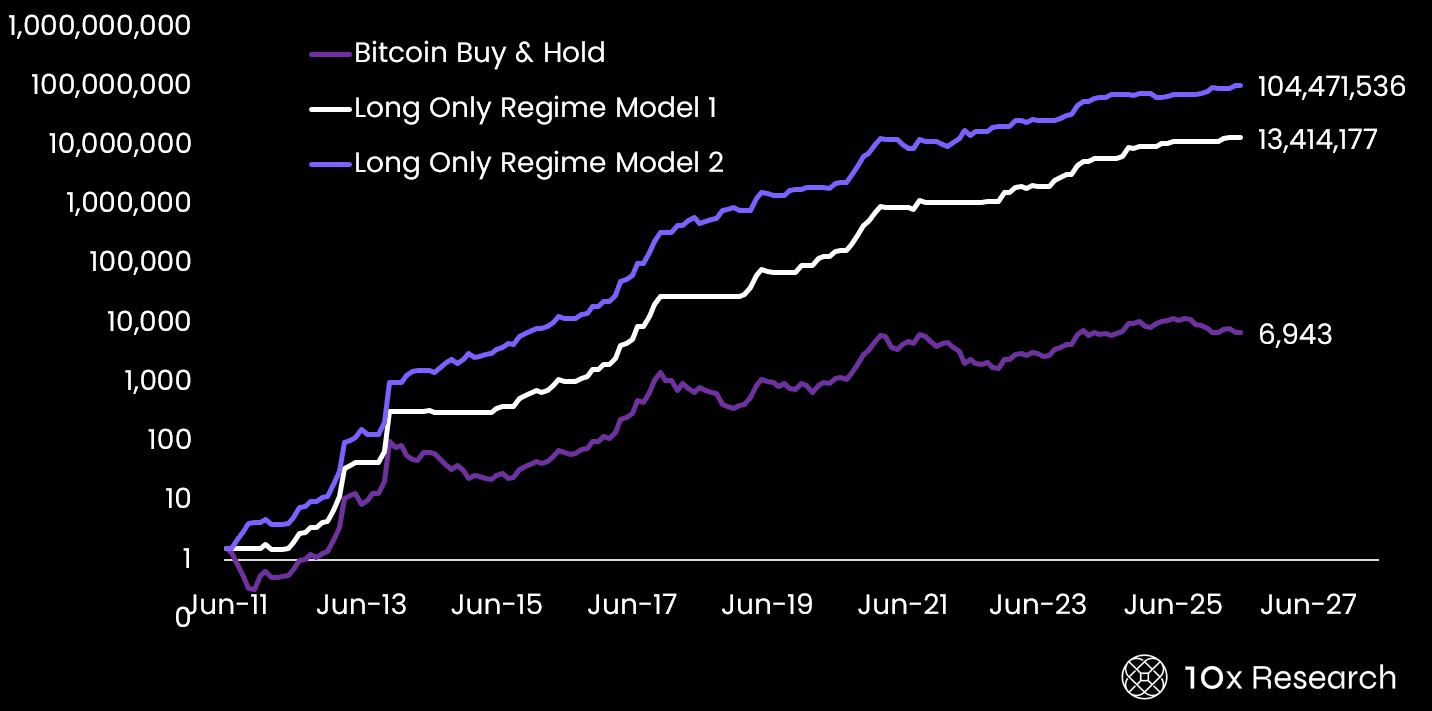


Markus Thielen, CEO of 10x Research, argues that dollar-cost averaging is one of the most common and costly mistakes advisors make on clients' behalf with bitcoin. The S&P 500 playbook — steady accumulation, time in the market — assumes an asset that consistently appreciates, which bitcoin's four-cycle history since 2011 has repeatedly violated. Peak-to-trough drawdowns for buy-and-hold investors have hit −80% three times, not as tail risk but as a recurring structural feature of the asset.
Why it matters
DCA offers psychological comfort, not mathematical protection, because it does not reduce exposure when the regime has structurally turned negative. Thielen's alternative is regime awareness: bitcoin spends 12 to 18 months in identifiable bull or bear phases driven by the four-year halving supply schedule, successive waves of institutional adoption and leverage cycles that amplify both upside and downside. 10x Research tracks ten independent signals across momentum, trend and on-chain cost-basis metrics to identify which regime is active.
The empirical spread is large: when most signals are positive, bitcoin's average monthly return has been +25%; when the majority are negative, the average is −6%, a 31-percentage-point gap. A cycle-aware long-only approach produced a Sharpe ratio of 1.22 in backtesting versus 0.82 for buy-and-hold over a 15-year period, and cut the maximum drawdown from −80% to −44%.
Market impact
The framework supports a dynamic allocation band rather than a fixed position. A mandate specifying a maximum 5% bitcoin allocation should still ask whether that 5% is deployed at 100%, 50% or 0% at any point in the cycle. Rules-based regime signals, proprietary or third-party, can drive those decisions without discretionary market calls. The approach wins not by being right more often than buy-and-hold but by stepping aside during the clustered months when bitcoin loses 20%, 30% or 40% — the drawdowns that, in practice, end portfolios rather than weather them.
Separately, Eric Tomaszewski of Verde Capital Management argues the bigger fiduciary question may be where value accrues within blockchain ecosystems, flagging Ethereum's potential as productive collateral for institutions and AI agents, and protocols like Hyperliquid and Aerodrome that prioritize revenue distribution over raw activity metrics. Dave LaValle, CoinDesk Data and Indices President, separately noted The Morgan Stanley Bitcoin Trust ETF crossed $230M in assets within a month of its early April launch — the first spot bitcoin ETF from a major US bank.

Frequently asked questions
-
Why is DCA a poor strategy for bitcoin compared to equities?
DCA assumes an asset that consistently appreciates. Bitcoin's four-cycle history since 2011 has produced −80% peak-to-trough drawdowns three times, and steady accumulation through the 2021–2022 cycle still exposed investors to catastrophic mark-to-market losses during the bear phase.
-
What does a cycle-aware bitcoin strategy actually measure?
10x Research tracks ten independent signals across momentum, trend and on-chain cost-basis metrics. When most signals are positive, bitcoin's average monthly return has been +25%; when the majority are negative, the average is −6%, a 31-percentage-point spread.
-
How much does a regime-based approach improve bitcoin risk-adjusted returns?
In backtesting over a 15-year period, a cycle-aware long-only approach produced a Sharpe ratio of 1.22 versus 0.82 for buy-and-hold, and cut the maximum drawdown from −80% to −44%.
-
How should advisors structure a bitcoin allocation under this framework?
Advisors should build a dynamic allocation band rather than a fixed position. A mandate specifying a maximum 5% bitcoin allocation should still determine whether that 5% is deployed at 100%, 50% or 0% at any point in the cycle, using rules-based regime signals.
-
What does Morgan Stanley's spot bitcoin ETF launch signal for the market?
Morgan Stanley's Bitcoin Trust ETF crossed $230M in assets within a month of its early April launch, making it the first spot bitcoin ETF from a major US bank. CoinDesk's Dave LaValle framed it as Wall Street's accelerating push into bitcoin exposure.
 CoinTelegraph
 Lookonchain
 WuBlockchain
 TheBlock
 WatcherGuru
 Altcoin Daily
 CryptoSlate
 Whale Alert