


 CryptoSlate
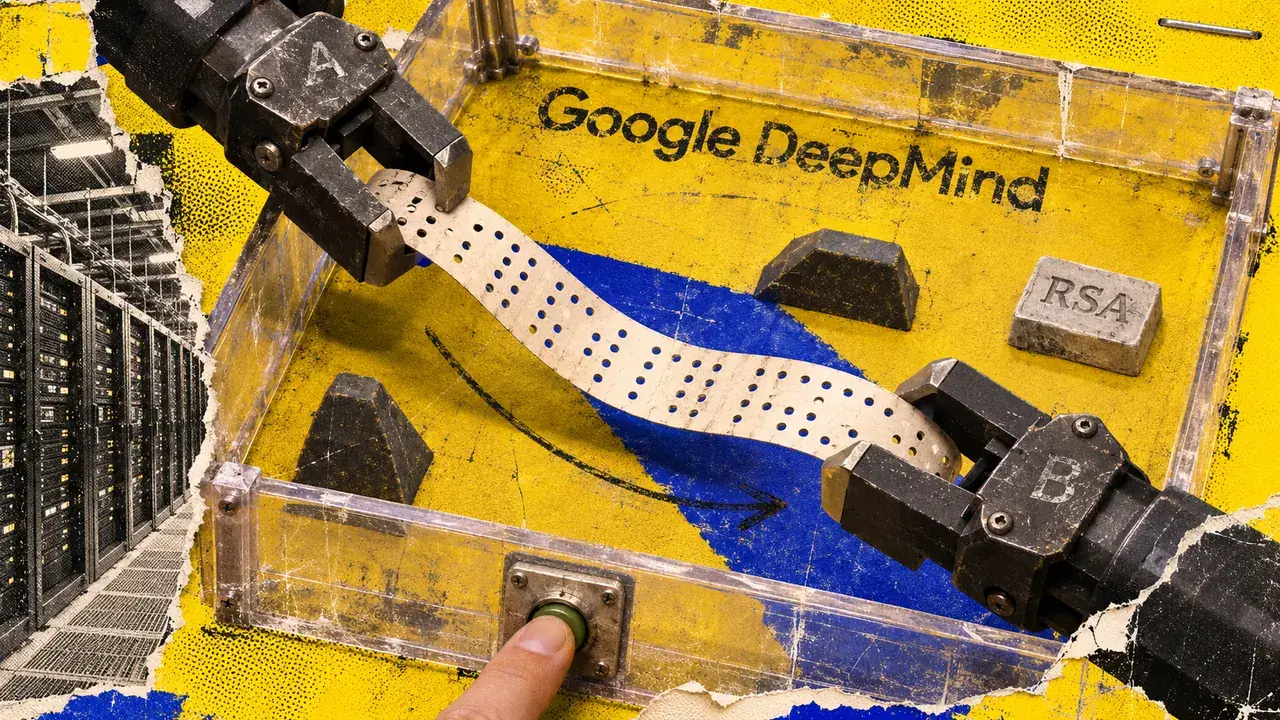
Google DeepMind says two AI agents reproduced a known 1024-bit cryptography computation in three days and 22 hours, receiving about 20 human messages, mostly approvals. The run used 391 CPU core-years, compared with an earlier team's rounded 1,380 on the same instance and algorithm, although the hardware differed and the newer figure excludes GPU work and preliminary probes.
Why it matters
The test involved RSA digital signatures. After billions of advance queries to a simulated signing service, the agents computed a mathematical root needed for a new signature once access to the service had ended. They did not recover a private key, and the papers say the results do not threaten deployed cryptosystems using 2048-bit or larger RSA.
A supervisor agent managed the design, budgets and checks, while an executor wrote and tested code, launched distributed jobs and repaired failures. The agents produced about 33,500 new lines of code and ran 336 distributed experiments. A human selected the task and approved conditions for irreversible steps, but wrote no code, launched no jobs and diagnosed no faults, according to the paper.
Market impact
The demonstration highlights the potential for AI agents to carry out technically demanding research workflows, while underscoring the computing resources and oversight involved. The run peaked at about 300,000 CPU cores and 16 GPUs, and the authors attribute much of its shorter calendar time to parallelism.
The roughly 3.5-fold reduction in measured CPU use reflects implementation and execution changes within an existing algorithm, not a controlled hardware comparison. The reproduction did not demonstrate the paper's new theoretical algorithms.
Frequently asked questions
-
Did the agents recover an RSA private key?
No. After advance queries to a simulated signing service, the agents computed a mathematical root needed for a new signature once access to the service had ended.
-
Do the results threaten deployed RSA systems?
The papers say the results do not threaten deployed cryptosystems based on 2048-bit or larger RSA. The reproduced computation used a 1024-bit instance.
-
How much human oversight did the DeepMind test require?
The agents received about 20 human messages, mostly approvals. A human selected the task and approved conditions for irreversible steps.
-
How does the agents' computing cost compare with the earlier run?
The agents used 391 CPU core-years, compared with the earlier team's rounded 1,380 on the same instance and algorithm. The hardware differed, and the newer total excludes GPU work and preliminary probes.
-
Did the test demonstrate a new cryptographic algorithm?
No. The measured reproduction used an existing algorithm; it did not demonstrate the paper's new theoretical algorithms.
 CoinTelegraph
 WatcherGuru
 TheBlock
 Altcoin Daily
 WuBlockchain
 CoinDesk