








 CoinDesk
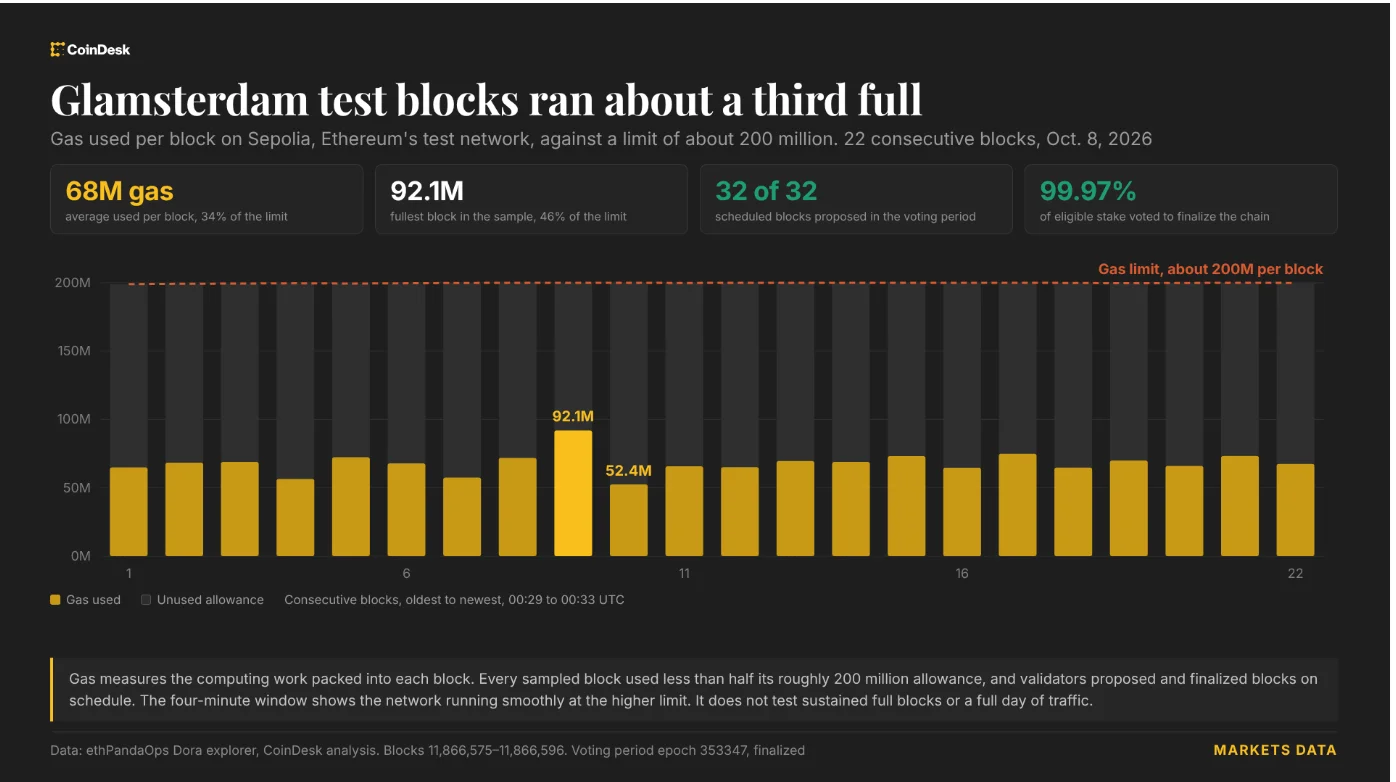



Ethereum's Glamsterdam upgrade raised Sepolia's block gas limit to nearly 200 million from about 60 million, giving developers a larger test environment for changes aimed at accommodating more payments and trades. Early blocks used roughly 26% to 46% of the available capacity, while all 32 scheduled blocks were proposed during a separate six-minute voting period and 99.97% of eligible stake voted toward finality.
Why it matters
Gas measures the computing work required to process Ethereum transactions. On the live network, users compete for block space when activity is high, which can push fees up. A higher limit could provide room for more activity before that competition intensifies, but it does not mean transaction capacity rises in direct proportion: Glamsterdam also changes the gas costs of particular tasks.
The upgrade changes how transaction assembly and block validation work. It brings the handoff between transaction-assembling specialists and validators into the network rules, giving validators more time to check transaction calculations. Blocks also include lists of the accounts and stored data their transactions touch, allowing software to fetch data ahead of time and check unrelated transactions simultaneously.
Market impact
The early Sepolia results show that blocks have so far remained well below the new limit, while the voting-period results indicate that the test network produced its scheduled blocks and saw near-total eligible-stake participation toward finality. These are testnet observations, not a measure of live-network throughput.
Higher activity still brings additional demands on the computers running Ethereum. Glamsterdam adjusts charges for creating and accessing stored data, so developers have been told to retest applications that rely on specific gas costs. A Hoodi test is tentatively planned for Oct. 27, pending Sepolia results. Ethereum has not set a mainnet activation date.

Frequently asked questions
-
How much did Glamsterdam raise Sepolia's block gas limit?
The limit rose to nearly 200 million gas from about 60 million.
-
How much of the new capacity did early Sepolia blocks use?
Sampled blocks used roughly 26% to 46% of their available gas limit.
-
What happened during Sepolia's six-minute voting period?
All 32 scheduled blocks were proposed, and 99.97% of eligible stake voted toward finality.
-
Why doesn't a threefold gas limit mean three times as many transactions?
Glamsterdam also changes the gas costs of particular tasks, so the larger block budget does not translate directly into the same proportional increase in transaction capacity.
-
When could Glamsterdam reach Ethereum mainnet?
No mainnet activation date has been set. A Hoodi test is tentatively planned for Oct. 27, pending Sepolia results.
 Crypto News
 CoinTelegraph
 CryptoSlate
 WuBlockchain