








 CryptoSlate


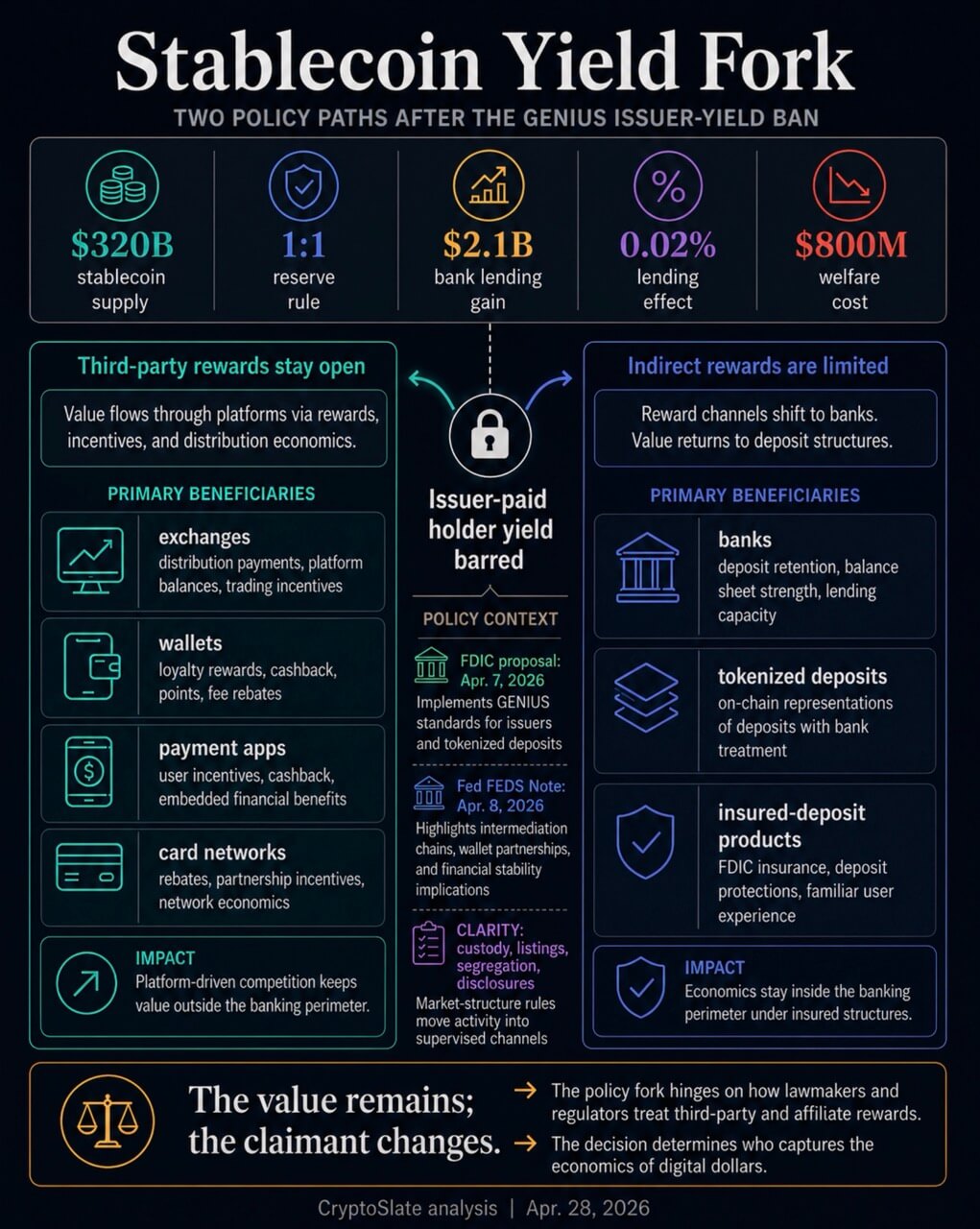

The GENIUS Act bars permitted payment stablecoin issuers from paying holders any form of interest or yield for simply holding, using, or retaining a stablecoin. The FDIC's April 7 proposal layers operating standards on top — reserves, redemption, capital, custody, and pass-through insurance — turning compliant payment stablecoins into regulated cash-management products. The redistribution question lands on a market that reached roughly $320 billion in supply by mid-April, with USDT near $189.71 billion and USDC around $77.63 billion.
Why it matters
A direct issuer-yield ban does not eliminate the economics of digital dollars — it relocates them. The White House's own April 8 yield-prohibition note estimated a baseline $2.1 billion increase in bank lending from eliminating stablecoin yield, equal to a 0.02% lending effect, alongside an $800 million net welfare cost. The same note left affiliate and third-party arrangements open unless CLARITY variants close that channel. That caveat is where the post-CLARITY money map starts: value moves through issuer retention, platform-balance economics, distribution agreements, reserve management, and payments to approved participants rather than to holders in direct form.
Market impact
The mechanism is already visible. Circle's 2025 Form 10-K and S-1/A describe payments to Coinbase tied principally to net USDC reserve income, with Coinbase receiving 50% of the remaining payment base after approved-participant allocations. Coinbase's own filing said a hypothetical 150bp move in average rates applied to daily USDC reserve balances would have shifted stablecoin revenue by $540 million for 2025. BlackRock's Circle Reserve Fund posted a 3.60% seven-day SEC yield as of April 27, with Circle describing BlackRock as a preferred reserve-management partner. PayPal's July 2025 Pay with Crypto launch — 0.99% merchant rate, PYUSD rewards for on-platform balances — and Visa's December 2025 USDC settlement launch, citing $3.5 billion in annualized stablecoin settlement volume as of Nov. 30, 2025, show the same intermediary lane through payments and card networks. The Bank Policy Institute's August 2025 filing argued third-party rewards undermine the issuer-yield ban; trade groups countered that those rewards are competitive consumer benefits. CLARITY's market-structure section adds another layer by moving customer balances, custody, and staking access into supervised digital-commodity channels.



Frequently asked questions
-
What does the GENIUS Act actually ban for stablecoin holders?
The GENIUS Act bars permitted payment stablecoin issuers and foreign payment stablecoin issuers from paying holders any form of interest or yield solely for holding, using, or retaining a payment stablecoin. Affiliate and third-party reward arrangements remain a live question pending CLARITY Act variants.
-
Why does the FDIC's April 7 proposal matter for stablecoins?
The proposal would turn parts of GENIUS into operating standards for FDIC-supervised issuers, covering reserves, redemption, capital, risk management, custody, pass-through insurance, and tokenized-deposit treatment — effectively regulating compliant payment stablecoins like cash-management products.
-
How does value from stablecoin reserves reach intermediaries instead of holders?
Circle's filings describe payments to Coinbase tied to net USDC reserve income, with Coinbase receiving 50% of the remaining payment base after approved-participant allocations. Coinbase's 10-K said a 150bp rate move on USDC reserve balances would have shifted its stablecoin revenue by $540M for 2025.
-
What role do Visa and PayPal play in the stablecoin economics map?
PayPal's Pay with Crypto (0.99% merchant rate, PYUSD rewards) and Visa's USDC settlement launch — $3.5B annualized stablecoin settlement volume as of Nov 30, 2025 — show intermediaries capturing economics through pricing, rewards, and settlement speed rather than direct issuer yield to holders.
-
What is the key open question in the CLARITY Act fight?
Whether regulators permit third-party rewards and affiliate arrangements, which would hand the economics of digital dollars to platforms that own users, balances, and distribution, or close that channel, letting banks and tokenized-deposit providers keep digital-dollar returns inside the deposit perimeter.
 WatcherGuru
 WuBlockchain
 CoinTelegraph
 Crypto News
 Altcoin Daily