








 WuBlockchain

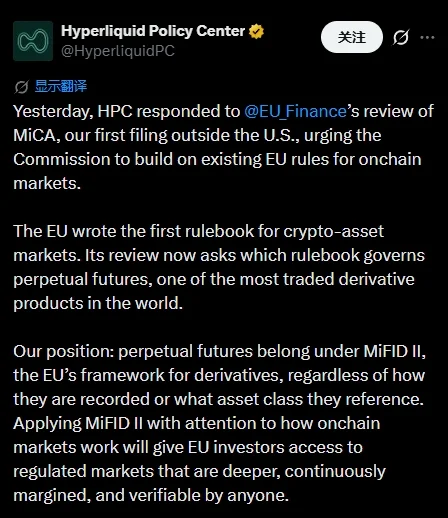
Hyperliquid Policy Committee has submitted its first regulatory filing outside the United States, responding to a European Commission consultation on the evolution of MiCA. It urged the EU to classify financial instruments by their economic substance and apply existing MiFID II rules and ESMA guidance to perpetual futures, rather than write new legislation.
Why it matters
The committee argues that perpetual futures traded on transparent central limit order books differ from bilateral contracts for difference. It says retail restrictions designed for those contracts should not automatically apply to perps.
HPC also wants regulators to recognize data already verifiable on public blockchains instead of requiring firms to report the same information again.
Market impact
The submission seeks to preserve European investors' access to global liquidity pools. It is a policy proposal, not a change to EU rules; its significance for derivatives markets depends on how regulators respond.
Frequently asked questions
-
What did Hyperliquid Policy Committee submit to the EU?
It submitted a response to the European Commission's targeted consultation on the evolution of MiCA. This was the committee's first regulatory filing outside the United States.
-
Why does the committee favor MiFID II for perpetual futures?
It wants instruments classified by economic substance and argues that existing MiFID II rules and ESMA guidance can govern perpetual futures without new legislation.
-
How does the committee distinguish perps from CFDs?
It says perpetual futures trade on transparent central limit order books and should not automatically face retail restrictions designed for bilateral contracts for difference.
-
What change does the committee seek for onchain reporting?
It asks EU regulators to recognize data already verifiable on public blockchains and avoid requiring firms to report that information again.
-
Has the filing changed EU rules or European access to global liquidity?
No. The filing is a policy proposal that seeks to preserve European investors' access to global liquidity pools; it does not itself change EU rules.
 CoinDesk
 CryptoSlate
 Crypto Rank News
 TheBlock
 CoinTelegraph
 Crypto News