








 CoinDesk

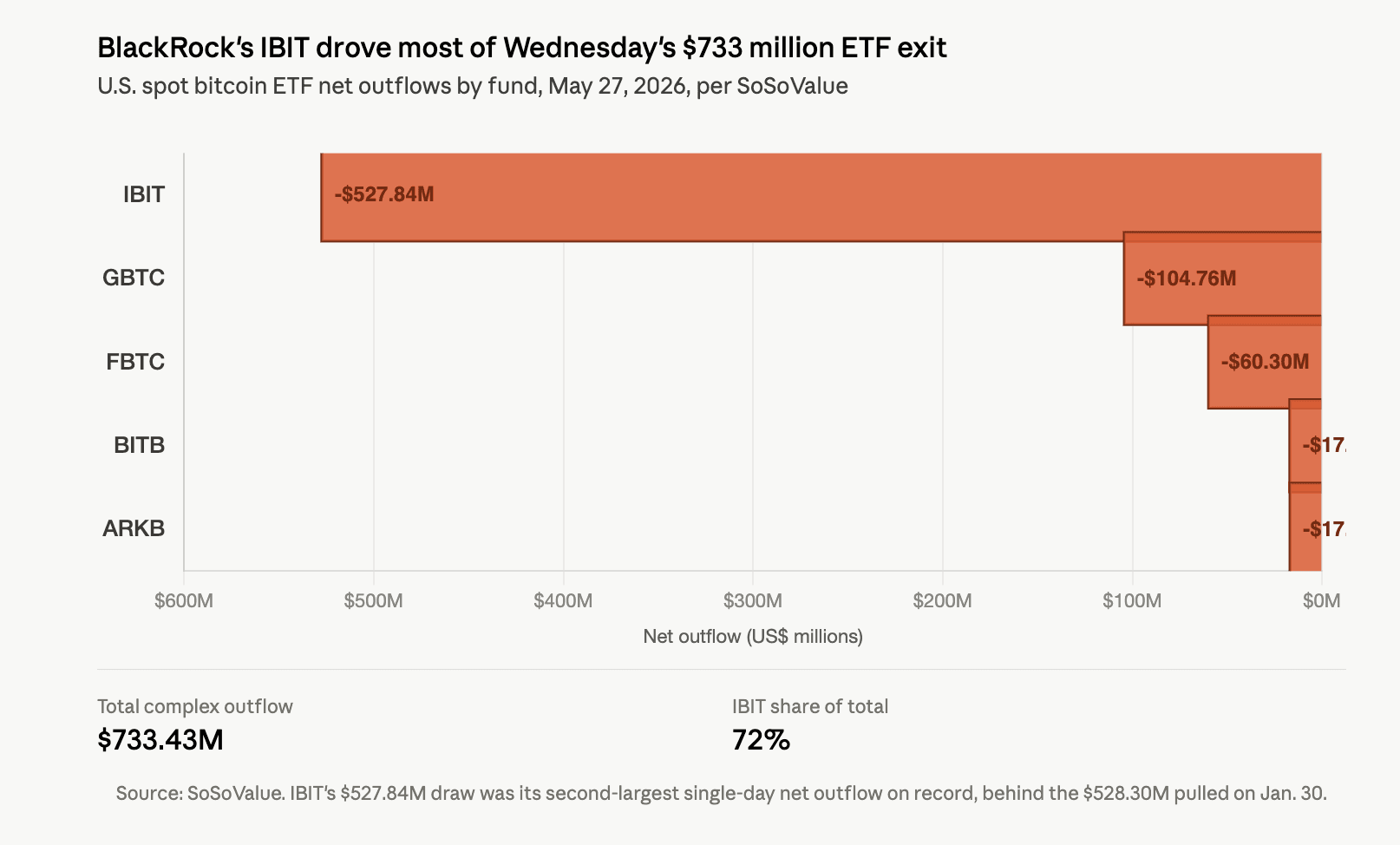

BlackRock's iShares Bitcoin Trust (IBIT) lost $527.84 million in net outflows on Wednesday, the second-largest single-day withdrawal since the fund launched in January 2024 and within roughly $500,000 of the $528.3 million record set on January 30, per SoSoValue data. The 11 U.S.-listed spot bitcoin ETFs together shed $733.43 million that session, with Fidelity's FBTC down $60.30 million and Grayscale's GBTC down $104.76 million alongside the IBIT draw. The complex has now bled more than $2 billion over the past two weeks as bitcoin broke below $73,000.
Why it matters
The IBIT print matters less for the headline number than for what it confirms about the flow regime. ETF accumulation that had thinned to a net of around 4,500 BTC for the year has now flipped decisively: May turned from the steady buying of March and April into distribution, and the channel that drove the 2025 rally is now pulling capital the other way. A $1.29 billion dark-pool block trade in IBIT on Tuesday — a privately negotiated transfer, not technically a net outflow since buyers absorbed the size — sits in the same institutional-de-risking narrative. IBIT still holds roughly $59 billion in assets and accounts for close to 4% of bitcoin's total supply, so when it sells, issuers must sell the underlying bitcoin to settle redemptions. The price action and the ETF flows are feeding each other.
Market impact
Bitcoin traded at $72,978 in Asian hours Thursday, down 3.4% over 24 hours, after U.S. airstrikes on an Iranian military site near the Strait of Hormuz reignited a conflict markets had started to price out. The Middle East overlay is the proximate catalyst, but the structural read is broader: institutional investors are trimming exposure into a backdrop where macro liquidity is already tightening — Michael Kramer of Mott Capital Management has flagged roughly $150 billion in upcoming U.S. Treasury operations as a potential liquidity drain, arguing bitcoin acts as a leading liquidity indicator and has already broken key support near $75,000 in an 11% pullback from May 6 highs above $82,000.

Frequently asked questions
-
How much did BlackRock's IBIT bitcoin ETF lose on Wednesday?
IBIT recorded $527.84 million in net outflows on Wednesday, the second-largest single-day withdrawal since the fund launched in January 2024 and roughly $500,000 shy of its $528.3 million record set on January 30, per SoSoValue data.
-
How much did the broader U.S. spot bitcoin ETF complex shed that day?
The 11 U.S.-listed spot bitcoin ETFs together lost $733.43 million on Wednesday, with Fidelity's FBTC down $60.30 million and Grayscale's GBTC down $104.76 million alongside the IBIT draw. The complex has now shed more than $2 billion over the past two weeks.
-
What was the $1.29 billion IBIT dark-pool block trade?
On Tuesday, a single investor sold $1.29 billion of IBIT shares in one dark-pool block trade — a privately negotiated transaction that lets large players move size without signalling the broader market. It was not a net outflow since buyers stepped in, and IBIT's actual net redemptions that day came to $192.44 million.
-
Why is bitcoin falling and ETFs bleeding at the same time?
Bitcoin broke below $73,000 after U.S. airstrikes on an Iranian military site near the Strait of Hormuz reignited a conflict markets had started to price out, with the cryptocurrency trading at $72,978 in Asian hours Thursday, down 3.4% over 24 hours. ETF redemptions force issuers to sell the underlying bitcoin to…
-
Has IBIT gone through extended outflow streaks before without reversing?
Yes — IBIT has cycled through extended outflow streaks earlier in this cycle without a permanent reversal, with institutional money returning each time the macro picture cleared. Whether the current stretch is tactical de-risking on Hormuz headlines or a deeper institutional pullback depends on how the Middle East and…
 CryptoSlate
 WuBlockchain
 Lookonchain
 Crypto News
 TheBlock
 CoinTelegraph