








 CryptoSlate



The Solana Foundation is lending USDT to Aave and bringing the AAVE token onto the Solana network as part of a cross-chain rescue effort following the April 18 KelpDAO rsETH exploit, which drained roughly $292 million in unbacked value from the restaking token and triggered mass exits across DeFi lending markets. Within hours, WETH utilization on Aave hit 100%, freezing withdrawals, and Oak Research estimates Aave saw more than $12 billion in outflows while total value locked across DeFi fell 17%.
Why it matters
The exploit began with a weakness tied to KelpDAO's LayerZero bridge configuration. Attackers allegedly redeemed 116,500 unbacked rsETH on Ethereum, then deposited the assets as collateral across Aave, Compound, and Euler before borrowing roughly $292 million in ETH and other assets. Galaxy Research noted that at full utilization, Aave's design does not allow withdrawals — whoever exits first is made whole, while later lenders wait for fresh supply or borrower repayments. The episode exposed how a bridge misconfiguration at one protocol can cascade into the largest lending venues in DeFi.
Market impact
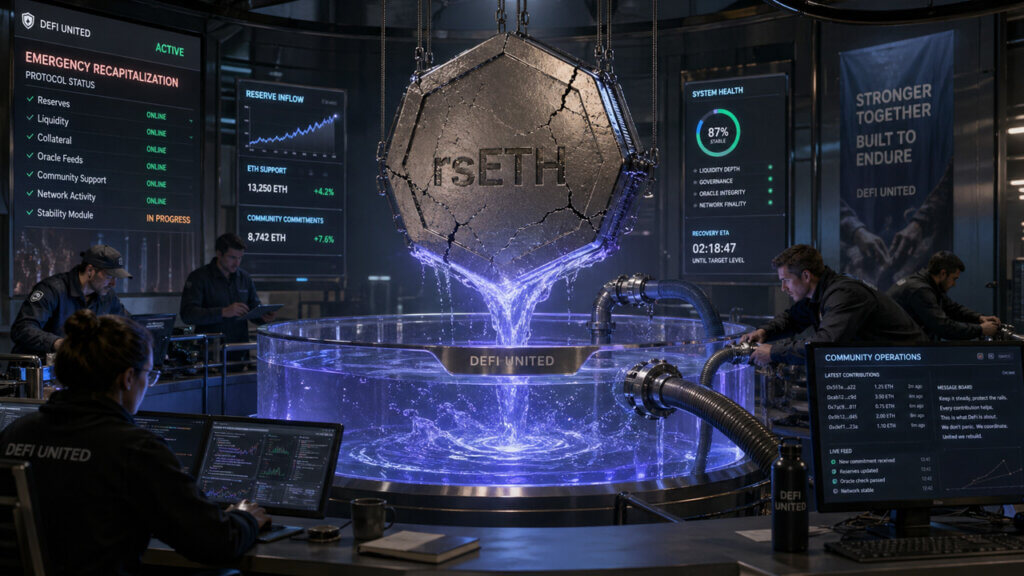
Aave and KelpDAO helped organize DeFi United, a recovery vehicle that has drawn roughly $240 million in commitments from Aave DAO, Arbitrum DAO, Mantle, Ether.fi, Lido, Kelp, and the Golem Foundation, among others. Solana Foundation chair Lily Liu framed the USDT lending as a cross-chain intervention rooted in shared infrastructure risk: blockchain economies do not operate in isolation, and Solana's long-term health depends on a functioning DeFi sector beyond its own ecosystem. The arrangement gives Solana a strategic opening — deeper cross-chain liquidity, broader lending access for its users, and a distribution channel for Aave at a moment when lending protocols are reassessing collateral standards, bridge dependencies, and emergency backstops. Governance questions remain, particularly around using treasury assets to backstop lender losses.



Frequently asked questions
-
What was the KelpDAO rsETH exploit and how much was lost?
On April 18, attackers allegedly exploited a weakness tied to KelpDAO's LayerZero bridge configuration, redeeming 116,500 unbacked rsETH tokens on Ethereum. They then deposited the assets as collateral across Aave, Compound, and Euler, borrowing roughly $292 million in ETH and other assets.
-
Why did Aave withdrawals freeze after the exploit?
Mass exits drove WETH utilization on Aave to 100% within hours. Galaxy Research notes that at full utilization, Aave's design does not allow withdrawals because there is no idle liquidity in the pool — later lenders must wait for new supply or borrower repayments.
-
How is the Solana Foundation helping Aave's recovery?
On April 25, foundation chair Lily Liu said the nonprofit is lending USDT to Aave to support recovery efforts. The foundation is also supporting the rollout of the AAVE token on Solana, giving the network's users direct access to Aave lending without leaving the chain.
-
What is DeFi United and how much has it raised?
DeFi United is a recovery vehicle organized by Aave and KelpDAO aimed at replenishing rsETH reserves and making affected users whole. According to its official site, the effort has drawn roughly $240 million in commitments from Aave DAO, Arbitrum DAO, Mantle, Ether.fi, Lido, Kelp, and the Golem Foundation, among…
-
What broader risks did the exploit expose in DeFi?
Oak Research said the episode showed how a bridge misconfiguration, a systemically important lending venue, and lenders unable to withdraw from depleted pools can combine into a defining failure. The incident has pushed lending protocols to reassess collateral standards, bridge dependencies, and emergency backstops.
 CoinDesk
 Lookonchain
 TheBlock
 CoinTelegraph
 WuBlockchain
 Crypto News