








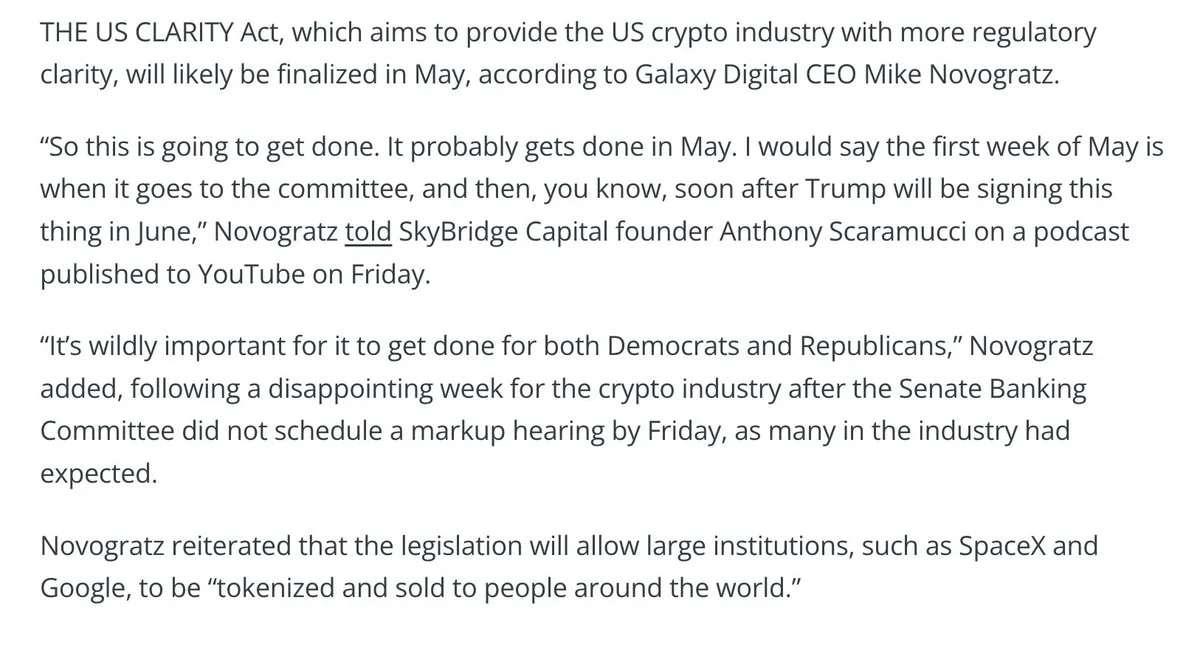
Galaxy Digital CEO Mike Novogratz said the U.S. CLARITY Act will likely be finalized in May and could be signed into law by June, delivering the clearer regulatory framework the crypto industry has spent years lobbying for. He framed the bill as the structural unlock that would let U.S. firms serve global users from a defined, compliant perimeter.
Why it matters
Alex Thorn, Galaxy's head of research, pegs the odds of passage in 2026 at 50%, with a sharp caveat: if the bill fails to advance by mid-May, those odds drop materially. The mid-May window is effectively a legislative line in the sand — staff negotiations, committee markups, and floor scheduling all hinge on movement before the congressional calendar tilts toward recess.
The CLARITY Act, the long-running effort to delineate SEC and CFTC authority over digital assets, has been the foundational piece of U.S. crypto market-structure legislation. Novogratz's timeline — finalization in May, signature by June — is the most concrete forecast a major industry CEO has put on the record in this cycle.
Market impact
For U.S.-headquartered exchanges, custodians, and token issuers, a signed CLARITY Act would resolve the jurisdictional ambiguity that has driven offshore migration and constrained institutional onboarding. Thorn's 50% framing is the line traders and compliance teams will now anchor to as the mid-May deadline approaches.

Frequently asked questions
-
What is the U.S. CLARITY Act?
The CLARITY Act is the long-running U.S. legislative effort to delineate SEC and CFTC authority over digital assets, defining which agency oversees which token categories and market participants.
-
What did Mike Novogratz say about the bill's timeline?
The Galaxy Digital CEO said the CLARITY Act will likely be finalized in May and could be signed into law by June — the most concrete forecast a major industry CEO has put on the record in this cycle.
-
What are the odds the CLARITY Act passes in 2026?
Alex Thorn, Galaxy's head of research, estimates a 50% chance of passage in 2026, warning that odds could drop if the bill fails to advance by mid-May.
-
Why is mid-May the key deadline?
Thorn framed mid-May as the make-or-break window: staff negotiations, committee markups, and floor scheduling all depend on movement before the congressional calendar tilts toward recess.
-
How would the CLARITY Act affect U.S. crypto firms?
A signed law would resolve the jurisdictional ambiguity that has driven offshore migration and constrained institutional onboarding, letting U.S. venues serve global users from a defined, compliant perimeter.

 CoinDesk
 CoinTelegraph
 CryptoSlate
 WatcherGuru
 TheBlock
 Crypto News