


 CryptoSlate


Nvidia co-founder Jensen Huang resigned as chief executive, president and board member, effective immediately, ending his 33-year leadership. Shares fell as much as 10% in premarket trading to about $156, implying a roughly $3.8T market capitalization, nearly $2T below October's approximately $5.8T peak. CryptoQuant CEO Ki Young Ju said analyst sentiment on Nvidia stock had hit -2.6σ, the most bearish reading on record.
Bitcoin fell below $71,500 and Ethereum below $1,990, their lowest levels since August, as Nvidia-linked uncertainty extended the risk-off move.
Why it matters
Chief Financial Officer Colette Kress was appointed interim CEO while Nvidia searches for a permanent successor, and longtime director Harvey Jones will serve as board chairman. Nvidia did not specify a reason for Huang's resignation. Its board has also been investigating allegations that remain unproven.
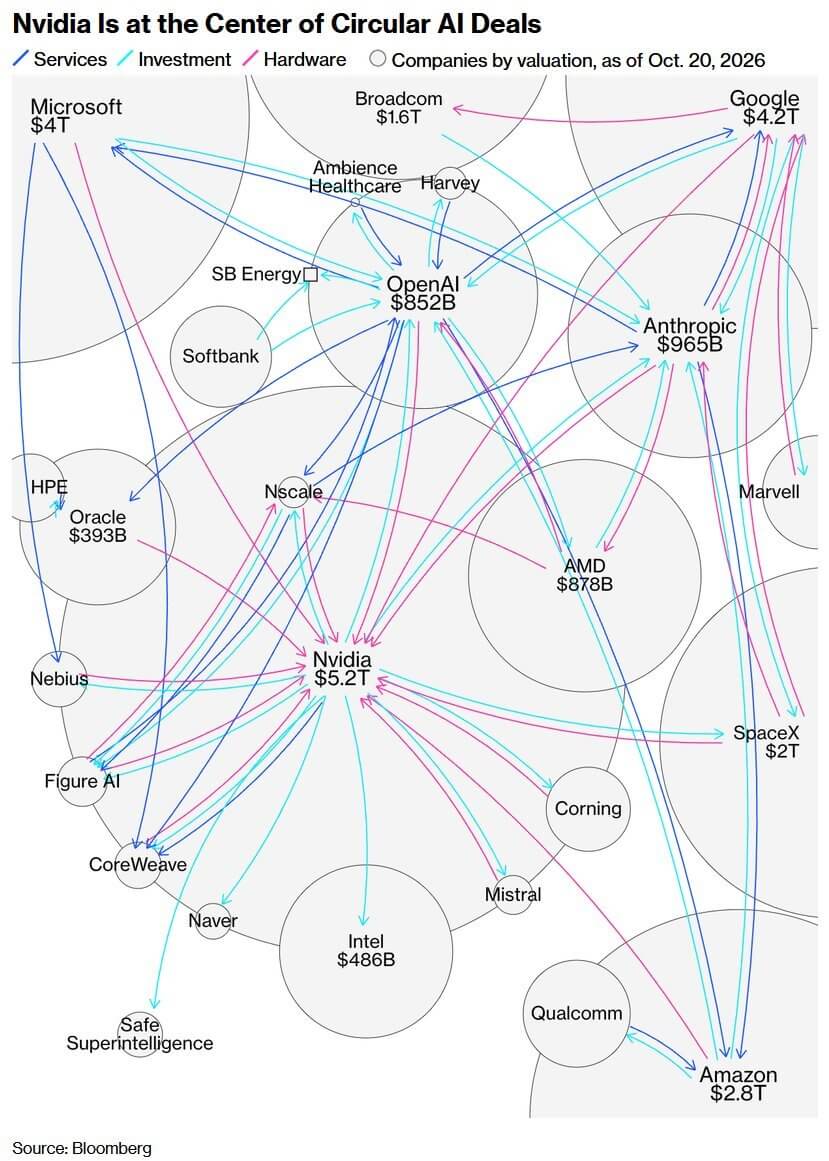
The larger concern is Huang's role in the AI investment boom. He helped negotiate financing arrangements linking chip suppliers, cloud operators and AI developers, raising the question of whether a successor can preserve that network. An October Bank for International Settlements study found that 55.2% of incoming investment value for AI companies between 2021 and 2025 came from other AI businesses. Of that AI-to-AI investment value, 46.4% involved companies with commercial relationships with recipients.
Market impact
Selling spread across Nvidia-backed infrastructure companies, with CoreWeave falling more than 13% and Nebius declining about 20% in premarket trading. Huang's departure does not alter Nvidia's existing contracts, but his successor will inherit a financing network whose sustainability depends on continued growth in AI computing demand.
The structure carries familiar risk. Nvidia invested $2B in CoreWeave in January, a cloud infrastructure provider that purchases Nvidia processors, deepening the financial relationship between supplier and customer. The next test arrives at Nvidia's Nov. 17 earnings call, when investors will look for any change in customer financing and support for infrastructure expansion.


Frequently asked questions
-
Who is leading Nvidia after Jensen Huang's resignation?
Chief Financial Officer Colette Kress was appointed interim CEO. Longtime director and former Synopsys executive Harvey Jones will serve as board chairman while Nvidia searches for a permanent replacement.
-
How did Nvidia's leadership crisis affect Bitcoin and Ethereum?
Bitcoin fell below $71,500 and Ethereum below $1,990, reaching their lowest levels since August. The decline extended a risk-off move triggered by uncertainty surrounding Nvidia and the AI investment boom.
-
Why is Huang's departure a risk for AI infrastructure financing?
Huang helped negotiate financing arrangements linking chip suppliers, cloud operators and AI developers. His successor must determine whether those interconnected investments can continue supporting demand without creating greater exposure.
-
How significant is circular investment in the AI sector?
A Bank for International Settlements study found that 55.2% of incoming investment value for AI companies between 2021 and 2025 came from other AI businesses. Nvidia participates in these arrangements.
-
What will investors assess at Nvidia's Nov. 17 earnings call?
Investors will look for signs that the leadership transition changes Nvidia's financing of customers or support for AI infrastructure expansion. Existing contracts remain in place, but the durability of future demand is the central question.
 WatcherGuru
 CoinTelegraph
 Crypto Rank News
 Lookonchain
 TheBlock
 CoinDesk