








 CryptoSlate

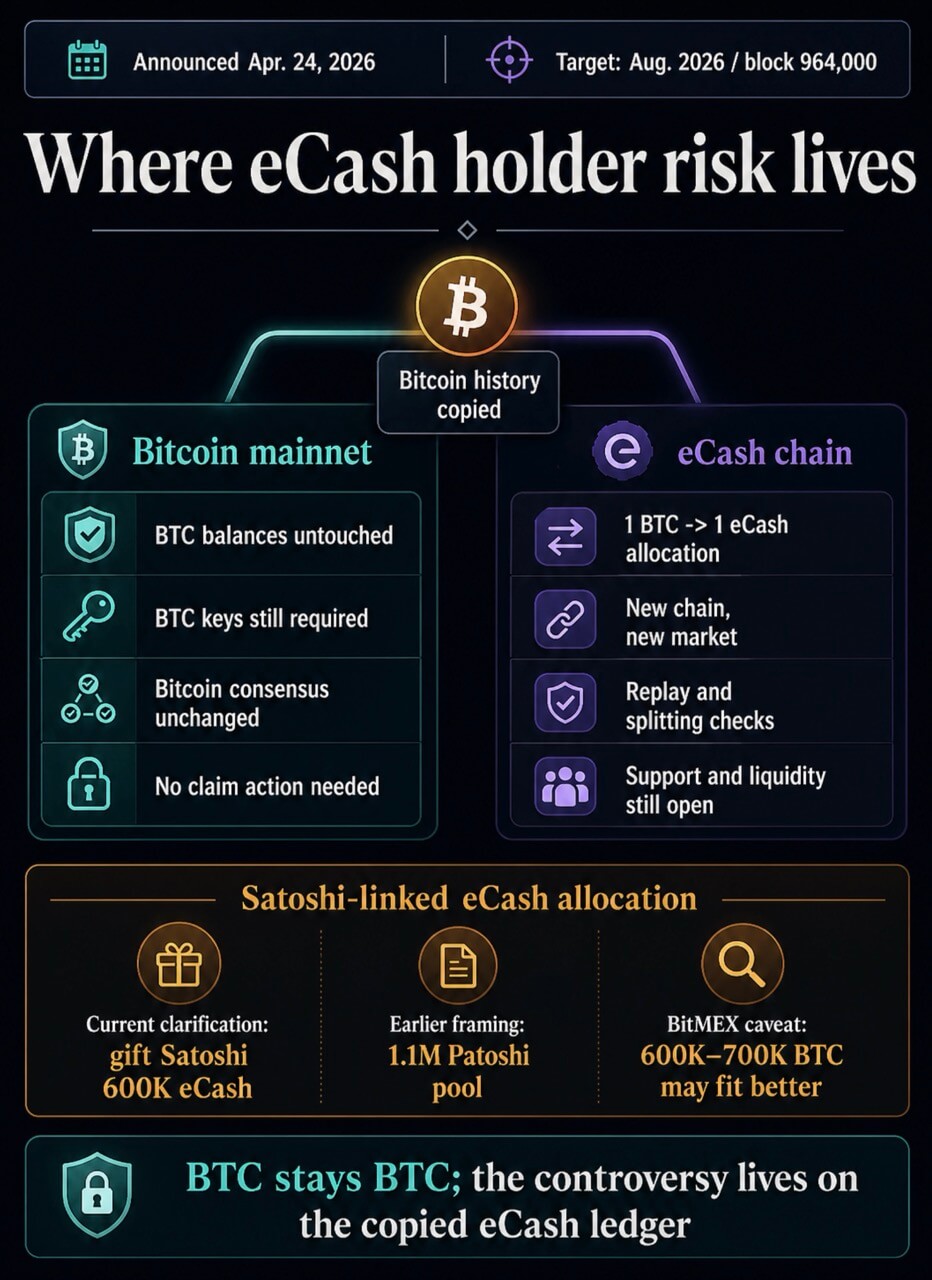
Paul Sztorc, LayerTwo Labs CEO and longtime Bitcoin developer, announced plans on April 24 for an August 2026 Bitcoin hard fork called eCash, targeted around block 964,000, that would copy Bitcoin's history and allocate 1 eCash for every 1 BTC held at the split. In a later clarification, Sztorc said the chain would assign Satoshi Nakamoto 600,000 eCash rather than 1.1 million, a figure closer to the lower Patoshi estimate from BitMEX Research, which put the early-miner pool between 600,000 and 700,000 BTC. Sztorc also reiterated that BTC balances are untouched: moving BTC still requires Bitcoin software and the relevant private keys, while eCash lives on a separate ledger mined with SHA-256d alongside BIP300 / BIP301 Drivechain-style sidechains via CUSF.
Why it matters
The proposal sits at the intersection of a routine technical mechanic and a contested social precedent. A pure 1:1 fork would copy every balance to the same keys that held BTC at the split height; eCash's current design would choose a different treatment for the dormant Patoshi-linked coins, reassigning roughly 600,000 eCash to Satoshi rather than the addresses that originally controlled those BTC. Critics read that as a precedent problem — a new ledger editing copied balances before launch — while Sztorc argues a fork that doesn't pre-capitalize contributors starts as a zombie project. The unresolved denominator (BitMEX's 600K-700K range versus the common 1M+ framing) means even the size of the disputed pool is still being negotiated.
The name overlap adds confusion. An eCash network with the XEC ticker already trades around $0.00000704 with a roughly $140.9M market cap, while Cashu markets itself as a Chaumian ecash protocol built on Bitcoin — so any search for "eCash" risks landing on the wrong chain. BTC itself traded near $76,824.95 on April 28, with a market cap close to $1.54T and 59.9% dominance, meaning even minor confusion around Bitcoin balances draws outsized attention.
Market impact
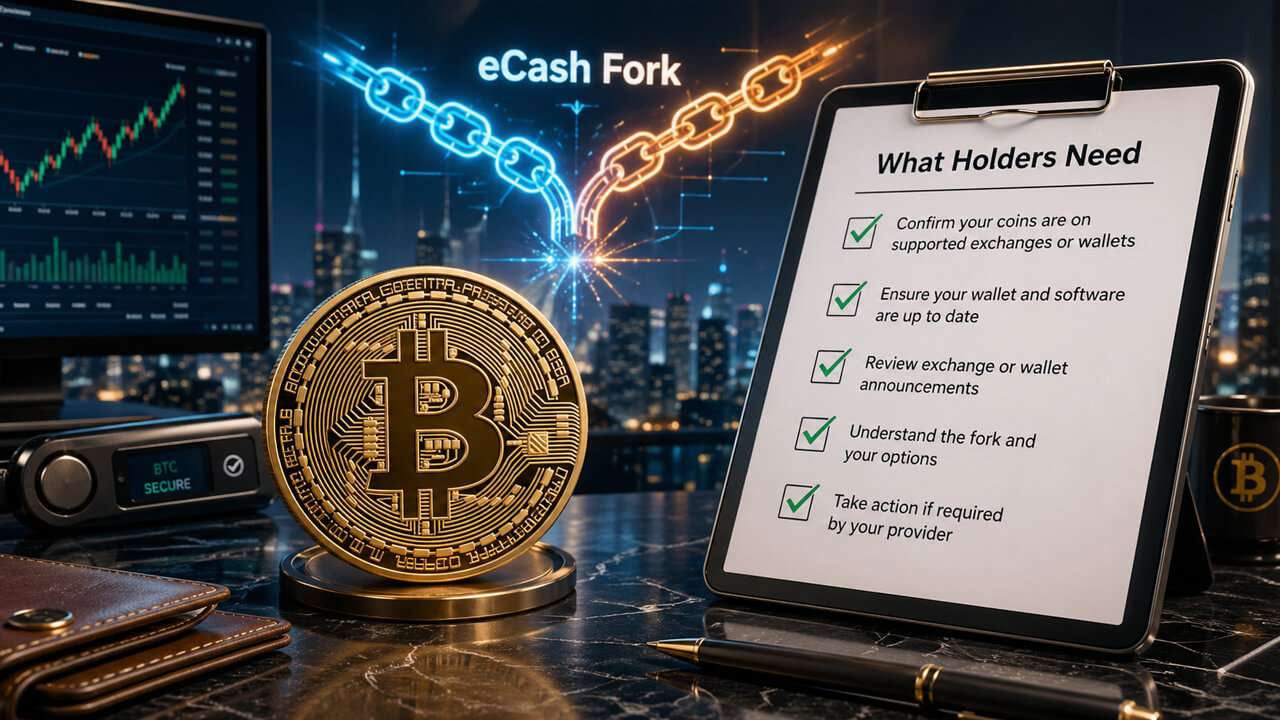
For ordinary holders, the practical question is sequencing. Until the chain exists, replay rules are verified, and major miners, exchanges, wallets, and custodians publish support policies, the eCash allocation is a paper balance on a copied ledger. Sztorc says default eCash software should block eCash spends from replaying on Bitcoin, but final tooling and split-grade wallet support still need verification.

Frequently asked questions
-
What is the eCash Bitcoin hard fork Paul Sztorc is proposing?
LayerTwo Labs CEO Paul Sztorc announced plans on April 24 for an August 2026 Bitcoin hard fork called eCash, targeted around block 964,000, that would copy Bitcoin's history and allocate 1 eCash for every 1 BTC held at the split. The new chain would use SHA-256d mining with BIP300 and BIP301 Drivechain-style…
-
Does the eCash fork change my BTC balance?
No. Sztorc reiterated that BTC balances are untouched by eCash and that moving BTC still requires Bitcoin software and the relevant Bitcoin private keys. eCash lives on a separate ledger; the fork only creates a new asset on a new chain, not a change to Bitcoin mainnet.
-
Why is the Satoshi eCash allocation controversial?
A pure 1:1 fork would copy every balance to the same keys that held BTC at the split, but eCash's current design reassigns the dormant Patoshi-linked coins — giving Satoshi 600,000 eCash rather than the addresses that originally controlled those BTC. Critics see that as a precedent problem for editing copied balances;…
-
Is this eCash the same as XEC or Cashu?
No. An existing eCash network with the XEC ticker already trades around $0.00000704 with roughly a $140.9M market cap, and Cashu is a separate open-source Chaumian ecash protocol built on Bitcoin. Sztorc's proposed eCash fork is a third project, and the name overlap means holders should verify domains, tickers, and…
-
What should Bitcoin holders actually do right now?
Wait. Until the chain exists, replay rules are verified, and major miners, exchanges, wallets, and custodians publish support policies, the eCash allocation is a paper balance on a copied ledger. Holders should avoid random claim tools, unofficial wallets, and phishing sites, and wait for guidance from reputable…
 Crypto Rank News
 WuBlockchain
 TheBlock
 CoinDesk
 CoinTelegraph