








 CoinDesk

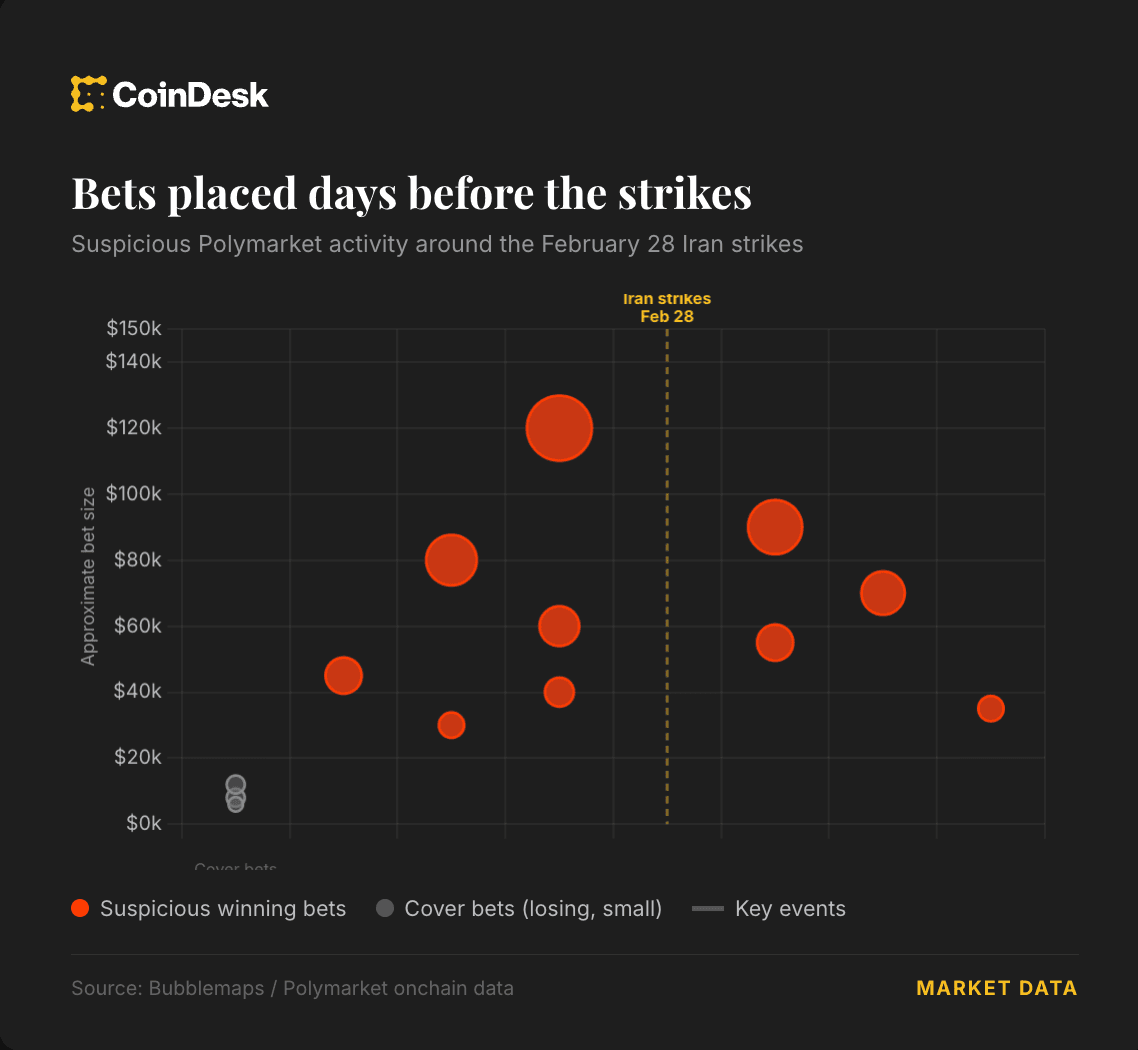
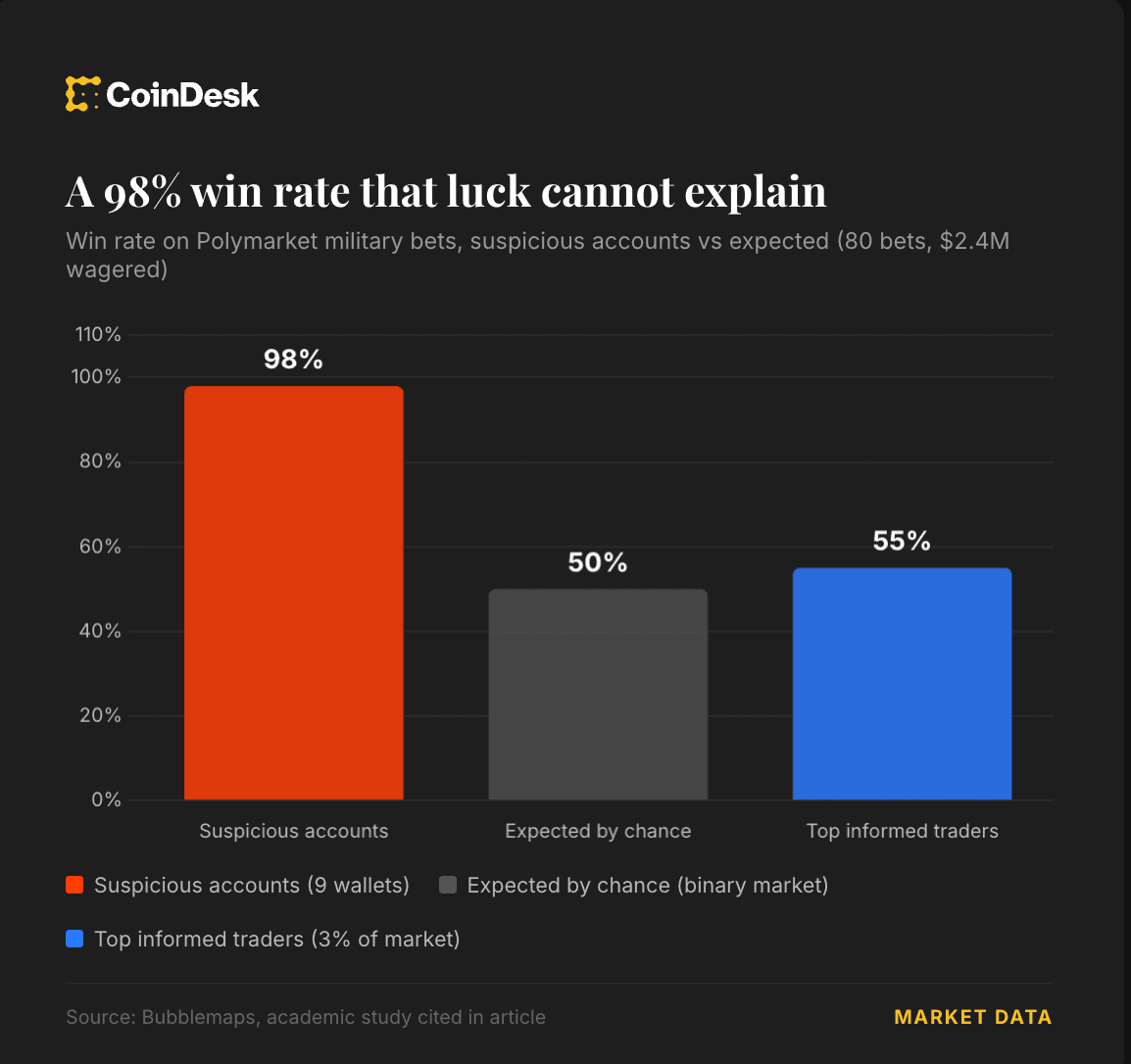

Bubblemaps investigators, led by co-founder and CEO Nicolas Vaiman, identified 80 bets on Polymarket with a 98% win rate tied to US military operations against Iran, calling the pattern statistically impossible to explain by luck alone. Nine linked accounts netted more than $2.4 million wagering almost exclusively on US strike timing, including on the Feb. 28 surprise attacks on Iran, the removal of its supreme leader and a subsequent ceasefire announcement.
Vaiman warned in an interview with CoinDesk that the same on-chain footprint visible to private analysts is visible to foreign adversaries — and that war plans could be reverse-engineered from prediction-market positioning. "The issue here is they can make war plans accordingly," he said. "Just to put it bluntly, this could potentially expose the lives of many people."
Why it matters
The findings land in the middle of a broader market in conflict-related contracts that has pulled in more than $1 billion this year, transforming prediction markets into a new category of insider-trading venue. Rep. Mike Levin said on X that the "insider trading problem with prediction markets is bigger than any of us could have known," announcing a DEATH BETS Act with Sen. Adam Schiff to ban war-related contracts outright. The national-security framing escalates the regulatory stakes well beyond routine CFTC or state-level scrutiny — it pulls prediction markets into the same threat-model conversation as foreign intelligence services.
Market impact
One insider-trading arrest has already been made: a US Army Green Beret, Master Sgt. Gannon Ken Van Dyke, made roughly $400,000 on Polymarket wagers tied to the Venezuela raid to extract President Nicolás Maduro, in which he participated. Two weeks before Bubblemaps published its findings, Polymarket announced a partnership with Chainalysis to add Wall Street-grade surveillance, though Vaiman pushed back on blaming the platform itself — noting that KYC'd accounts can be bought cheaply and VPNs are trivially available.
Frequently asked questions
-
What did Bubblemaps find about Polymarket bets on Iran strikes?
Bubblemaps identified 80 Polymarket bets with a 98% win rate tied to US military operations against Iran. Nine linked accounts cleared more than $2.4 million wagering almost exclusively on US strike timing, including wagers on the Feb. 28 attacks, the removal of Iran's supreme leader and a ceasefire announcement.
-
How much money is flowing into conflict-related prediction markets?
More than $1 billion has been wagered on conflict-related contracts on Polymarket this year alone, according to the Bubblemaps investigation. That scale is what turned what looked like isolated insider trading into a national-security concern for lawmakers.
-
What is the DEATH BETS Act and who introduced it?
The DEATH BETS Act is legislation introduced by Rep. Mike Levin and Sen. Adam Schiff to ban war-related prediction-market contracts. It is the direct policy response to concerns that insider trading on geopolitical bets can expose US military plans to adversaries.
-
Has anyone been arrested for prediction-market insider trading?
Yes. US Army Green Beret Master Sgt. Gannon Ken Van Dyke was arrested after reportedly making around $400,000 on Polymarket wagers tied to the Venezuela raid to extract President Nicolás Maduro — a mission in which he participated.
-
What is Polymarket doing about insider trading on its platform?
Polymarket announced a partnership with Chainalysis two weeks before the Bubblemaps findings went public, framing it as Wall Street-grade surveillance. The platform says it uses AI monitoring, blockchain forensics and strict insider-trading rules, and reports suspicious activity to authorities. Bubblemaps CEO Nicolas…
 TheBlock
 Crypto News
 WuBlockchain
 CoinTelegraph