








 WuBlockchain
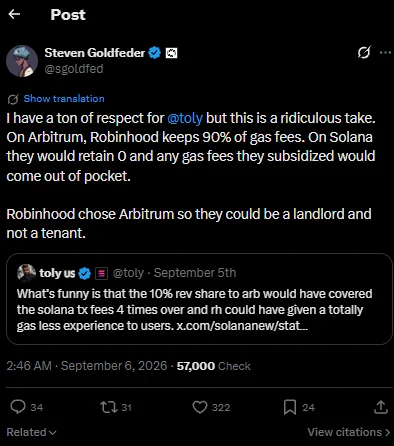
Yakovenko said the 10% revenue share Robinhood pays to Arbitrum would have covered Solana transaction fees four times over, allowing Robinhood Chain to offer users a fully gasless experience. Goldfeder called the argument a “ridiculous take.”
Goldfeder said Robinhood keeps about 90% of gas fees on Arbitrum, while a Solana deployment would leave it with none of the base-layer fees and require it to subsidize users. He said Robinhood chose Arbitrum “so they could be a landlord and not a tenant.”
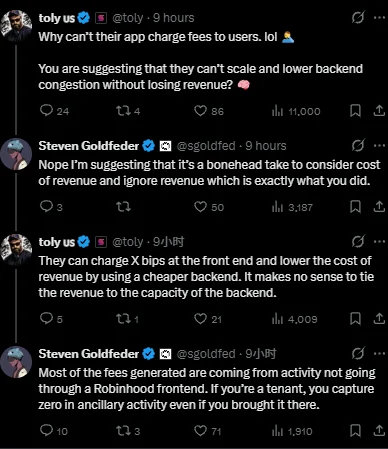
The disagreement centers on where fee value accrues. Yakovenko argued Robinhood could charge users at the frontend while using a cheaper backend. Goldfeder countered that most fee-generating activity does not pass through Robinhood's frontend, so a tenant on another chain would capture none of that ancillary activity.


Frequently asked questions
-
What did Yakovenko say the 10% Arbitrum share could cover?
He said it would have covered Solana transaction fees four times over, allowing Robinhood to offer users a fully gasless experience.
-
How does Goldfeder compare Robinhood's fee position on Arbitrum and Solana?
Goldfeder said Robinhood keeps about 90% of gas fees on Arbitrum, while it would retain none of Solana's base-layer fees and would have to subsidize users.
-
Why does activity outside Robinhood's frontend matter?
Goldfeder said most fee-generating activity does not pass through Robinhood's frontend. He argued a tenant on another chain would capture none of that ancillary activity.
-
What did Goldfeder mean by calling Robinhood a landlord?
He used the phrase to argue that Robinhood captures fee value on Arbitrum, unlike a tenant on another chain that would not capture ancillary activity it brought there.
-
How did Yakovenko propose lowering Robinhood's transaction costs?
Yakovenko argued Robinhood could charge users at the frontend while lowering costs by using a cheaper backend.
 TheBlock
 Crypto News
 CryptoSlate
 CoinDesk
 CoinTelegraph