


 CoinDesk
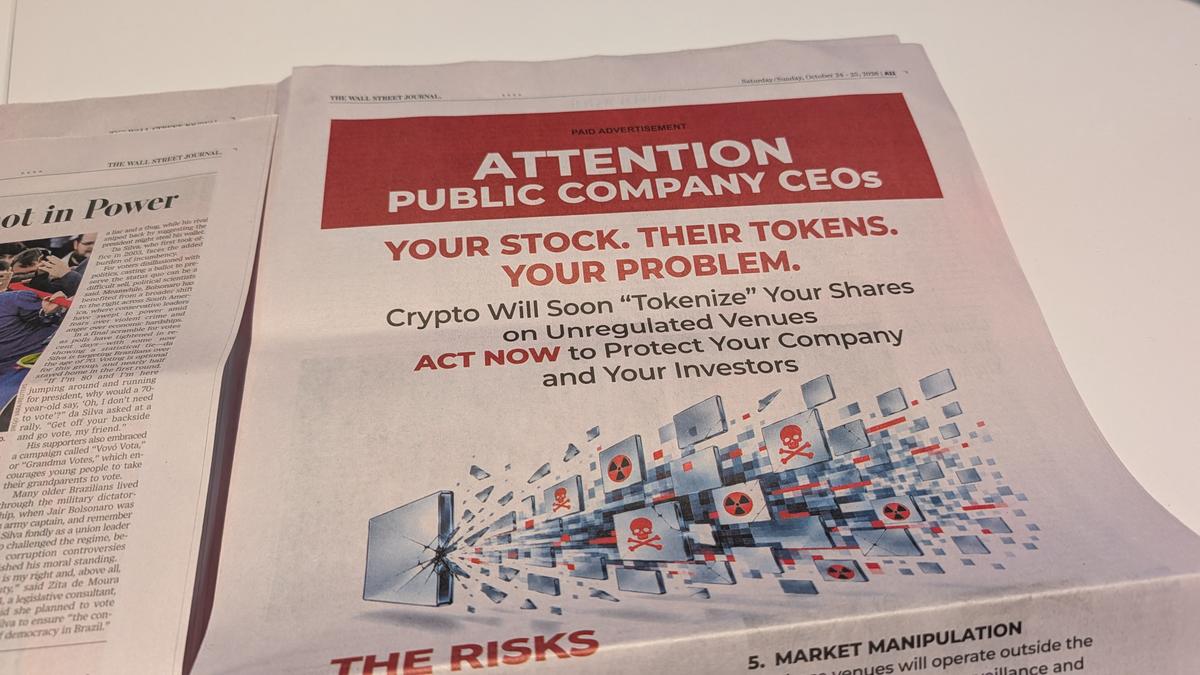


A Wall Street Journal ad urged public-company CEOs to opt out of tokenized stock trading, warning of price distortions, hidden ownership, manipulation and cybertheft. The campaign followed the SEC's temporary innovation exemption for select blockchain-based trading venues. So far, 33 companies have said no to listing on the OKX–Intercontinental Exchange tokenized securities venue.
Why it matters
The dispute is about more than whether shares can trade on blockchain rails. It tests whether tokenized securities can retain the investor protections, oversight and shareholder rights associated with traditional markets. The ad warned broadly about unregulated venues, while the SEC exemption offers a path for certain trading under regulatory conditions. It also grouped synthetic stock trackers with blockchain-based versions of actual securities, which are not the same model.
Companies' opt-out window is tied to notice: a third-party venue must tell an issuer it intends to tokenize its shares, and the 30-day period starts after delivery. Vertalo CEO Dave Hendricks said the notice must include contact information.
Market impact
The ad's sponsor was Common Sense Leadership Fund, a Virginia-based 501(c)(4) nonprofit. Who ultimately financed the campaign remains unclear. Galaxy research head Alex Thorn noted the group had previously listed SIFMA as a client. Nasdaq said it had no connection to the ad and had not authorized use of its FAQ, which the ad's QR code linked to. Nasdaq opposes its shares being listed on venues using the exemption, citing price transparency and trade reporting, and is pursuing its own issuer-focused model.
Securitize responded with its own Journal ad, arguing that tokenization can operate within existing rules. It promoted tokens backed one-for-one by shares, with voting and dividend rights, transfers limited to verified investors and trading on SEC-compliant venues. The competing campaigns put issuer consent and the design of tokenized shares at the center of the market's debate.
Frequently asked questions
-
What does the SEC's temporary innovation exemption allow?
It provides select blockchain-based trading venues a path to offer tokenized versions of U.S. stocks under regulatory conditions.
-
When does a company's 30-day opt-out period begin?
It begins after a third-party tokenized securities venue delivers notice that it intends to tokenize the company's shares. Vertalo CEO Dave Hendricks said the notice must include contact information.
-
How many companies have rejected the OKX–ICE tokenized securities venue?
The article says 33 companies have declined to be listed on the venue.
-
What did Nasdaq say about the advertisement?
Nasdaq said it had no connection to the campaign and had not authorized use of its FAQ. It opposes its shares being listed on venues using the SEC exemption, citing price transparency and trade reporting.
-
What rights did Securitize say its tokenized shares preserve?
Securitize promoted tokens backed one-for-one by actual shares, with voting and dividend rights, transfers restricted to verified investors, and trading through SEC-compliant venues.
 WatcherGuru
 WuBlockchain
 CoinTelegraph
 Crypto Rank News
 TheBlock