








 CoinDesk
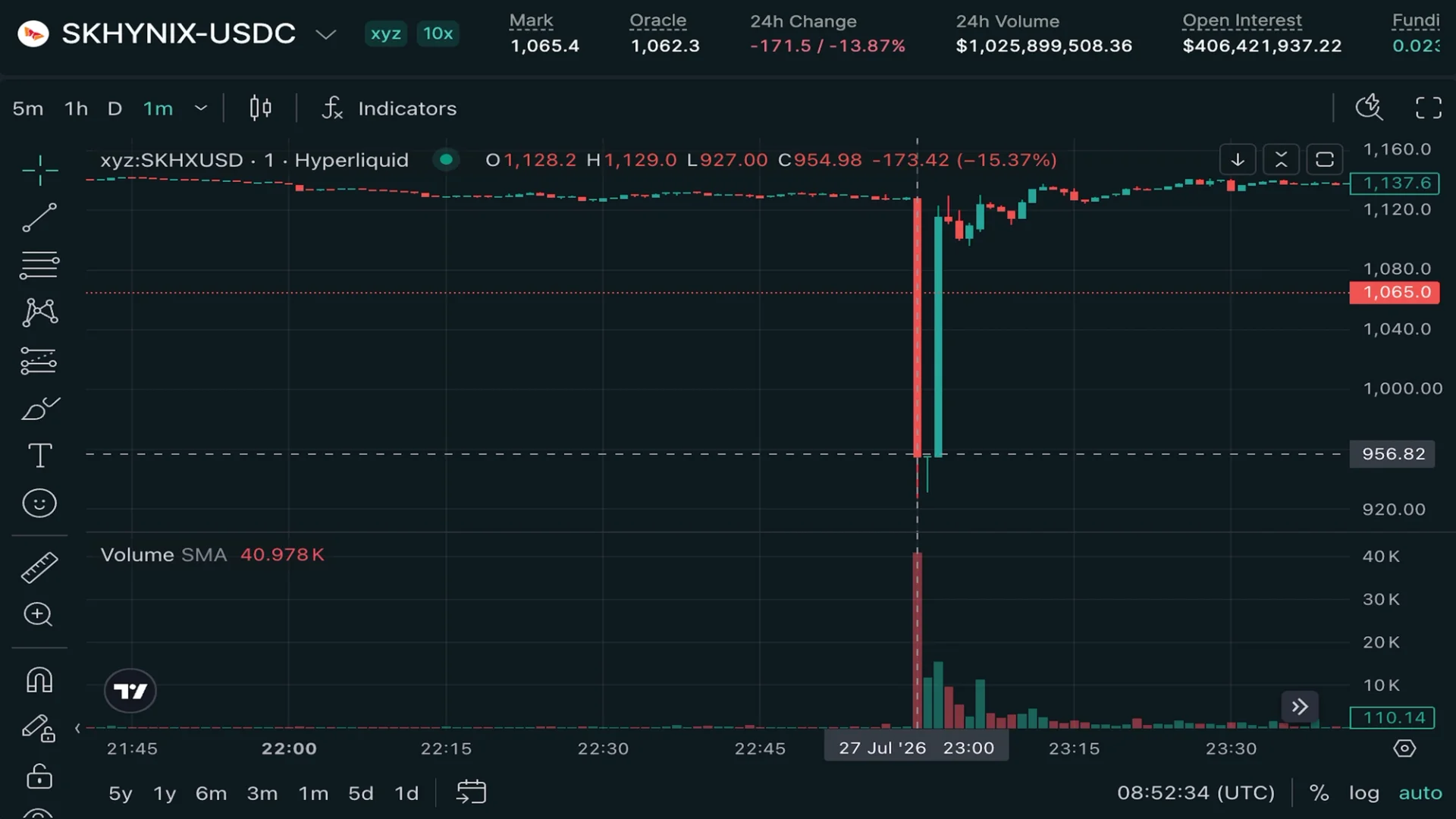


Perpetual futures tracking SK Hynix plunged 20% from above $1,000 to $900 on Hyperliquid between 23:00 UTC and 23:01 UTC. The USDC-denominated contract rebounded above $1,000 the next minute and was recently priced at $1,092. The move occurred about an hour before South Korea's stock market opened sharply lower.
SK Hynix shares subsequently dropped about 15% to 1,550,000 won, while its Nasdaq-listed American depositary receipts fell 4.5% in pre-market trading to $136.51. The benchmark Kospi sank 11%, with Samsung Electronics and Hyundai Motor also among the decliners.
Why it matters
Hyperliquid has become a major venue for traders using perpetual contracts to express views on traditional assets outside their primary market hours. That access comes with a structural risk: liquidity between the US close and Asian market openings can be too thin to absorb large orders without severe price dislocations.
The timing also highlights how decentralized derivatives are becoming part of the price-discovery process for equities. The flash crash preceded the Korean session's selloff, but the sequence does not establish that the Hyperliquid move caused the decline in SK Hynix shares.
Market impact
Pressure on SK Hynix extends beyond the one-minute dislocation. The high-bandwidth memory supplier has fallen nearly 48% from its June 26 peak as sentiment toward AI-linked stocks weakens.
Nvidia also slid 5% after a report that it could provide a roughly $250 billion financial backstop for an OpenAI-linked data-center project. For traders, the episode puts Hyperliquid's overnight depth and the reliability of synthetic equity pricing under closer scrutiny.

Frequently asked questions
-
How quickly did the SK Hynix perpetual recover?
The contract fell 20% to $900 between 23:00 UTC and 23:01 UTC, then rebounded above $1,000 the following minute. It was recently priced at $1,092.
-
Why was the Hyperliquid contract vulnerable to a flash crash?
Liquidity tends to be thinner between the US market close and Asian market openings. Large orders can therefore cause sharper price dislocations than during more active trading hours.
-
Did the Hyperliquid crash cause SK Hynix shares to fall?
The perpetual's flash crash preceded the Korean market selloff by about an hour, but the sequence does not establish that it caused the decline in the underlying shares.
-
How did South Korean markets perform after the flash crash?
SK Hynix shares dropped about 15% to 1,550,000 won, while the Kospi fell 11%. Samsung Electronics and Hyundai Motor were also among the decliners.
-
Why does broader AI-stock weakness matter for SK Hynix?
SK Hynix supplies high-bandwidth memory used in Nvidia's AI processors. Its shares have fallen nearly 48% from their June 26 peak as sentiment toward AI-linked stocks has weakened.
 TheBlock
 Crypto Rank News
 CryptoSlate