


 CryptoSlate



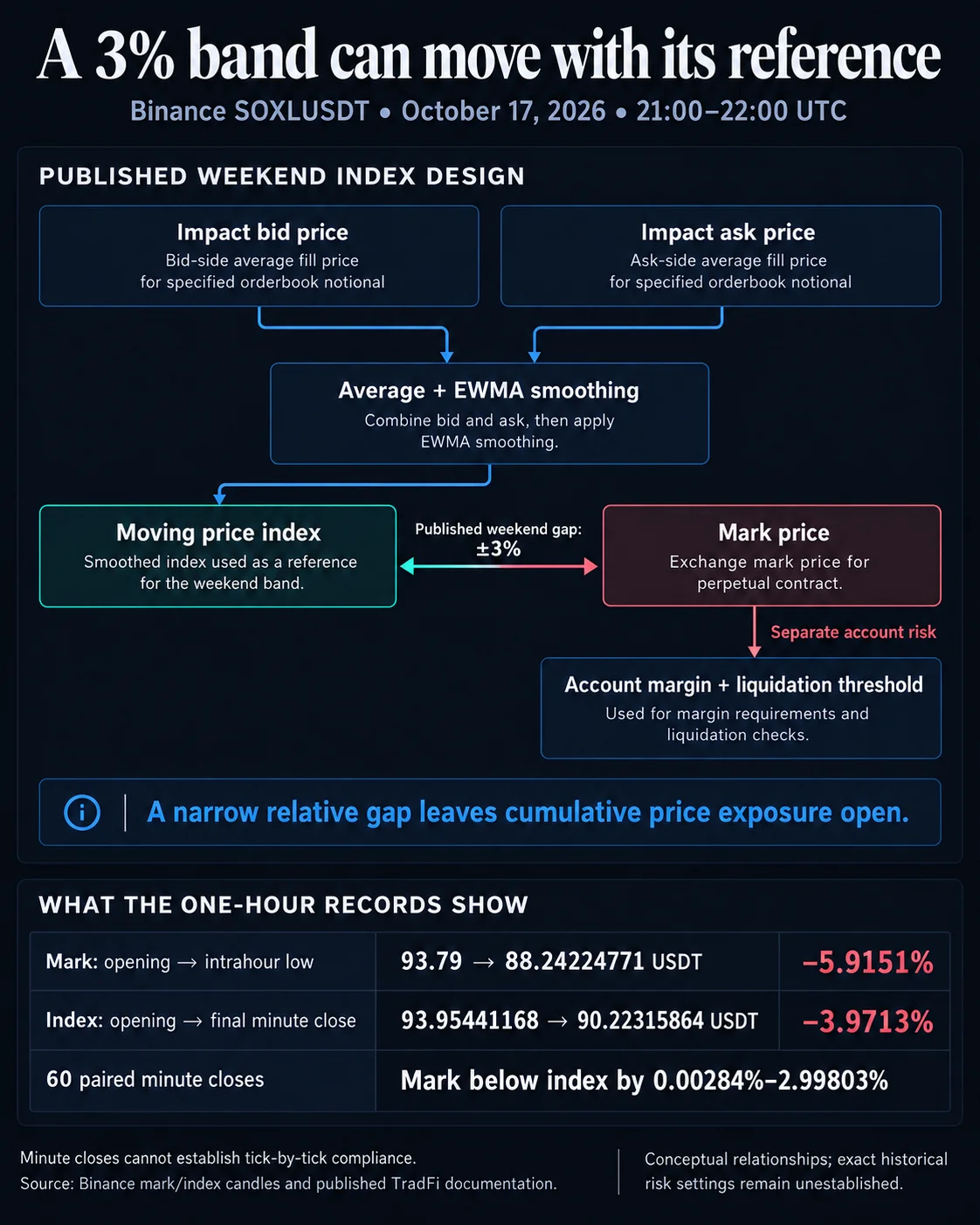
Binance's SOXL perpetual saw its mark price fall 5.9% from opening to low during the 21:00 to 22:00 UTC hour on Saturday, Oct. 17, even though every one of 60 sampled minute-close gaps between the mark and its reference index stayed below the exchange's stated 3% weekend band. SOXLUSDT opened at 93.79 USDT, touched an intrahour low of 88.24 USDT at 21:41, and closed the hour at 90 USDT, down about 4%. The orderbook-derived index fell 3.97% over the same window.
Why it matters
The two numbers measure different risks. Binance's ±3% weekend and holiday band constrains the distance between the mark, which drives margin calculations, and the reference index at any given moment. It does not cap how far either price can travel from a trader's entry. Because the equity-based index is now derived from Binance's own orderbook during NYSE Arca closures, rather than anchored to the last traded share price, the whole reference can move with the market, taking the band with it.
That detail contradicts Binance's simpler learn-page summary, which still describes a fixed index outside underlying trading hours. The detailed TradFi FAQ dates the switch to a moving orderbook-derived reference for equity perpetuals to May 16, 2026, and Clearing Procedures 67 and 68.5 describe the smoothed calculation behind it.
Market impact
Liquidation risk therefore depends on collateral and account-specific thresholds, not on the band. The SOXL specifications tie liquidation to the mark reaching a position's liquidation price, which varies with cross or isolated margin and with leverage tiers Binance can adjust, including for existing positions.
MarginPad's Oct. 17 recap logged $11.3 million in SOXL liquidated positions across 1,043 events across exchanges, a measure of position value rather than cash losses. The underlying Direxion ETF targets 300% of the daily NYSE Semiconductor Index move, and the perpetual adds a separate layer of exchange leverage on top. Traders holding equity perpetuals over weekends should treat the band as a mark/index constraint only, not a drawdown limit.

Frequently asked questions
-
Why did Binance's SOXL mark fall 5.9% if it stayed inside the 3% band?
The 3% weekend band limits the gap between the mark price and the reference index at any moment, not the total move. The orderbook-derived index itself fell almost 4% during the hour, so both prices dropped together while their separation stayed under 3%.
-
How is Binance's weekend index for equity perpetuals calculated?
Per Clearing Procedures 67 and 68.5, the index is derived from Binance's own orderbook during underlying-market closures, taking the average of impact bid and impact ask prices and smoothing it with an exponentially weighted moving average. This lets the reference move even when NYSE Arca is closed.
-
Does the 3% mark/index band prevent liquidations?
No. Liquidation is tied to the mark reaching a position's specific liquidation threshold, which depends on collateral, cross or isolated margin, and Binance's leverage tiers. A narrow mark/index gap can coexist with large losses from a trader's entry price.
-
How much in SOXL positions was liquidated on Oct. 17?
MarginPad's full-day, cross-exchange recap listed $11.3 million in SOXL liquidated positions across 1,043 events. The figure measures liquidated position value rather than investor cash losses.
-
What is the underlying asset of Binance's SOXL perpetual?
The contract references the price of one Direxion Daily Semiconductor Bull 3X ETF share on NYSE Arca, which targets 300% of the NYSE Semiconductor Index's daily performance. Holding the perpetual gives derivative exposure, not ownership of the ETF share.
 Whale Alert
 WuBlockchain
 Lookonchain
 TheBlock
 Crypto Rank News
 CoinTelegraph
 CoinDesk
 Crypto News