








 WuBlockchain
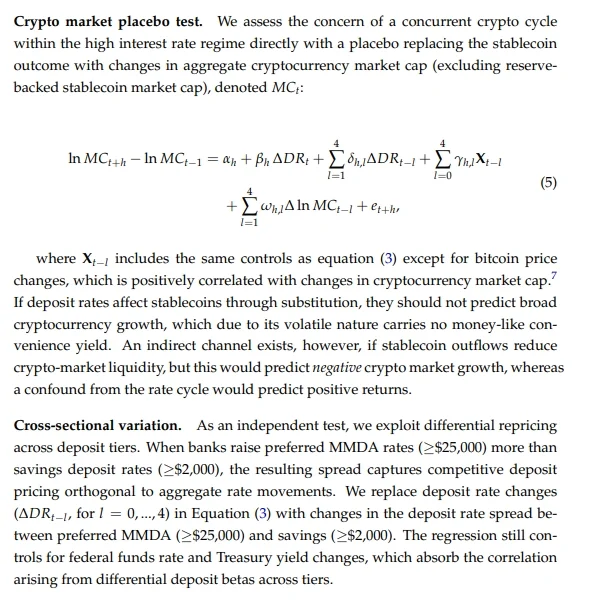
BIS working paper quantifies the substitution effect directly: a 1-basis-point rise in U.S. bank deposit rates shaves about 3 percentage points off 10-week stablecoin market-cap growth, and up to roughly 9 percentage points under the paper's instrumental-variable specification.
Why it matters
The finding reframes stablecoin demand as rate-sensitive flow rather than purely crypto-narrative demand. U.S. deposit accounts and stablecoins compete for the same short-duration dollar parking, so any Federal Reserve holding cycle quietly bleeds stablecoin issuance through Treasury competition. The effect is markedly lopsided: onshore-tied USDC loses about 4.8 percent of growth per basis point, versus 1.9 percent for offshore-centric USDT. The gap tracks where each user base can readily substitute into bank products and where they cannot.
Market impact
The substitution also holds across bank CD rates and DeFi lending yields, meaning the drag is not narrowly tied to checking-account pricing. Under higher-for-longer macro settings, U.S.-anchored issuers face structural headwinds to wallet growth until competitive yields return. Offshore distribution, long framed as a regulatory quirk, starts to look more like a rate-hedge moat for issuers whose users cannot easily reach U.S. bank products.
Source: [source](https://www.bis.org/publications/working-paper-1382-are-stablecoins-and-bank-deposits-substitutes.pdf)


Frequently asked questions
-
What did the BIS paper find about stablecoins and bank deposits?
It finds the two are direct portfolio substitutes. A 1-basis-point rise in U.S. bank deposit rates shaves about 3 percentage points off 10-week stablecoin market-cap growth, and up to roughly 9 percentage points under an instrumental-variable specification.
-
Why is USDC more rate-sensitive than USDT?
Onshore-anchored USDC shows roughly 4.8 percent growth sensitivity per basis point versus 1.9 percent for offshore-centric USDT. The gap tracks how easily each user base can reach U.S. bank products, a structural rather than transient difference.
-
Does the rate drag extend beyond deposits to DeFi yields?
Yes. The same substitution effect appears against bank CD rates and DeFi lending yields, indicating the drag is not narrowly tied to checking-account pricing but reflects broader appetite for short-duration dollar yield.
-
What does this mean for stablecoin issuers under higher rates?
U.S.-anchored issuers face structural headwinds to wallet growth until competitive yields return. Offshore distribution, which long looked like a regulatory quirk, increasingly functions as a rate-hedge moat.
-
Why does this BIS paper matter for crypto markets broadly?
It reframes stablecoin demand as rate-sensitive rather than purely crypto-narrative. A Federal Reserve holding cycle moves stablecoin growth through Treasury competition, which in turn feeds on-chain dollar liquidity and DeFi collateral depth.
 WatcherGuru
 CryptoSlate
 CoinDesk
 CoinTelegraph
 TheBlock