


 CryptoSlate


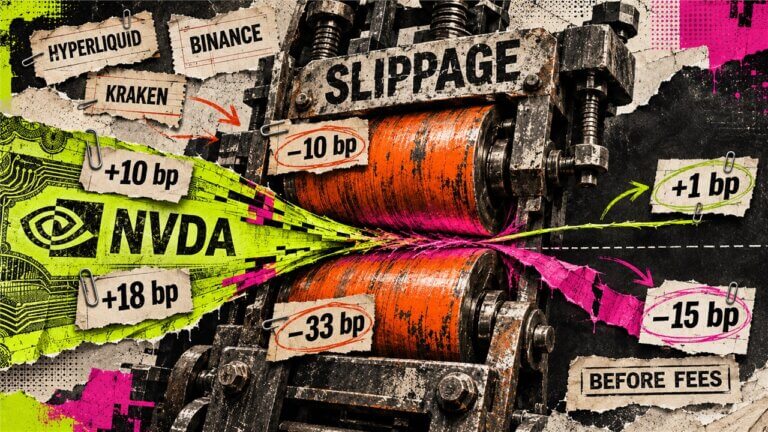
Bitquery’s study of 121 stocks across 17 weekends found that stock-token prices read before equity-index futures reopened correctly predicted 54% of qualifying Monday openings. An always-up guess scored 55%. The main direction test covered 533 openings that moved at least 0.5% from Friday’s close; balanced accuracy, which accounts for rising and falling opens, was 53%, with a 95% interval of 44% to 62%.
Why it matters
Weekend trading gives investors more opportunities to transact, but access is not the same as predictive value. Across all 791 opening observations, the median forecast error using token moves was 1.2%, compared with 0.9% using Friday’s stock close. Bitquery estimated 0.3 percentage points of excess error, with a 95% range of 0.2 to 0.5 points.
A separate Sunday reading just before 8 p.m. produced 59% balanced accuracy across 220 openings. But that test also changed the weekend-volume threshold and movement filter, and came after futures reopened. It therefore cannot isolate whether token prices supplied independent information.
Market impact
Nasdaq expects to move to 23-hour, five-day trading on Dec. 6, subject to clearing and market-data readiness. If implemented, longer conventional trading hours could narrow one access advantage of stock tokens for investors eligible to use both routes. Weekend availability and blockchain-wallet portability remain distinct features, while token holders may lack ownership and voting rights in the underlying shares.
The next useful test would keep timing and eligibility consistent, compare token prices with available market benchmarks, and measure executable results after costs. Until then, weekend prices should not be treated as a demonstrated forecasting edge.
Frequently asked questions
-
How did stock-token prices compare with an always-up prediction?
Token moves correctly called 54% of qualifying openings in Bitquery’s main test. Predicting that every stock would open higher scored 55%.
-
What did balanced accuracy show in the main test?
Balanced accuracy was 53%, averaging success on rising and falling openings. Its reported 95% interval was 44% to 62%.
-
How did token-based forecast error compare with Friday’s closing prices?
Across 791 openings, median error was 1.2% using token moves and 0.9% using Friday’s stock close.
-
Why does the later Sunday result not settle whether tokens add forecasting information?
The later test scored 59% balanced accuracy, but changed the volume threshold and movement filter and used prices after futures reopened.
-
How could Nasdaq’s planned trading hours affect stock tokens?
Nasdaq expects 23-hour, five-day trading to begin Dec. 6, subject to infrastructure readiness. If implemented, it could narrow one access advantage for investors eligible to use both routes.
 Whale Alert
 Altcoin Daily
 CoinDesk
 Lookonchain
 WuBlockchain