








 CoinDesk

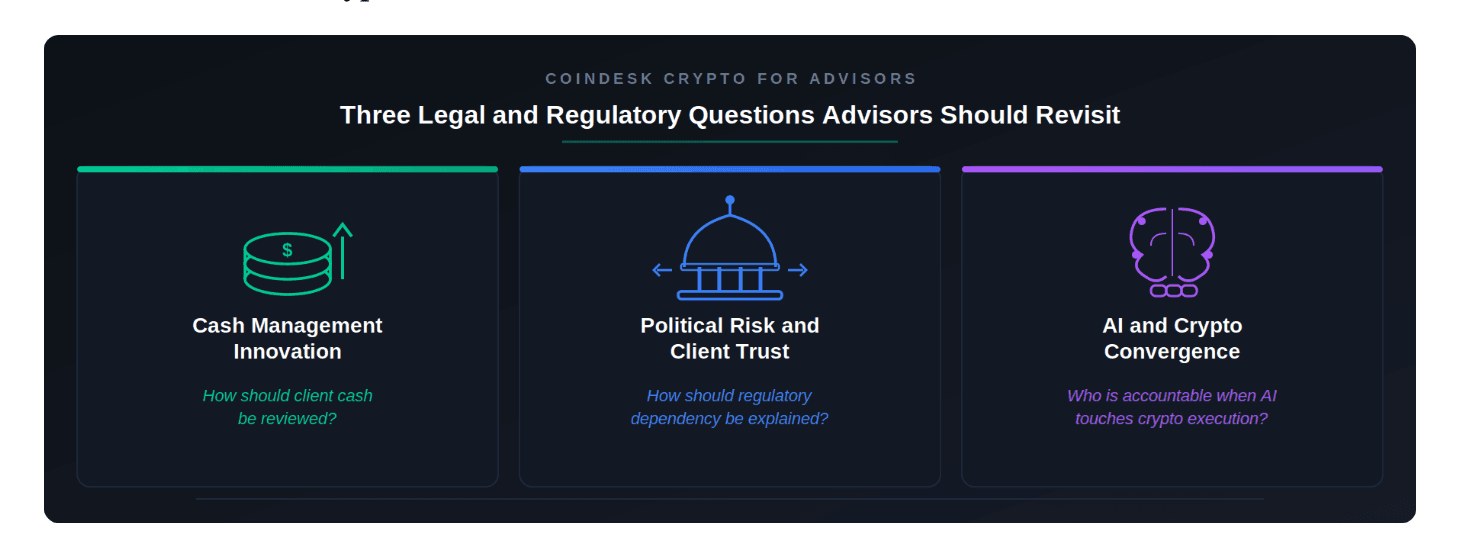
CoinDesk's Crypto for Advisors newsletter flagged three due diligence questions wealth advisors should be revisiting in 2026 as stablecoins, shifting US regulation and AI-enabled crypto infrastructure mature. The piece, written by Warburton Advisers managing partner Beth Haddock, frames the gaps as fiduciary, not technical: how client cash is managed, how regulatory assumptions are disclosed, and who is accountable when AI executes crypto trades.
On cash management, the newsletter notes that stablecoin lending via platforms like Axal, plus tokenized money market funds from BlackRock, Fidelity and J.P. Morgan, have moved billions of dollars into on-chain, daily-liquid short-term vehicles. It cites the SEC's recent cash-sweep enforcement actions against Wells Fargo Advisors and Merrill Lynch as proof that the choice between a traditional sweep, a money-market alternative and a tokenized short-term product is no longer a neutral default.
Why it matters
The piece lands as the GENIUS Act implementation clock is ticking. The statute was signed July 18, 2025 and becomes effective on the earlier of January 18, 2027 or 120 days after federal payment-stablecoin regulators issue final rules, with interagency rulemaking due by July 18, 2026. Aaron Brogan of Brogan Law, in the newsletter's 'Ask an Expert' section, notes that current stablecoins are still issued under state money transmitter licenses without dedicated federal oversight — meaning advisors recommending them today are recommending pre-GENIUS paper.
Market impact
The third diligence gap — AI agents settling transactions on crypto rails — is the one with the least settled liability framework. Haddock flags IMF concerns over operational resilience, the SEC's AI-washing cases as a precedent for vetting vendor claims, amended Reg S-P and the Fidelity data-breach settlement as the data-governance baseline, and quantum readiness as the structural security question. For advisors, the takeaway is procedural: documented analysis on each of the three questions is the line between a defensible recommendation and one the next enforcement cycle can reach for.

Frequently asked questions
-
What are the three crypto due diligence questions advisors should revisit in 2026?
Per CoinDesk's Crypto for Advisors newsletter, advisors should revisit how client cash is managed, how regulatory dependency on the GENIUS Act is disclosed, and who is accountable when AI executes crypto trades.
-
When does the GENIUS Act take effect for stablecoins?
The GENIUS Act becomes effective on the earlier of January 18, 2027 or 120 days after federal payment-stablecoin regulators issue final implementing regulations, with interagency rulemaking due by July 18, 2026.
-
Are current stablecoins already GENIUS-compliant?
No. As of the newsletter, stablecoins remain regulated under state money transmitter licenses without dedicated federal oversight; GENIUS compliance begins once the statute takes effect on the timeline above.
-
Why did the SEC fine Wells Fargo Advisors and Merrill Lynch over cash sweeps?
The SEC's recent cash-sweep enforcement actions against Wells Fargo Advisors and Merrill Lynch underscore that cash management is not a neutral decision and that advisors must document their analysis of fees, conflicts and suitability.
-
What AI-related due diligence should advisors run on crypto execution platforms?
The newsletter recommends four priorities: verify quantum readiness, vet AI capability claims against the SEC's AI-washing cases, validate and supervise AI outputs before they touch advice or trading, and apply Reg S-P-grade data governance to prompts, outputs and training data.
 WatcherGuru
 WuBlockchain
 Crypto Rank News
 CoinTelegraph
 TheBlock