








 CoinDesk
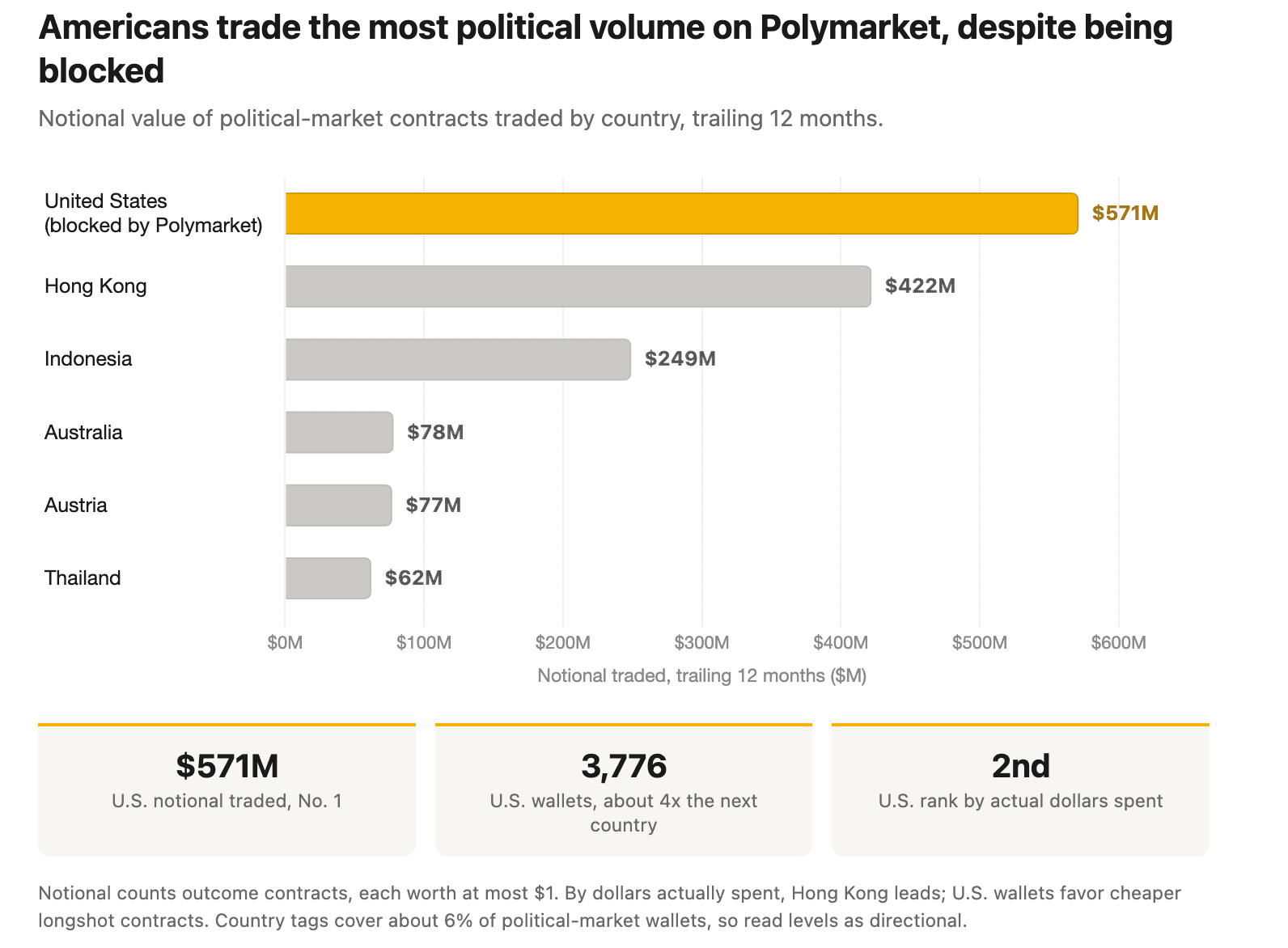

U.S.-linked wallets traded $571 million in notional value across Polymarket's political markets over the past 12 months, more than any other country and ahead of Hong Kong's $422 million, according to a new report from on-chain analytics firm Allium. The platform is supposed to block American users by IP because it cannot legally serve them, but crypto rails, stablecoins and wallet-based access with no broker or bank in the loop make that block easy to bypass. The $571 million is not the whole U.S. footprint, since Allium can only tag roughly 6% of Polymarket's political-market wallets to a country, and the firm itself reads the figures as directional rather than exact.
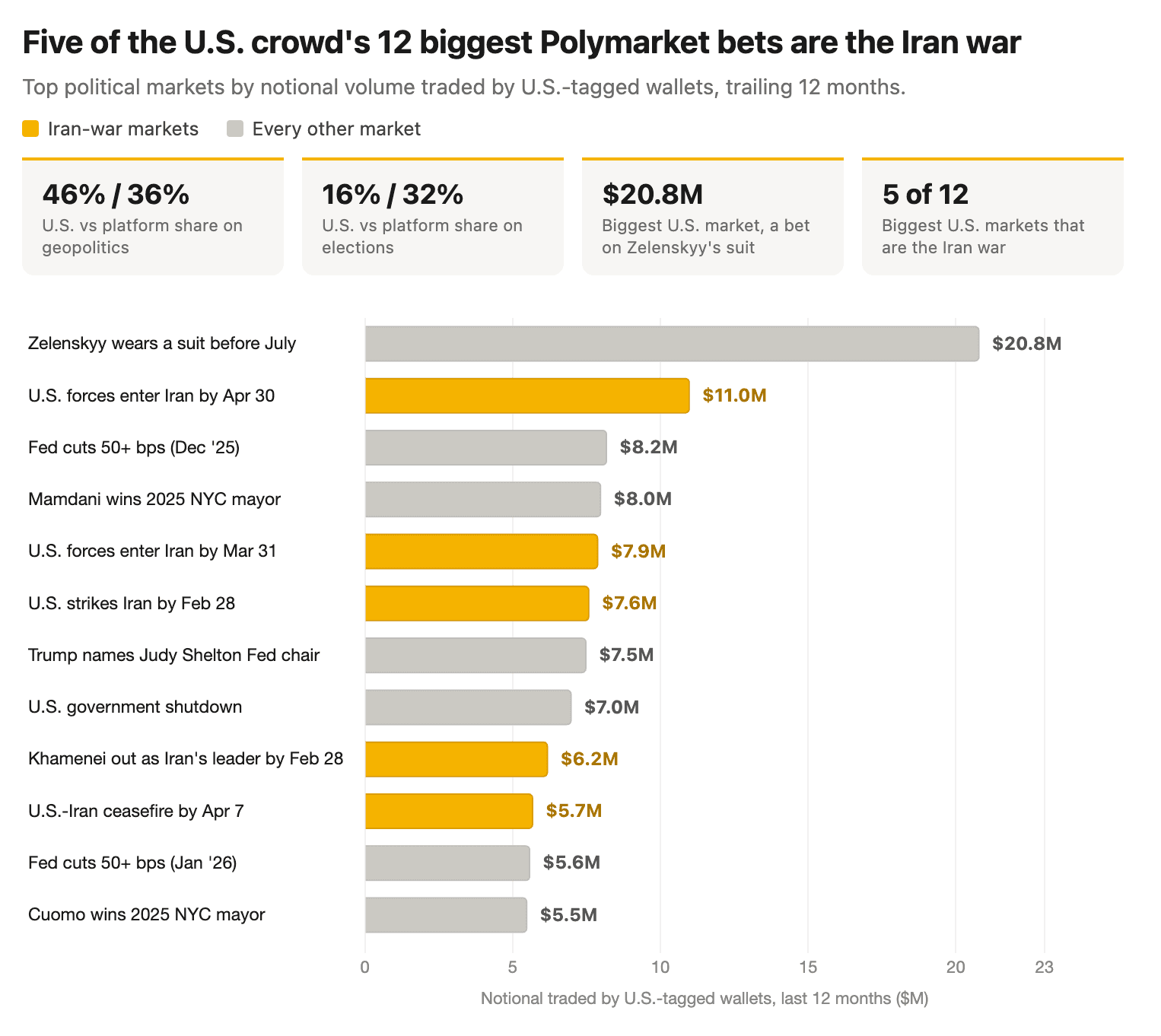
The most interesting split is what Americans actually bet on. Geopolitics made up 46% of U.S. notional against 36% for the platform as a whole, while elections drew 16% from U.S. wallets against 32% platform-wide. Five of the top twelve U.S. markets were bets on the Iran war, and the single largest position, at $20.8 million, was a novelty market on whether Ukrainian President Volodymyr Zelenskyy would wear a suit. Those are largely the markets that Kalshi and Polymarket's compliant U.S. arm do not carry.
Why it matters
The data reframes the U.S. policy debate from "is anyone really using Polymarket?" to "is the largest U.S. political market already offshore?" Allium's country attribution comes from on-chain wallet behavior rather than IP, so the VPN that fools Polymarket's block does not hide a U.S. wallet from the analytics. U.S. users were Polymarket's biggest national crowd despite being barred, and the demand that flowed to the offshore platform tilts toward exactly the markets U.S. rules restrict, including regime change, ceasefires and active foreign conflicts.
Market impact
U.S. wallets were no better at picking winners than the rest of the market: on resolved markets they backed the outcome 81.9% of the time against 80.3% for everyone else, with returns nearly identical. They did, however, lean harder into tail risk, at one point placing 53% of their volume on a U.S. invasion of Iran when the rest of the market sat at 26%.
Frequently asked questions
-
How much did U.S. traders move on Polymarket?
U.S.-linked wallets traded about $571 million in notional value across Polymarket's political markets over the past 12 months, more than any other country and ahead of Hong Kong's $422 million, according to on-chain analytics firm Allium.
-
How does Polymarket block U.S. users, and why doesn't it work?
Polymarket blocks U.S. users by IP address. Allium argues the block does little because the platform runs on crypto rails, a wallet and stablecoins, with no bank, broker or account in the loop, so a VPN and an existing wallet are enough to get in.
-
What do American bettors trade most on Polymarket?
Geopolitics made up 46% of U.S. notional against 36% for the platform overall, while elections drew 16% from U.S. wallets against 32% platform-wide. Five of the top twelve U.S. markets were bets on the Iran war, and the largest single position was a $20.8M novelty market on whether Zelenskyy would wear a suit.
-
Are U.S. traders better at picking winners on Polymarket?
No. On resolved markets U.S. wallets backed the outcome 81.9% of the time against 80.3% for everyone else, with returns nearly identical, effectively no edge. They did, however, lean harder into tail risk, at one point placing 53% of their volume on a U.S. invasion of Iran when the rest of the market sat at 26%.
-
Why can't U.S. regulators just shut this down?
The activity is offshore, denominated in stablecoins and visible only on-chain. There is no U.S. account to deny, no broker to discipline and no bank payment to block, which is the policy dilemma the Allium data underscores for U.S. regulators weighing onshore access versus continued offshore flow.
 Lookonchain
 WuBlockchain
 CoinTelegraph