








 CryptoSlate

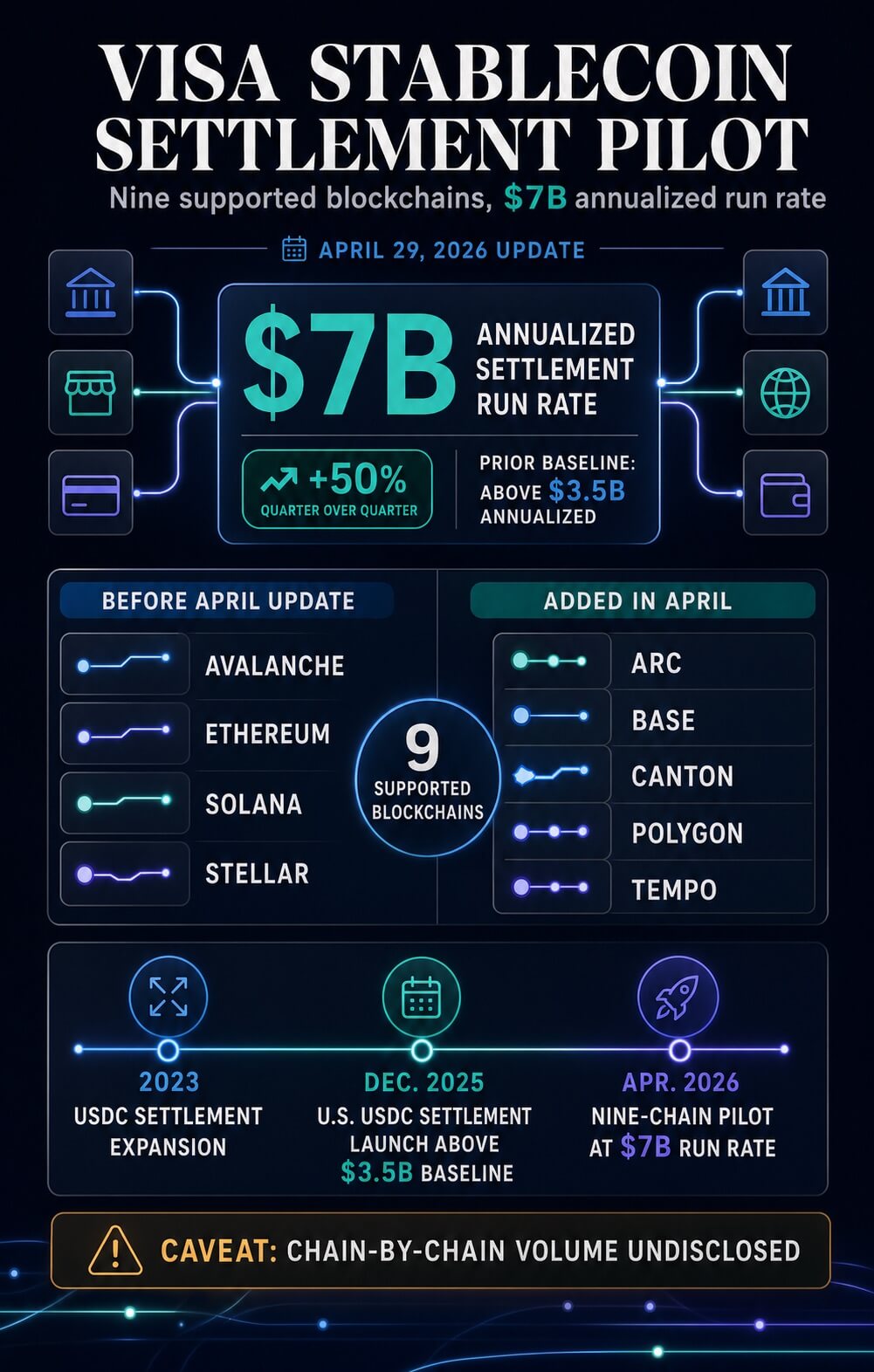
Visa's stablecoin settlement pilot now spans nine blockchains and is moving value at an annualized run rate of $7 billion, the company said on April 29. That figure is up roughly 50% from the prior quarter's baseline of more than $3.5 billion, which Visa set when its U.S. issuer and acquirer partners first gained the ability to settle with Visa in USDC in December 2025.
The April expansion added Arc, Base, Canton, Polygon and Tempo to a pilot that already used Avalanche, Ethereum, Solana and Stellar. The new mix is a deliberate blend: Arc brings USDC-native fees and deterministic finality, Base connects Coinbase-linked wallets and payment tooling, Canton adds institutional privacy, and Polygon and Tempo position the pilot for global payment throughput. Visa described the chain list as a footprint, not a volume map — the $7B run rate applies to the pilot as a whole, with no disclosed split across the nine networks.
Why it matters
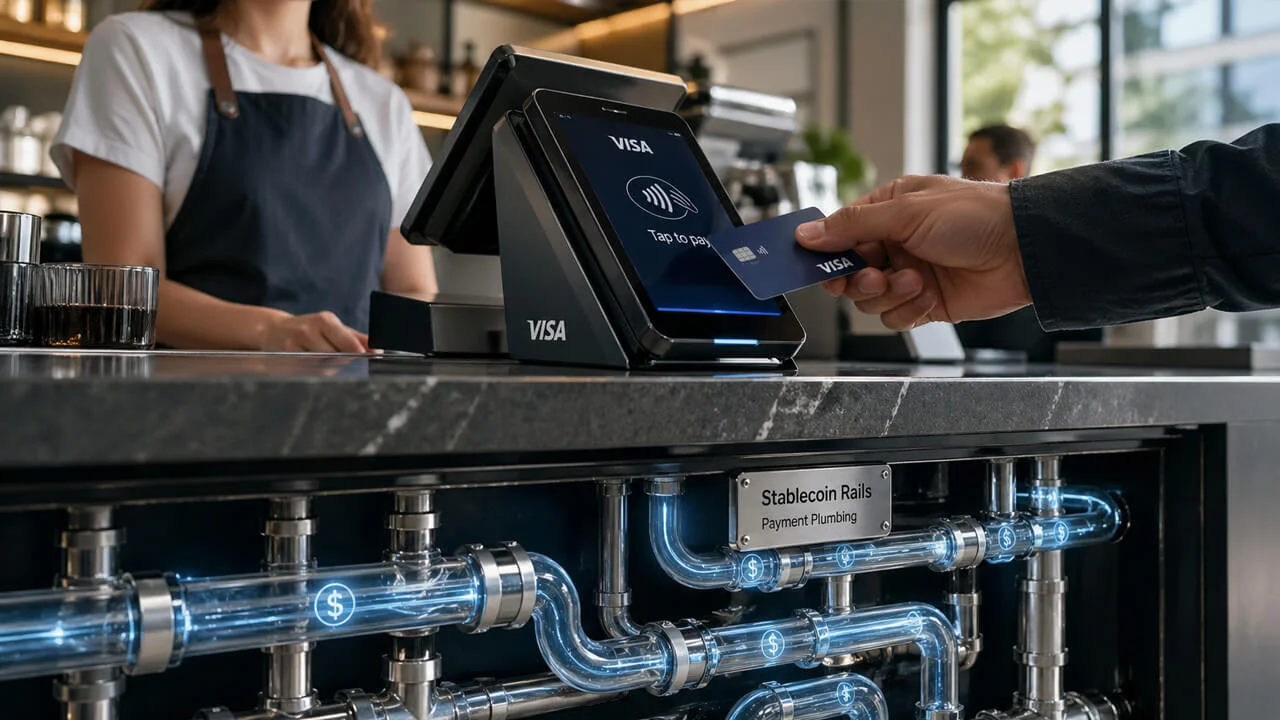
The update is best read as a settlement-infrastructure signal, not a blockchain support list. Stablecoins are entering the part of payments consumers rarely see: the layer that moves value between issuers, acquirers, banks, program managers and treasury systems after a card transaction has already been authorized. Crypto adoption is moving into the back office before it becomes visible at the checkout screen.
Visa has been building toward this point for several years. In 2023 the company moved millions of USDC between partners over Solana and Ethereum to settle fiat-denominated VisaNet payments, then expanded the work to acquirers Worldpay and Nuvei, and later to Cross River Bank and Lead Bank. The April release also tied the chain expansion to more than 130 stablecoin-linked card programs across more than 50 countries, framing the nine-chain footprint as part of a broader payment operating model rather than a standalone ledger experiment.
Market impact
The market context supports the move while keeping price data in the background. Total crypto market capitalization sat near $2.55 trillion as of April 30, with stablecoin market cap at roughly $319.8 billion, enough liquidity and operating history for large payment networks to treat dollar tokens as infrastructure rather than as a trading niche. A January analysis of BlackRock's stablecoin thesis argued dollar tokens were shifting from trading utility to settlement infrastructure within and alongside traditional finance, and Visa's pilot is the kind of operating example that thesis now points to.
The next test is scope. With regulators in the U.S.



Frequently asked questions
-
How many blockchains does Visa's stablecoin settlement pilot now support?
Nine, after the April 29 update added Arc, Base, Canton, Polygon and Tempo to the four networks already in the pilot: Avalanche, Ethereum, Solana and Stellar.
-
What is the current annualized run rate of Visa's stablecoin settlement pilot?
$7 billion, up roughly 50% from the prior quarter's baseline of more than $3.5 billion, which was set when U.S. issuer and acquirer partners first settled with Visa in USDC in December 2025.
-
What does the $7B run rate actually represent?
It is the annualized pace of stablecoin settlement volume inside Visa's pilot as a whole. Visa disclosed no breakdown of how that volume is split across the nine supported chains, by stablecoin, partner or geography.
-
Why is the chain mix important?
The five additions cover distinct needs: Arc is a stablecoin-native Layer 1 with USDC-denominated fees, Base connects Coinbase-linked wallets and payment tooling, Canton adds institutional privacy, and Polygon and Tempo target global payment throughput. Together they let Visa position stablecoins as adaptable…
-
What is the next test for Visa's stablecoin settlement work?
Whether the option stays a specialist rail for selected partners or becomes routine inside how global payment firms move value after the consumer-facing transaction is done — a question the pilot label and the missing chain-by-chain disclosure keep open.
 CoinTelegraph
 Benjamin Cowen
 TheBlock
 WatcherGuru
 CoinDesk
 WuBlockchain
 Lookonchain