








 CryptoSlate
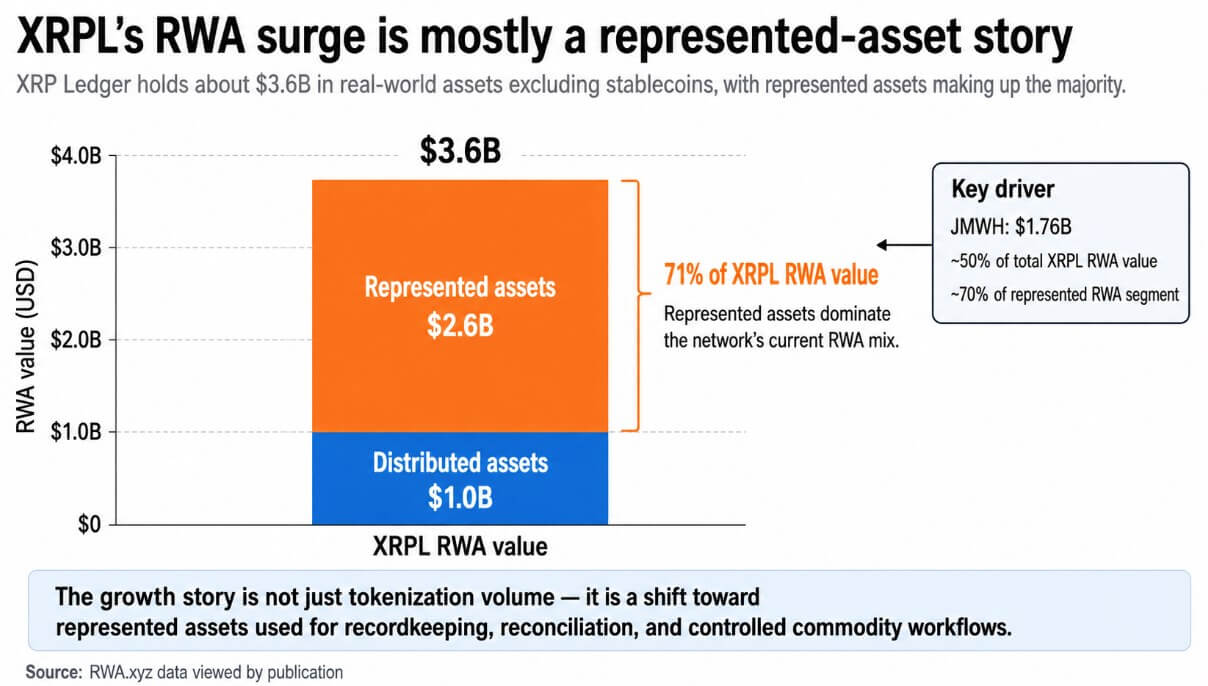
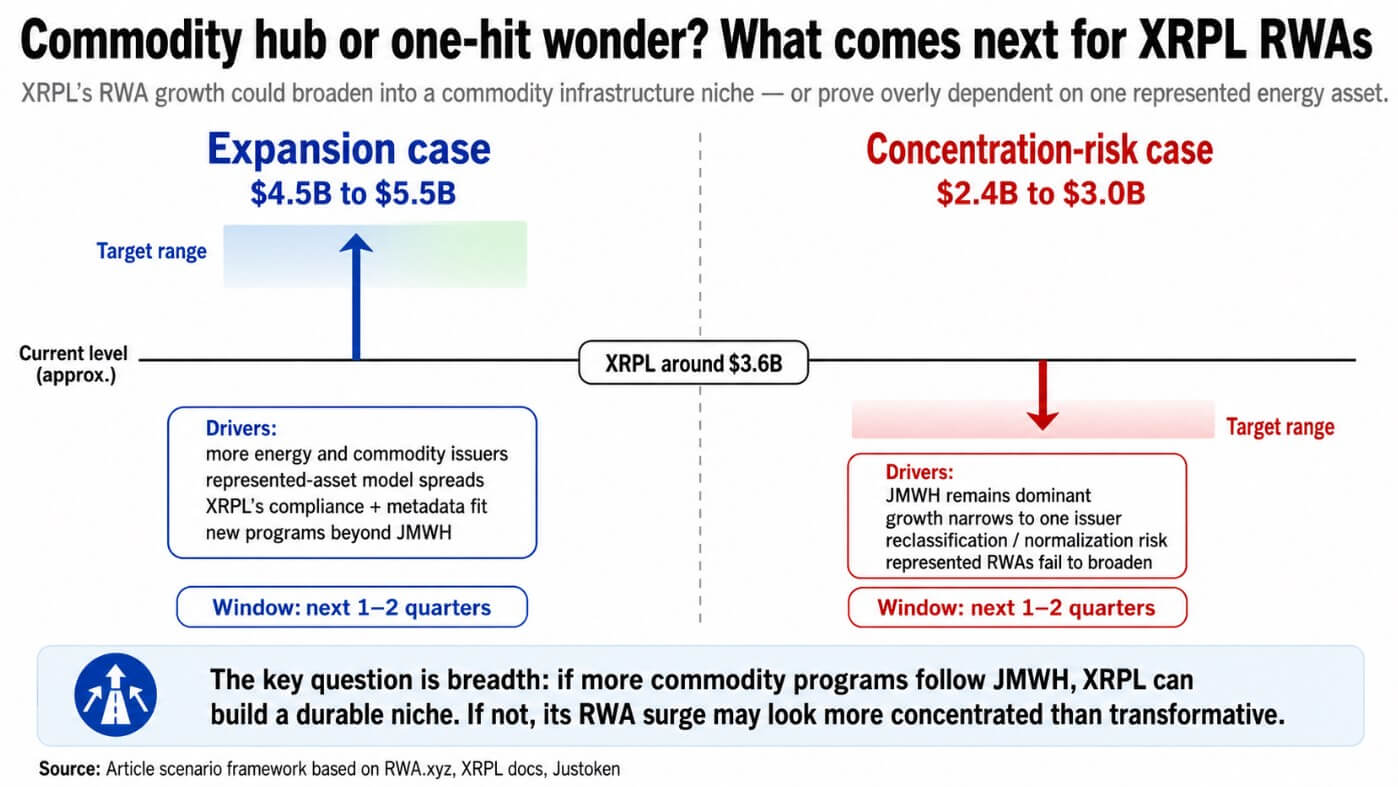
The XRP Ledger now holds roughly $3.6 billion in real-world assets excluding stablecoins, split between about $1 billion in distributed assets and $2.6 billion in represented assets — a 71% tilt toward the represented-asset model in which blockchain records and reconciles claims tied to real-world contracts held inside controlled platforms. The headline number is dominated by a single issuer: JMWH, a token backed one-to-one by real megawatt-hours of energy from Justoken's Enertoken program, built in partnership with Argentine producer YPF Luz. JMWH sits at $1.76 billion in value, up 104.79% over 30 days since its Jan. 13 inception, and accounts for roughly half of XRPL's total RWA and about 70% of its represented segment.
Why it matters
Energy and commodities present operational problems — production allocation, contract execution, delivery confirmation, consumption tracking, billing, ESG reporting, audit trails — that go well beyond investor access and need a shared, trustworthy ledger across counterparties with different back-office systems. XRPL's native Multi-Purpose Token feature set maps onto that workflow: authorization, freeze, clawback, rich metadata, and delegated administration are embedded at the token layer rather than added through custom smart contracts, and RippleX's Luke Judges has framed JMWH specifically as a verifiable record of ownership and fulfillment. The represented-asset design prioritizes auditability and compliance over DeFi composability, which is why the value lives inside a controlled platform instead of flowing through open DEX rails.
Market impact
RWA.xyz data show tokenized commodities across all networks at $8.1 billion, up 7.43% over 30 days, alongside nearly $15 billion in tokenized US Treasuries — large enough that a single energy-linked represented asset can materially shift a network's RWA profile. XRPL currently shows 301 RWA projects and $150.8 million in 30-day RWA transfer volume, a network-building footprint rather than a flow-heavy one.

Frequently asked questions
-
What is JMWH and why does it dominate XRPL's RWA base?
JMWH is a token issued by Justoken that represents one real megawatt-hour of energy, developed in partnership with Argentine energy producer YPF Luz under the Enertoken program. It sits at $1.76 billion in value — roughly half of XRPL's total RWA and about 70% of its represented-asset segment on its own.
-
What is the difference between distributed and represented assets?
Per RWA.xyz, distributed assets are tokenized assets that can be moved off the issuing platform and transferred peer-to-peer, while represented assets stay inside the issuing platform, with the blockchain recording and reconciling claims tied to real-world assets. XRPL's RWA base is 71% represented, a heavier tilt…
-
How big is the tokenized commodities market overall?
RWA.xyz data cited in the source show tokenized commodities across all networks at $8.1 billion, up 7.43% over 30 days, alongside nearly $15 billion in tokenized US Treasuries — large enough that a single energy-linked represented asset can materially shift a network's RWA profile.
-
Why does XRPL's feature set fit energy and commodity workflows?
XRPL's native Multi-Purpose Token capabilities — authorization, freeze, clawback, rich metadata, and delegated administration — are embedded at the token layer rather than added through custom smart contracts. That maps onto the audit trails, compliance controls, and reconciliation needs of energy and commodity back…
-
Does growth in XRPL's RWA base translate directly into $XRP demand?
Not directly. $XRP is used for settlement and network fees on XRPL, not as a claim on the underlying tokenized real-world assets. Any incremental demand is indirect, tied to transaction throughput and liquidity mechanics rather than to the RWA value held on the ledger.
 Crypto Rank News
 WuBlockchain
 TheBlock
 CoinDesk
 CoinTelegraph
 Crypto News