








 CoinDesk

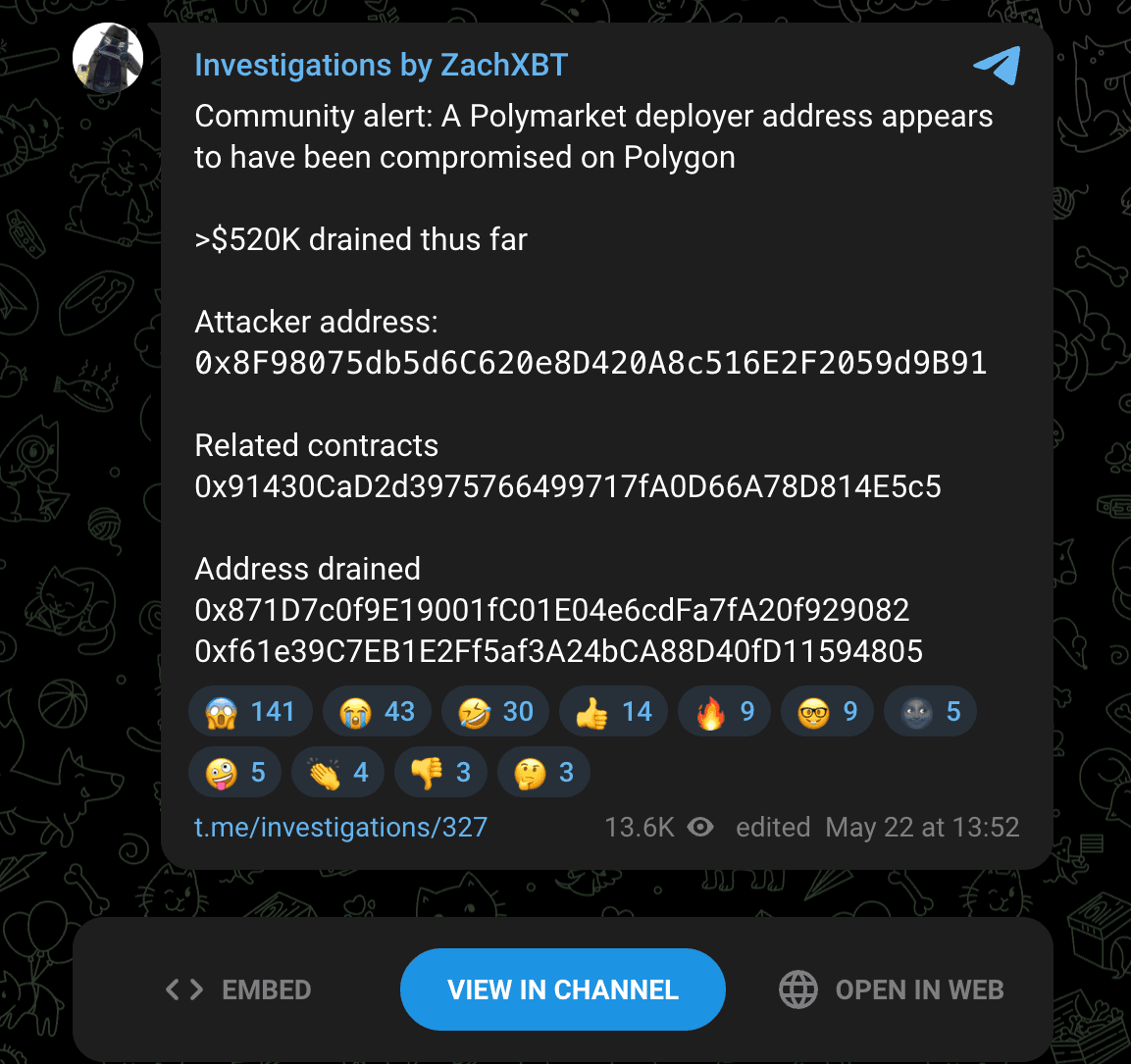


Blockchain investigator ZachXBT flagged a suspected security breach at Polymarket on Wednesday after more than $520,000 was drained from two Polymarket-controlled smart contracts on the Polygon blockchain. Funds were routed to a single attacker address within hours of the activity, according to on-chain data shared by ZachXBT.
Polymarket developers responded on X that the incident stemmed from a private key compromise tied to an internal operations wallet connected to the platform's rewards payout system. The team stressed that user funds and market resolutions remain unaffected and framed the event as an operational security failure rather than a smart-contract exploit or core infrastructure breach. The company has not yet issued a statement from its main account.
Why it matters
The attack vector matters as much as the dollar figure. A private-key compromise on an operations wallet is categorically different from a smart-contract bug — it means the protocol's on-chain logic held, but a human-managed signer didn't. That distinction is why Polymarket's messaging leans on user-fund safety, and it's why forensic investigators will treat this as a targeted intrusion rather than a systemic flaw.
The breach also lands during a period of heightened scrutiny for DeFi platforms, where operational key management has repeatedly proven to be the weakest link in otherwise audited codebases. Several multi-million-dollar exploits over the past year traced back to compromised signer keys rather than protocol logic, a pattern ZachXBT has chronicled extensively.
Market impact
The direct market impact is contained. Polymarket is a prediction platform rather than a liquidity protocol, so the drained funds do not represent user deposits under custody. The more measurable second-order effect is reputational: prediction-market credibility depends on resolution integrity, and any narrative — even a corrected one — about compromised wallets can slow institutional onboarding and weigh on POL trading activity tied to the broader Polygon DeFi ecosystem.

Frequently asked questions
-
Was the Polymarket exploit a smart contract bug?
No. Polymarket developers said the incident stemmed from a private key compromise on an internal operations wallet tied to the rewards payout system, not a flaw in the protocol's smart contracts or core market infrastructure.
-
How much was stolen in the Polymarket Polygon breach?
More than $520,000 was drained from two Polymarket-controlled smart contracts on Polygon, according to on-chain data shared by investigator ZachXBT. Funds were routed to a single attacker address.
-
Are user funds on Polymarket safe after the exploit?
Polymarket developers said user funds and market resolutions remain unaffected, because the compromised wallet was tied to the internal rewards payout system rather than to user deposits or market custody.
-
Who flagged the Polymarket security breach?
Blockchain investigator ZachXBT publicly flagged the suspected breach and shared the two affected Polymarket-controlled addresses along with the attacker address on the Polygon blockchain.
-
Has Polymarket issued an official statement about the exploit?
Polymarket developers responded via X, but the company had not yet issued an official statement from its main account at the time of reporting. Further updates from the team are expected.
 WatcherGuru
 CryptoSlate
 TheBlock
 WuBlockchain
 Lookonchain