








 CoinDesk
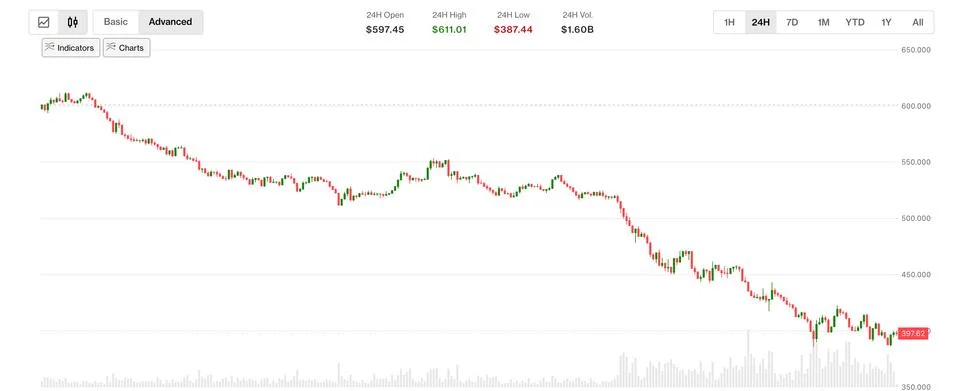



Zcash plunged roughly 30% to around $400 in the 24 hours after Shielded Labs disclosed a critical vulnerability in the blockchain's Orchard privacy pool — a flaw that, if exploited, could have allowed an attacker to mint unlimited, undetectable counterfeit ZEC tokens. The bug, present since Orchard activated in May 2022, was discovered on May 29 by security engineer Taylor Hornby working with Anthropic's Opus 4.8 model, and was patched in an emergency fix by June 1. ZEC's slide was amplified by broader market weakness but the disclosure is what crystallised the selling.
Why it matters
Orchard is Zcash's most advanced shielded pool, and a counterfeiting bug at the circuit level is the worst-case scenario for any privacy chain: it doesn't just lose user funds, it silently breaks the supply invariant that the entire market prices against. Shielded Labs stressed that the bug evaded years of scrutiny from experienced cryptographers and only surfaced with deliberate, AI-assisted review — a fact that reads as both reassuring and damning. If cutting-edge tooling was required to find a flaw that had lived in production for four years, the market has to reprice its assumption that ZEC's supply was ever verifiably clean. The team is now proposing a network upgrade with a new shielded pool and turnstile accounting on Orchard coins, plus expanded security hires and a formal verification project, to let anyone independently audit the supply.
Market impact
The 30% slide in 24 hours is the headline number, but the more durable damage is the uncertainty overhang. Shielded Labs conceded there is no cryptographic way to determine whether the bug was exploited before the fix, which means a non-zero probability of hidden counterfeit supply sits over the market until either a chain-level accounting reconciliation rules it out, or the proposed upgrade ships. Watch the ZODL upgrade proposal publication expected next week, the formal verification timeline, and any on-chain analytics from independent researchers probing historical Orchard activity — those are the catalysts that will decide whether ZEC reclaims the $500 area or tests the next leg lower.

Frequently asked questions
-
What exactly was the Zcash Orchard bug?
A critical vulnerability in the Orchard privacy pool circuit, present since Orchard activated in May 2022, that could have allowed an attacker to mint unlimited, undetectable counterfeit ZEC tokens by exploiting a flaw in the cryptographic proof system.
-
Who discovered the bug and how was it found?
Security engineer Taylor Hornby, engaged by Shielded Labs in April 2026, discovered the bug on May 29 using Anthropic's Opus 4.8 AI model during a targeted review of the Orchard circuit. He reportedly wrote a complete working exploit before disclosing it.
-
When was the Zcash bug patched?
The vulnerability was patched in an emergency fix on June 1, just days after discovery, with coordination handled by the Zcash Open Development Lab (ZODL). Shielded Labs disclosed the issue publicly on Thursday after the patch shipped.
-
Could the Zcash bug have been exploited before the fix?
Shielded Labs says there is no cryptographic way to know for sure. The team believes exploitation is unlikely because the flaw evaded years of cryptographer review and was only found via deliberate AI-assisted work, but it is proposing a network upgrade with turnstile accounting so anyone can independently verify the…
-
How did the market react to the Zcash disclosure?
ZEC fell roughly 30% to around $400 within 24 hours of the disclosure, amplified by broader market weakness. The proposed network upgrade, formal verification project, and any independent on-chain reconciliation of historical Orchard activity are the next catalysts to watch.
 WuBlockchain
 Crypto News
 CryptoSlate
 CoinTelegraph
 TheBlock
 WatcherGuru