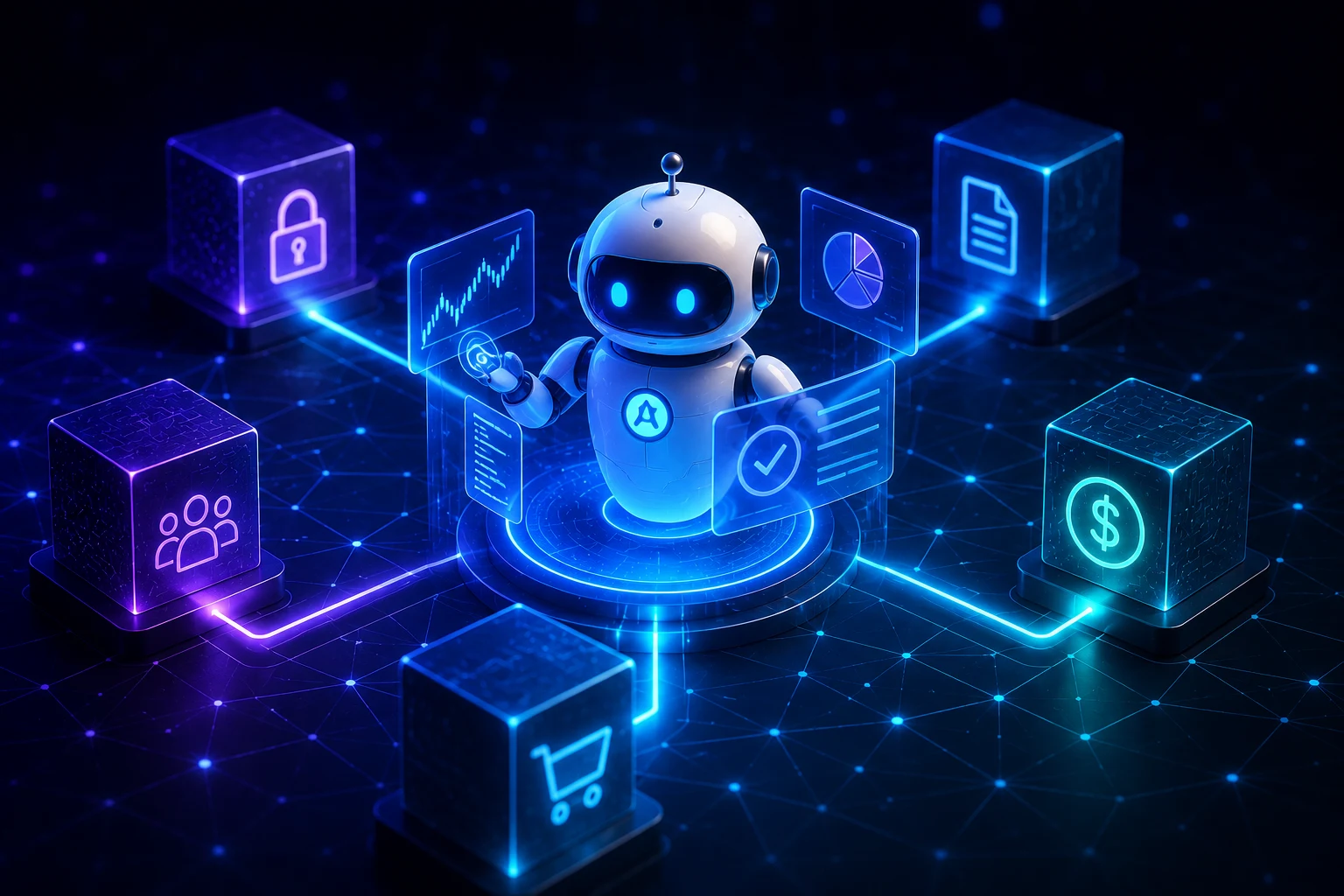
When software starts acting on its own
Most software does exactly what you tell it, when you tell it. AI agents are different: they are designed to pursue goals autonomously — making decisions and taking actions on their own, adapting as they go. Combine that autonomy with a blockchain, where an agent could hold and spend real money and trigger irreversible transactions, and you get one of the most intriguing — and genuinely risky — frontiers in the AI and crypto convergence. This guide explains the idea and why it demands as much caution as excitement.
This is educational and forward-looking, not investment advice. Much of what follows is potential, not present reality.
What an AI agent is
An AI agent is an autonomous software program that can perceive its environment, make decisions, and take actions to achieve goals — without a human directing each step. Unlike a simple tool you operate, an agent operates: you give it an objective, and it figures out and executes the steps.
This autonomy is the crucial feature. A traditional program follows fixed instructions; an agent makes its own choices within the bounds it is given. As AI has advanced, agents have grown more capable, and the idea of letting them operate in the real economy has moved from science fiction toward experimentation.
Why blockchains and AI agents fit together
Blockchains offer something AI agents need to operate economically on their own: a native way to hold value and transact without human intermediaries.
- A wallet of their own. An agent can control a crypto wallet, holding and spending funds autonomously — something far harder with traditional bank accounts that assume a human owner.
- Permissionless action. Blockchains let anyone (or anything) transact without asking a gatekeeper's permission, which suits autonomous software.
- Smart contracts to interact with. Agents could engage directly with smart contracts and DeFi protocols, executing complex financial actions programmatically.
- Machine-native money. Crypto provides a form of money that software can natively handle, enabling the idea of agents paying each other.
In short, crypto could become the financial layer for autonomous AI — the rails on which agents transact.
What AI agents on blockchains could do
The proposed use cases range from plausible to speculative:
- Automated finance. Agents managing portfolios, executing strategies, or interacting with DeFi protocols on a user's behalf according to set goals.
- Machine-to-machine payments. Agents autonomously paying for services — data, computing power, APIs — from other agents or services, enabling an "agent economy."
- Autonomous services. Agents that provide services and get paid in crypto without human operators.
- On-chain task execution. Agents handling complex multi-step blockchain operations that are tedious or difficult for humans.
The grand vision is an economy where autonomous agents transact with each other and with humans, using crypto as the medium — a genuinely novel possibility.
The serious risks — read carefully
This is where excitement must be tempered with hard realism. Combining autonomous decision-making with irreversible financial transactions is inherently dangerous:
- Irreversibility meets autonomy. Blockchain transactions generally cannot be undone. An agent that makes a bad or manipulated decision could cause irreversible losses, with no "undo" and no customer service.
- Bugs and unintended behavior. Autonomous systems can behave in unexpected ways. An agent pursuing a goal in an unforeseen manner could do real financial damage.
- Security and manipulation. Agents could be hacked, tricked, or manipulated into harmful actions. An agent controlling funds is an attractive target.
- Smart-contract risk compounded. Agents interacting with smart contracts inherit all the smart contract risks, now executed automatically and at speed.
- Accountability gaps. If an autonomous agent causes harm, who is responsible? The legal and ethical questions are unresolved.
- Hype far ahead of reality. As with the whole AI tokens space, much of the current excitement outpaces what actually works safely today.
A grounded perspective
AI agents on blockchains represent a genuinely fascinating convergence with real potential to enable new kinds of automation and economic activity. But the same properties that make it powerful — autonomy plus irreversible, permissionless transactions — make it uniquely risky, and the field is early, experimental, and heavily hyped.
The sensible stance is informed curiosity: take the ideas seriously as a possible direction for the technology, while treating current projects with deep skepticism and refusing to confuse an exciting vision with a working, safe reality. We look further ahead in the future of autonomous finance and AI agents. None of this is investment advice.
Follow an emerging frontier critically
AI agents in crypto are early and surrounded by speculation, making real progress hard to distinguish from hype. Zippfeed tracks crypto and AI-related headlines with sentiment and importance scoring, so you can follow this fast-moving frontier with a clear read on what's genuinely developing versus what's narrative — keeping perspective on an idea that's as easy to overhype as it is to find compelling.