What a DEX pair page is actually showing you
When you open DexScreener, DEXTools, DexView, or any of the smaller scanners, you are looking at a single trading pair. A pair is just a smart contract that holds two reserves, for example ETH and a memecoin, and lets anyone swap between them at a price set by the ratio of those reserves. The page is a read-out of that contract plus the trades and transfers that touch it, pulled from the blockchain and from each scanner's own index.
The visual density of these pages is intentional. A dozen colored boxes, a price chart, social links, and audit badges make a token look vetted. In reality, a pair contract is usually twenty to forty lines of code that anyone can copy, deploy, and point a free scanner at in under five minutes. The page is a view of data, not a guarantee about the code underneath.
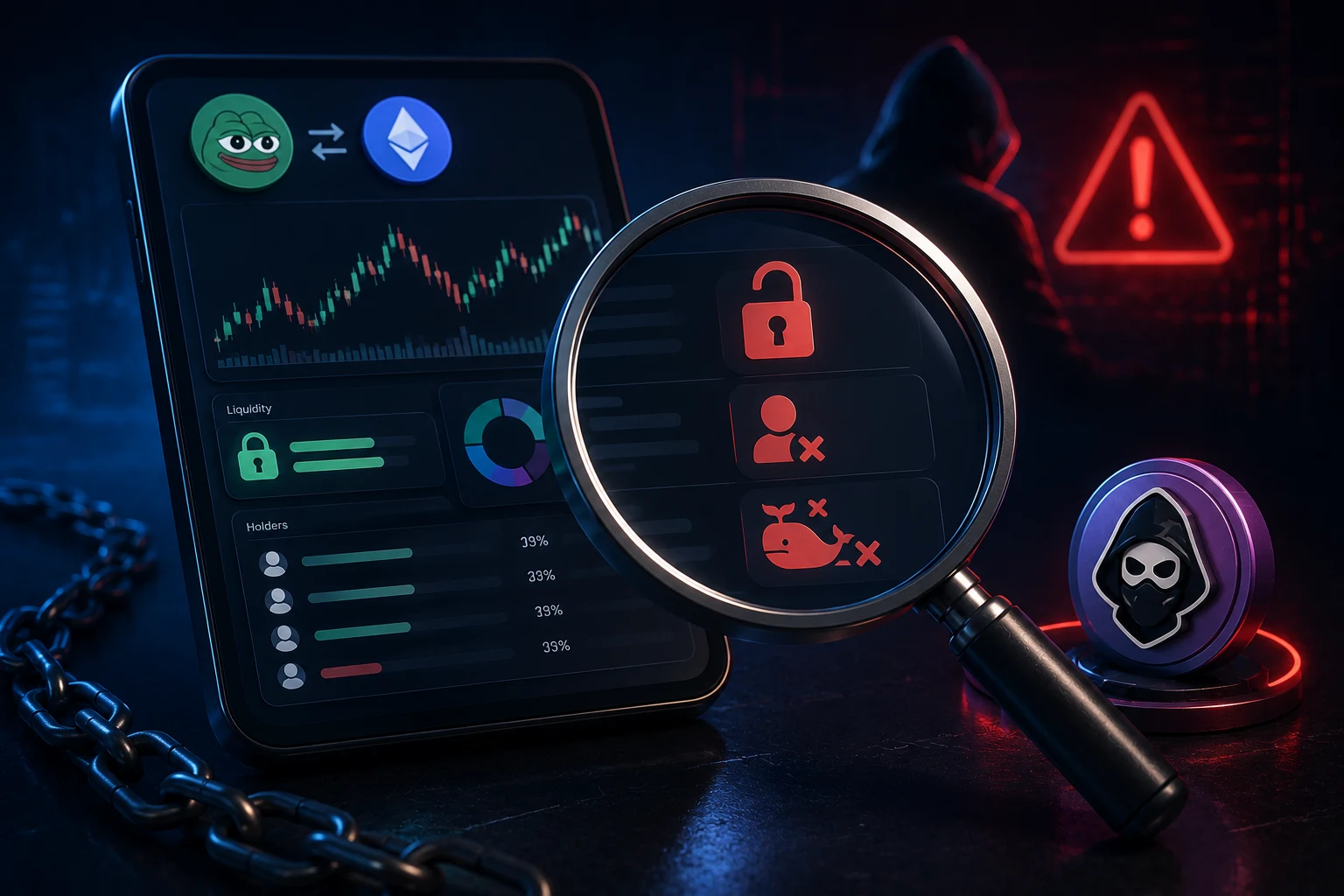
The fields you see fall into five buckets: price and market cap derived from the pool, liquidity (how much value sits in the reserves), volume (how much has been swapped recently), holders and concentration (who owns the token), and contract metadata (taxes, owner powers, and whether the source has been published). Every one of these buckets has a fake version. Learning to read the page means learning which number a scammer is most likely to be spoofing right now.
Real risks before you click buy
The honest framing is that retail memecoin buying on a DEX is one of the highest-risk activities in crypto. Public reports from Chainalysis and Solidus Labs have repeatedly found that a large share of newly launched tokens on DEXs show patterns consistent with pump-and-dump or outright theft. Scam detection teams have published internal numbers suggesting that on busy launch days the majority of new pairs on Uniswap, for instance, exhibit at least one manipulation signal. None of that is deterministic for any single token, but it sets the base rate: most new pairs end at zero.
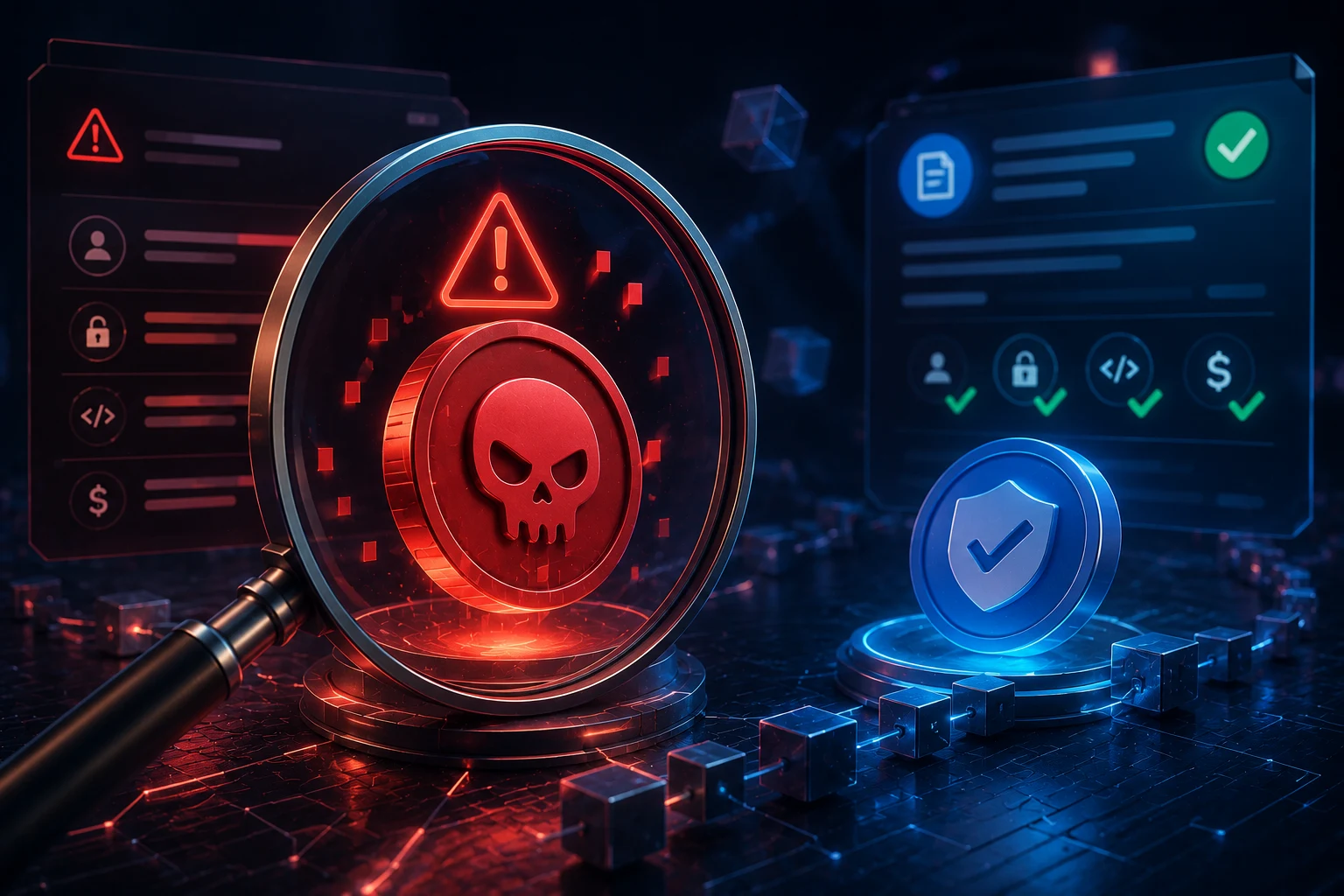
Failure modes on a DEX pair page break into a few familiar shapes. A soft rug is when the team sells its own bag into a thin pool and price collapses. A hard rug is when the liquidity is pulled entirely, leaving the chart flatlined at zero with your tokens un-sellable. A honeypot is when you can buy but the contract forbids selling, often through a transfer tax, a blacklist, or a pause function. A wash-and-dump is when a bot loops buy and sell orders between its own wallets to manufacture volume, attract attention, then dump on real buyers. Each of these is visible on a pair page if you know which field encodes it.
The uncomfortable truth is that even with a perfect checklist you can still lose money. You can read every field correctly, the taxes can read 0/0, liquidity can be locked, and the team can still exit through a function the scanner does not display. The checklist is a filter for obvious traps, not a certificate of safety. Treat anything you read here as one input among many, and size positions so that a total loss is not life-changing.
Field by field: what each number really means
\h2>Liquidity, locked versus burned versus unlocked
The liquidity number, often shown in USD or in the paired token, is the value sitting in the pair contract ready to be swapped against. Higher is better in absolute terms, but the deeper question is who controls it. There are three states to look for.
Unlocked liquidity means the deployer still owns the LP tokens that represent the pool share. They can redeem those LP tokens for the underlying reserves at any time, draining the pool. This is the standard configuration for a brand-new launch.
Locked liquidity means the LP tokens have been sent to a time-locked contract (popular services include Unicrypt, Team.Finance, and Mudra Locker). The lock prevents withdrawal until the timer expires. Check the unlock date, the platform name, and whether the lock contract address matches the real platform rather than a copy.
Burned liquidity means the LP tokens were sent to a dead address (0x000...dEaD is common). No one can ever move them, which is the strongest configuration, but burned LP is rarer because the deployer sacrifices any future claim on the pool.
The trap is that a lock receipt can be faked. A scammer can deploy a contract called 'Unicrypt Locker,' point a lock transaction at it, and the scanner reads 'locked' on a platform that does not actually exist. Always click through to the lock platform's website and verify the lock ID yourself. If the platform URL is unfamiliar, the lock is not real.
Top-10 holder concentration
This is the percentage of the supply held by the ten largest non-pair wallets. A healthy number on a launched memecoin is roughly under 25 percent. Anything over 40 percent is a warning, and over 60 percent is essentially a guarantee that a few wallets can move the price at will.
The hidden issue is that concentration can be split across many wallets controlled by one person. A team that holds 30 percent of supply can split it across ten fresh addresses and the top-10 figure drops to a comfortable-looking 12 percent. To detect this you need to follow the funding: did the top-10 wallets all receive their tokens from the same deployer wallet in the same block? If yes, they are almost certainly the same actor.
The pair itself usually shows up as a holder. Exclude it. So does any known burn address. What you want to see is the remainder spread across many independent buyers, with no single cluster of wallets receiving early transfers from the deployer.
Buy and sell taxes
Taxes are the percent the contract takes from every swap. A 0/0 pair charges nothing on entry or exit. A 5/5 pair charges 5 percent on the way in and 5 percent on the way out. Anything above roughly 10 percent on either side is hostile to traders, and a 99/99 or a 0/99 configuration is a classic honeypot signature.
The scanner reads taxes by simulating a test swap, but this is a known weakness. A contract can have dynamic taxes that start at zero and switch to 99 percent once a target wallet buys. It can have a whitelist that exempts the deployer. It can pause selling entirely through an onlyOwner modifier that the scanner does not simulate. There are also 'transfer tax' patterns that hit normal peer-to-peer transfers even when no swap is happening, which drain tokens into a black hole address.
If a tool like GoPlus or Honeypot.is reports the contract as safe, that is one signal, not a verdict. The strongest check is reading the verified source code on the block explorer, looking for functions that can change tax rates, blacklist addresses, or pause trading after launch.
The dev wallet funding trail
Every contract is deployed from an EOA (externally owned account, the basic wallet type that a person controls with a private key). That wallet has a history. Open it on the block explorer and look at three things: how it was funded, how many other tokens it has deployed, and what happened to those tokens.
Funding source matters. If the deployer was funded by a privacy mixer like Tornado Cash, or by a fresh wallet that was itself funded by a mixer, expect a scam. If the deployer was funded directly from a centralized exchange's hot wallet, the operator has done KYC and that is a stronger signal, though still not proof.
Previous deploys matter even more. A wallet that has launched forty tokens over six months, where every single one rugged within a week, is a serial scammer regardless of what any individual launch page says. The cluster of past rugs is the single most predictive field on the whole pair page, and it is the one most beginners skip because it requires opening a second tab.
Volume and the wash-trading problem
The volume number on a DEX pair page is the dollar value of all swaps in the selected time window. It looks impressive on a chart with a million-dollar bar at launch. The problem is that volume is the easiest field to fake on any blockchain, because every transaction is just a state change you can submit yourself.
The classic fake is same-block wash: a bot wallet buys from the pair, then sells back to the pair, in the same block, multiple times. The pair contract does not care. The reserves do not move. The volume counter ticks up by tens of thousands of dollars per minute. To detect this, look at the count of unique makers (the number of distinct wallet addresses that initiated swaps) compared to the volume. A token with five million dollars of volume but forty unique makers is almost certainly being washed.
Another wash pattern is two coordinated bots that trade back and forth across a wide price range to manufacture a chart shape. The signature is long wicks on the candles and no real net change in liquidity. DEXTools' 'wash score' and DexScreener's buyer/seller counts are rough attempts to flag this, but the underlying data is just the swap log, which any scanner can summarize only so well.
The fields people over-trust
Audit badges from services like Certik or Hacken are the most over-weighted signal on pair pages. An audit is a snapshot of the code at a point in time, often paid for by the team that wrote the code. Audits routinely miss honeypot patterns, and they almost never cover the operational risks (will the team sell, will they pull liquidity if the lock expires). A green audit badge with a hundred-thousand-dollar volume is a common look for low-effort scams.
Social links and follower counts are equally manipulable. Telegram groups can be bought by the thousand, Twitter followers can be faked in bulk, and Discord raids use real-looking humans. None of these imply the contract is safe. They imply the team spent money on marketing.
Finally, the 'renounced ownership' field. Renounced means the deployer called a function that destroys the ability to call admin functions, which is good if true. The trap is that some contracts have a hidden owner in storage, or the 'renounce' function does not actually remove all powers. Always check the verified source for the admin modifiers and confirm the owner address is the zero address.
A practical 30-second pre-buy checklist
Use this sequence every time, in this order. If any step fails, do not buy. If you cannot complete a step in under thirty seconds, the signal is not strong enough to act on.
- Open the contract on a block explorer. Confirm it is verified. If source code is not published, walk away.
- Check the deployer wallet's history. Count how many other tokens it launched. If more than three and any of them rugged, walk away.
- Read top-10 holder concentration. Over 40 percent is a no. Funding-trail cluster of the top-10 wallets from the deployer is a no.
- Confirm liquidity status by clicking through to the locker. Verify the platform URL is real, the lock amount matches the pool, and the unlock date is months away, not days.
- Simulate a sell with two independent honeypot checkers. Disagreement or any flagged risk is a no.
- Compare unique buyers to volume. Fewer than roughly one hundred unique makers for the day with six-figure volume is wash. Walk away.
If all six pass, the trade is still risky, just less obviously so. Size the position so that a 100 percent loss is an annoyance, not a disaster. Never use money you would not be willing to lose on a coin flip.
How to follow memecoin launches the smart way
Memecoin launches move in minutes and the news cycle around them is louder than the data. Manually checking every contract that trends on social media is a losing game for a retail trader. Zippfeed surfaces trending token headlines with sentiment scoring (bullish, neutral, or bearish) and an importance rating, so you can filter hype from signal before a pair page ever loads. Pair the news with the checklist above and you stop reacting to banners and start reacting to facts.