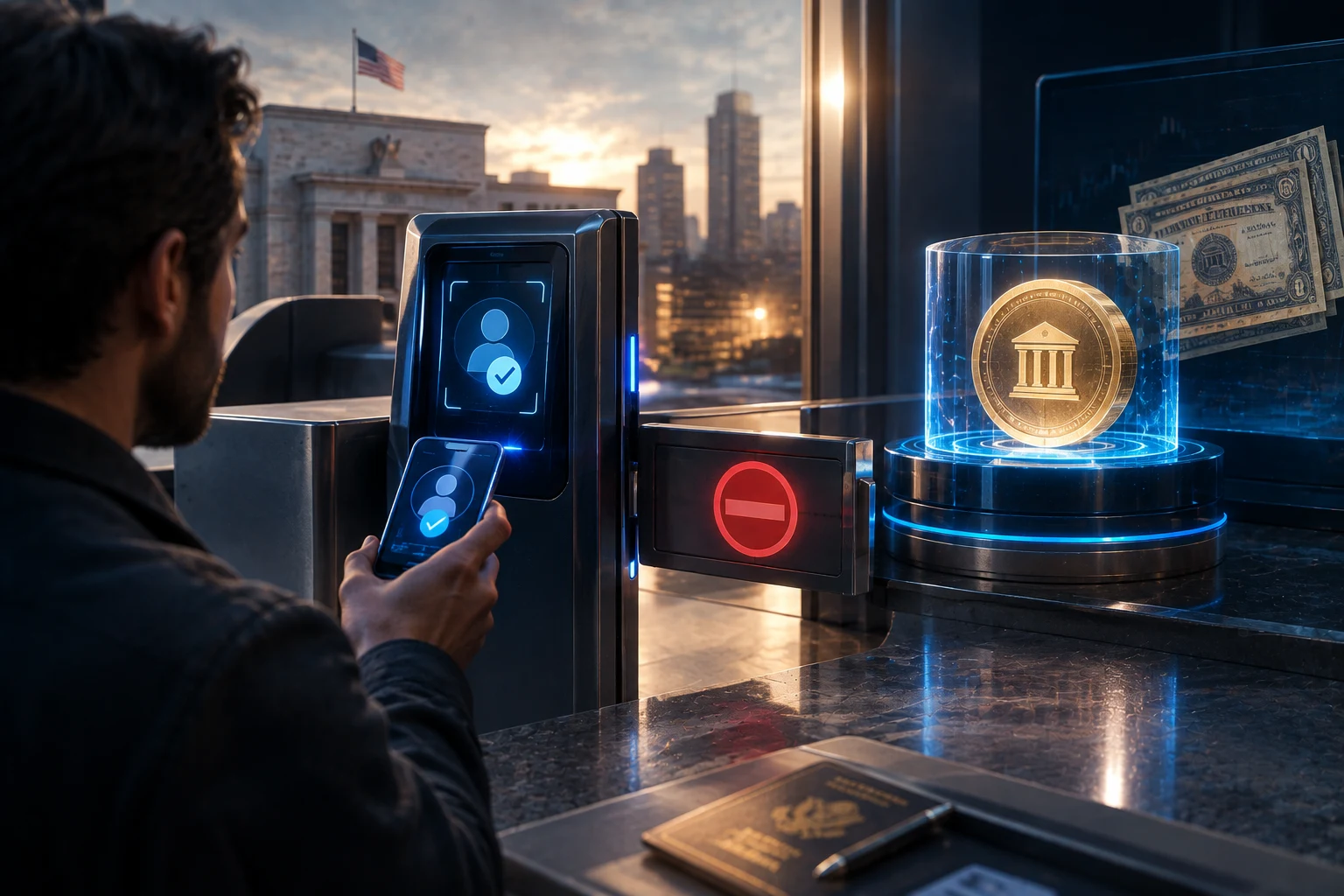
What "tokenized treasury" actually means in practice
The pitch is simple. A US Treasury bill yields roughly 4 to 5 percent a year, and blockchain works 24/7, so why not wrap the bill in a token and let anyone earn that yield from a self-custody wallet? The reality is layered. The token you see in your wallet is a record of a share in a fund, trust, or special-purpose vehicle that the issuer set up to buy the bill. The issuer is usually a registered or registered-adjacent entity, and the fund sits behind a layer of legal structure, custody, and compliance.
That structure is the product. When you buy BUIDL from BlackRock, OUSG from Ondo, USDY from Ondo's yield product, USYC from Hashnote, or USTB from Superstate, you are not buying a bill. You are buying a fund share. The fund buys the bill. The token is a receipt, and the receipt is governed by the fund's offering documents, not by the smart contract that moves it on-chain.
This matters because the marketing copy treats "on-chain" and "liquid" as synonyms. They are not. On-chain means the share can be transferred peer-to-peer at any hour. Liquid means you can convert that share back into dollars with minimal friction. Those are two different promises, and only the first one is enforced by code.
Risks most marketing pages hide
Before walking through the mechanics, the honest framing is that the risk surface for tokenized treasuries is wider than the brochures suggest. The biggest issues show up precisely when you want your money back, so it makes sense to map them first.
Redemption gate risk. Most fund prospectuses give the manager the right to suspend redemptions under stressed conditions, similar to a money market fund's gate. If US Treasury markets seize up, as they did briefly in March 2020, the manager can pause withdrawals while the fund sells bills in an orderly way. The token still trades on-chain, but the official cash-out path is closed.
NAV and pricing risk. Tokenized treasury funds are typically marked to the value of the underlying bills, with the share price staying close to one dollar. Bills can deviate from par, especially in rising rate environments, and accrued interest has to be factored in. If you redeem at the wrong moment, or into a thinning market, you may not get exactly a dollar back.
Counterparty and concentration risk. Several tokenized treasury products rely on a small number of liquidity providers, custodians, and authorized participants. If one of those firms has an operational issue, the redemption queue grows. The early days of BUIDL in 2024 included real friction around redemptions and minimums that surprised users who assumed the token behaved like USDC.
Regulatory and access risk. Most of these products are permissioned. KYC checks gate who can mint or redeem at the primary venue. Permissionless peer-to-peer transfer exists, but the off-ramp back to dollars usually still requires an authorized participant to step in. Owning the token is not the same as being able to redeem it directly with the issuer.
Redemption windows, minimums, and the T+1 reality
Once you understand the structure, the redemption mechanics make more sense. The headline numbers vary by product, but the pattern is similar across BUIDL, OUSG, USDY, USYC, and USTB.
Cut-off times. Most tokenized treasury funds operate on a daily cycle. You submit a redemption request before a stated cut-off, often in the early US morning, and settlement arrives the next business day. That is T+1, the same cadence as the underlying Treasury market. The token can travel 24/7, but the cash does not.
Minimums. Minimum redemption amounts exist and they are not tiny. BUIDL has historically required redemptions of US$250,000 or more at the primary venue, though secondary market wrappers have lowered that for retail-facing interfaces. OUSG and USDY have similar institutional minimums, with smaller lots available only through partner platforms that pre-buy and resell.
Accreditation and KYC. The primary redemption path is reserved for verified, often accredited, participants. USYC is notable for being more retail-accessible through partner channels, but the core off-ramp still runs through authorized participants who handle the KYC and banking leg.
The net effect is that the on-chain experience and the cash-out experience live on different clocks. You can move BUIDL between wallets at 3am on a Sunday, but you cannot turn that BUIDL into a wire in your bank account until the next business day's settlement window.
The role of NAV, share class, and accrual
Tokenized treasury funds are usually structured as stable NAV or accrual products. Stable NAV means the share price is designed to stay at one dollar, with yield distributed by minting new shares or by separate rebasing tokens. Accrual means the share price drifts up over time as interest accumulates, similar to a traditional money market fund.
BUIDL uses a stable NAV model with new tokens minted to reflect accrued interest, so the share count in your wallet grows. OUSG and USDY use an accrual approach where the token's value rises each day. USTB from Superstate similarly uses an accrual structure. None of these are designed to behave like a stablecoin that stays pinned to a dollar in your wallet's display.
This has two practical consequences for cash-out. First, when you redeem, the price you get is the NAV on the redemption date, not the price shown on a third-party dashboard that may lag or use a different reference. Second, the choice of share class and accrual method affects how tax, accounting, and slippage work. A small difference in how interest is recognized can be a meaningful difference for an institutional user redeeming a million dollars.
Liquidity provider backstops and secondary markets
To close the gap between on-chain speed and T+1 settlement, most tokenized treasury ecosystems rely on liquidity providers and market makers. These firms hold inventory of the token and stand ready to buy from you at a price close to NAV, then redeem with the issuer on the standard cycle and pocket the spread.
This is the layer that makes "instant redemption" possible on certain platforms. It is also the layer that introduces basis risk. The price the market maker quotes can drift away from NAV if Treasury markets move, if the market maker's inventory is constrained, or if redemptions spike across the product at once. In normal conditions, the spread is a few basis points. In stressed conditions, it can widen sharply.
Permissionless on-chain secondary markets, including DEX pools and OTC desks, add another path, but they have their own limitations. A Uniswap-style pool of BUIDL against USDC is only as deep as the liquidity providers have funded, and the price can depeg from NAV if the pool becomes imbalanced. ONDO and other issuers have worked to deepen these markets, but secondary liquidity is still a fraction of what a major stablecoin pool looks like.
Permissioned versus permissioned-off access
It helps to separate two layers of permissioning. The first is the issuer layer. The fund, the SPV, and the primary redemption path are permissioned. You cannot walk in off the street and redeem with the issuer unless you have passed KYC, met the minimum, and possibly cleared accreditation checks.
The second is the transfer layer. Once minted, the token can usually be transferred between wallets without the issuer's permission, on-chain. This is what makes the product composable with DeFi, usable as collateral, and tradable on DEXs. The peer-to-peer transfer is permissionless even if the on-ramp and off-ramp are not.
"Permissioned-off" is a useful phrase for this. The RWA exists on open rails, but the doors in and out of dollars are controlled. The result is a product that is more accessible than a private fund but less accessible than a USDC balance. For most users, the practical question is which platforms have integrated authorized participant relationships to handle the permissioned layer on the user's behalf.
What happens when everyone tries to exit at once
The acid test for any redemption mechanism is a stress event. Tokenized treasuries are young products, but there are useful data points. In early 2024, as tokenized treasury products scaled, BUIDL experienced real friction at the redemption edge. Users expecting stablecoin-like behavior hit minimums, KYC gates, and settlement delays. The product worked as designed, but the design was not what many on-chain users had assumed.
The wider risk scenario is a Treasury market selloff. If US Treasury yields spike, the NAV of underlying bills can drop, the share price can drift from one dollar, and redemptions can surge as users try to exit into cash. The fund manager's tools include slowing the pace of redemptions, drawing on credit lines, and using the orderly sale of bills. If those tools are not enough, gates and fees kick in. On-chain, the token would still trade, but the price on DEXs would reflect the off-ramp friction, not the NAV.
This is the scenario that separates tokenized treasuries from stablecoins. A well-backed stablecoin like USDC or USDT has mechanisms, including reserve management and redemption at par, designed to keep the on-chain price close to one dollar even under stress. Tokenized treasury products do not have the same mandate. Their job is to track the value of the underlying bills and to honor the fund's redemption terms, not to defend an on-chain peg through every market regime.
What this means if you are considering one
For a user weighing a position, the practical checklist is short. First, identify the redemption path you will actually use, primary or secondary, and check the minimum, cut-off, and KYC requirements. Second, look at the liquidity provider and authorized participant setup, including who they are, what the typical spread is, and what happens to that spread under stress. Third, read the prospectus language on gates, suspensions, and NAV calculation. Finally, size the position knowing that the on-chain token and the cash in your bank account are separated by a settlement window and a counterparty stack.
The honest summary is that tokenized treasuries are a real and growing product class with real yield from real bills, but the on-chain wrapper does not make them instantly cashable. It makes them instantly transferable, which is a different and more limited promise. If you need dollars in a hurry, you are depending on the off-chain layer, and that layer has rules, minimums, and failure modes that the token itself does not protect you from.
Follow tokenized treasuries with the right signal
Tokenized treasury markets move on news you will not catch by scrolling a price feed. NAV updates, liquidity provider changes, regulatory developments, and stress signals in the underlying bill market all matter. Tracking all of that manually is a losing game. Zippfeed surfaces RWA headlines with sentiment scoring, marked bullish, neutral, or bearish, and an importance rating, so you can see which tokenized treasury stories are noise and which ones are the early signal of a redemption event or a structural change in the product.






 TheBlock
 Crypto Capital Venture
 CoinDesk
 CoinTelegraph