The problem it solves
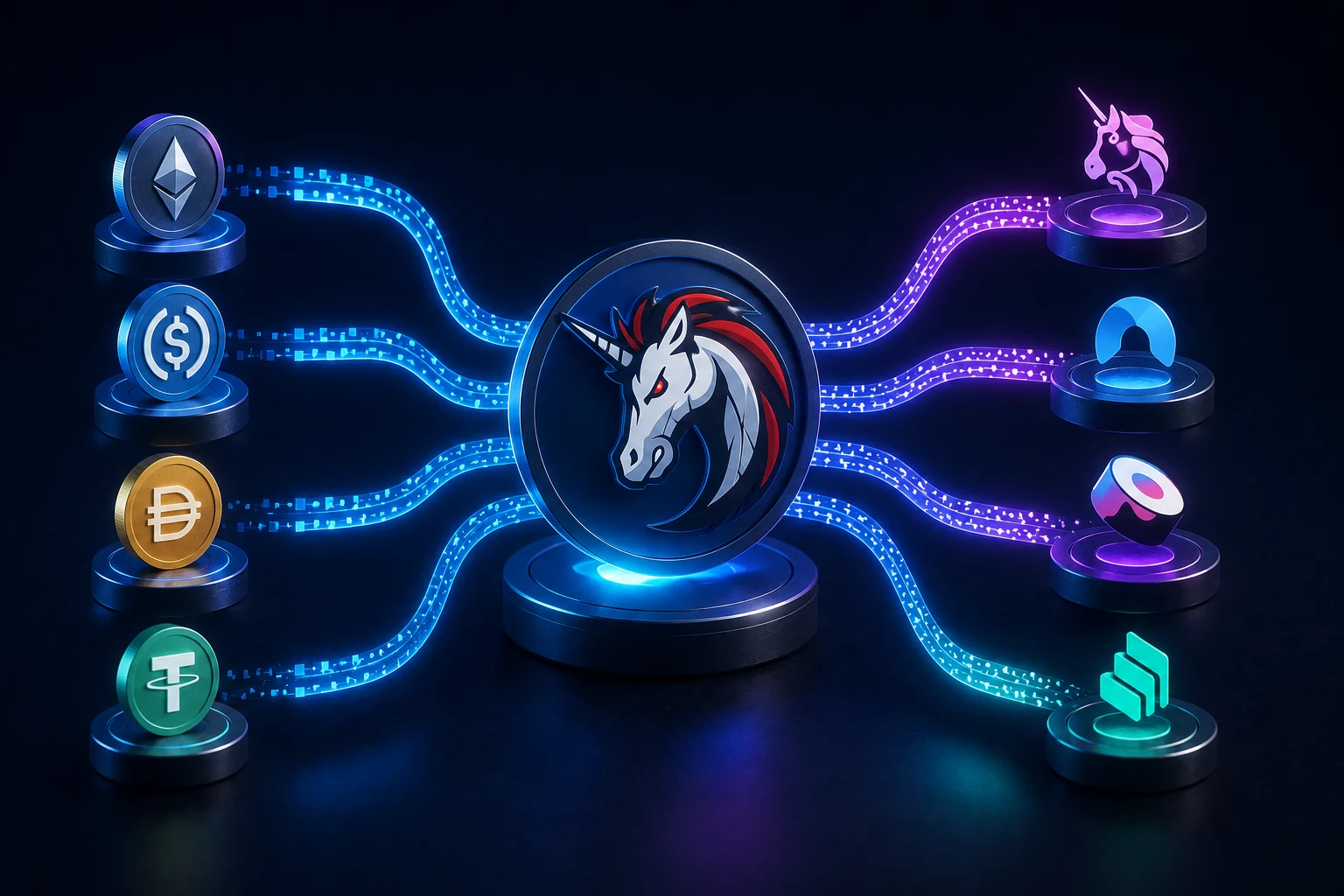
DeFi liquidity is fragmented across many DEXes — Uniswap V2 and V3, Curve, Balancer, PancakeSwap, Sushi, niche AMMs, and dozens of others. For any specific swap, the best price might be on a different venue depending on size, route, and timing. A single-DEX router will leave money on the table; an aggregator hunts across venues and chooses for you.
How it works
1inch is built around its routing algorithm and aggregator contract.
Route discovery
The 1inch backend solves for the cheapest path between your input and output tokens. For a USDC → wBTC swap it might consider routes through ETH, through stETH, through Curve pools, across multiple hops — and split the trade if that nets better.
Atomic execution
The aggregator contract executes the planned route in a single transaction. If any leg fails, the whole transaction reverts — you do not end up half-done in the middle of a multi-pool swap.
Limit orders and Fusion
Beyond simple market swaps, 1inch supports limit orders and a system called Fusion that lets resolvers compete to fill your order, often with MEV protection and gasless execution from the user's perspective.
The 1INCH token
1INCH is the protocol's governance and incentive token. Holders can:
- Stake 1INCH for governance weight and a share of accrued protocol fees under the current revenue model.
- Vote on aggregation parameters, integrated DEXes, and protocol upgrades.
The exact tokenomics evolve through governance; check the most recent proposals before relying on a specific yield or vote weight.
Real use cases
- Better prices on swaps. For trades where the single-DEX price is poor, an aggregator usually finds savings — sometimes a basis point or two, sometimes much more on niche pairs.
- Trading large size with less slippage. Splitting a trade across many pools reduces the price impact of any one of them.
- Limit orders on-chain. 1inch's limit-order book is on-chain, not held by a central matcher.
- Gasless swaps via Fusion. Resolvers can settle your trade in exchange for a share of the value, with you signing an order rather than sending a gas-paying transaction.
Risks worth knowing
- Router contract risk. An aggregator is a smart contract that executes complex routes. A bug in the router can be more painful than a bug in any single pool. 1inch is audited and battle-tested but never immune.
- Sandwich and MEV risk. Public mempool transactions can be front-run or back-run. Use sane slippage and consider MEV-protected RPCs or Fusion-style mechanisms.
- Token-listing risk. Aggregators route to tokens — they do not vouch for them. A scam token routed through 1inch is still a scam token; verify contract addresses.
- Gas vs. savings. A long multi-hop route can be expensive on Ethereum L1. The net win depends on size.
- Permits and approvals. Complex aggregator flows ask for token approvals; manage them and revoke when finished.
None of this is financial advice — it is the context you need before using an aggregator.
Following 1inch with the right lens
1inch headlines move on protocol upgrades (Fusion versions, new chains, new DEX integrations), governance proposals on tokenomics, and broader DeFi liquidity events. Each one matters differently for a swap user and a 1INCH staker. Zippfeed surfaces 1inch-related headlines with sentiment and importance scoring across sources, so you can tell whether a new feature is shipped or in proposal and whether a wider DeFi event might shift aggregator routing. This is education, not financial advice — but the users and stakers who manage exposure calmly are the ones reading the protocol, not just the chart.