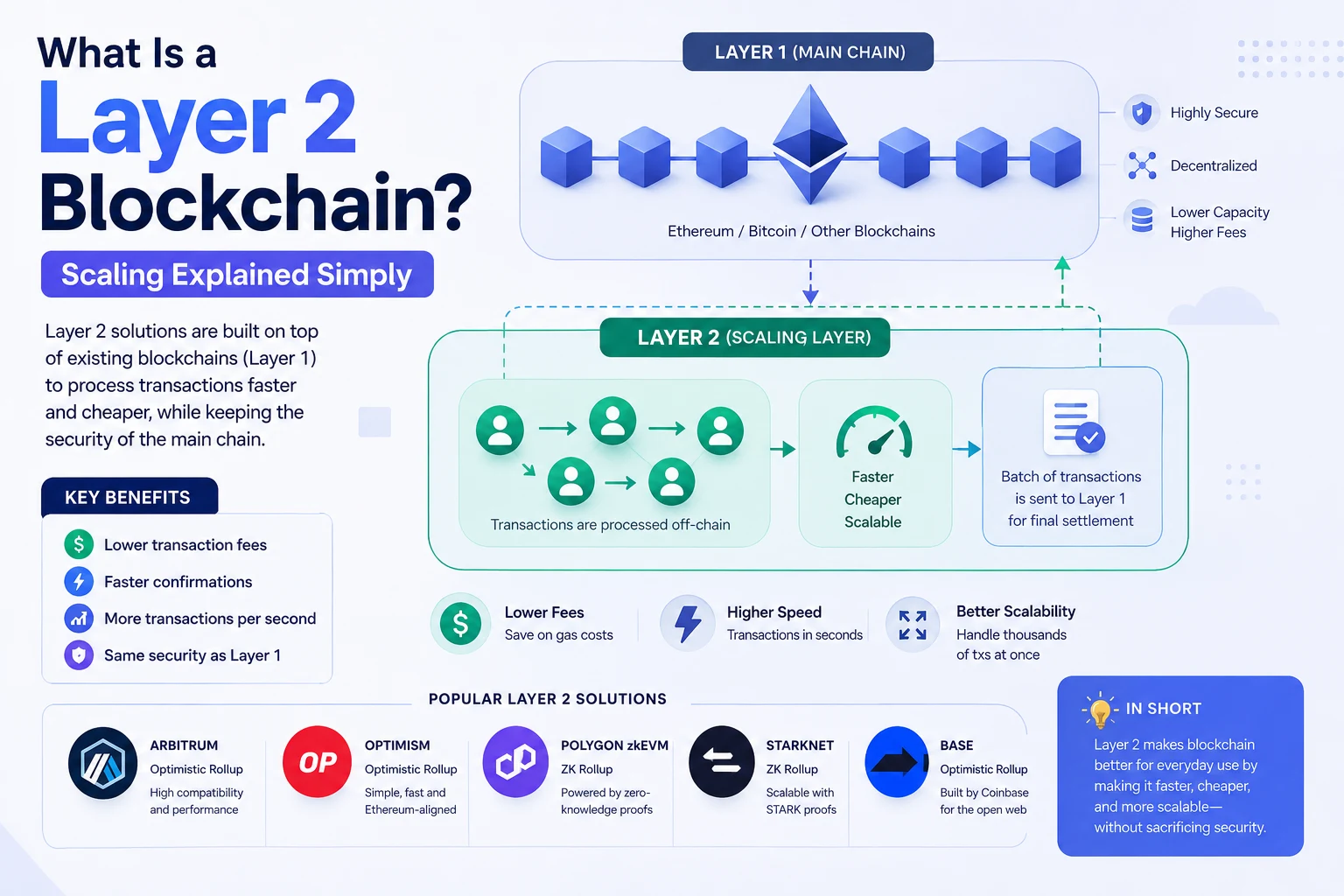
The problem Layer 2 solves
Popular blockchains have a frustrating ceiling. The very thing that makes them secure and decentralized — every transaction being verified by a huge, distributed network — also makes them slow and expensive when lots of people want to use them at once. During busy periods, fees on major networks have spiked to absurd levels, pricing out ordinary users. This is the scalability problem, and Layer 2 is the leading answer.
Layer 1 vs Layer 2: the foundation
Think of a Layer 1 (L1) as a city's main highway — secure, reliable, but prone to traffic jams when everyone uses it at once. Adding more lanes to the highway itself (changing the base blockchain) is slow, risky, and contentious.
A Layer 2 (L2) is like building express lanes and side roads that branch off the highway, handle most of the traffic, and then merge the results back. The L2 does the heavy lifting; the L1 remains the source of truth and security. Ethereum is the most prominent L1 that leans heavily on L2s to scale, which is why understanding L2s is central to understanding modern crypto. See our Bitcoin vs Ethereum guide for the base-layer context.
How Layer 2s actually work
The core idea is simple: do the work somewhere cheaper and faster, but anchor the result to the secure base chain.
A Layer 2 bundles up many transactions off the main chain, processes them quickly and cheaply, and then posts a compressed summary back to the Layer 1. Because the L1 only has to record the summary rather than every individual transaction, costs drop dramatically — often by a hundredfold or more — while the security of the base layer still backs the final result.
Rollups: the dominant approach
Most modern Layer 2s are rollups. They "roll up" hundreds or thousands of transactions into a single batch posted to the L1. There are two main flavors:
- Optimistic rollups assume transactions are valid by default and allow a window for anyone to challenge fraud. Efficient, with a delay on withdrawals.
- Zero-knowledge (ZK) rollups use cryptographic proofs to mathematically guarantee the batch is valid before posting it. More technically complex, but with stronger, faster finality.
Other scaling approaches
Beyond rollups, there are state channels, sidechains, and validiums, each with different security and trust trade-offs. The key distinction is always: *how much of the base layer's security does this approach actually inherit?*
Why this matters for ordinary users
You may already be using a Layer 2 without thinking about it. When a transaction that once cost dollars now costs cents and confirms in seconds, a Layer 2 is usually why. They have made on-chain activity — DeFi, NFTs, gaming, payments — practical for normal amounts of money again.
The trade-offs
Layer 2s are not free wins:
- Added complexity. Bridging assets between L1 and L2 introduces extra steps and risks.
- Bridge risk. The bridges connecting layers have historically been major targets for exploits.
- Varying decentralization. Some L2s rely on a single operator (a "sequencer"), a centralization point being actively worked on across the industry.
- Fragmentation. Liquidity and users spread across many L2s, which can complicate the experience.
None of this is investment advice — it is the practical context for using these networks safely. Always understand the bridge you are using and verify addresses, as covered in how to store crypto securely.
Keep up with a fast-moving layer
The Layer 2 landscape evolves constantly — new networks launch, bridges get exploited, and token incentives shift week to week. Zippfeed tracks Layer 2 and scaling headlines with sentiment and importance scoring, so you can follow which networks are gaining traction and spot security incidents early, instead of piecing the picture together from scattered sources.