The problem it solves
Traditional borrowing is gated. You apply, someone scores your credit, the bank decides, and you wait. The on-chain version of the same job — letting holders earn yield and giving borrowers access to liquidity — was missing in early DeFi. Aave is the answer that worked at scale.
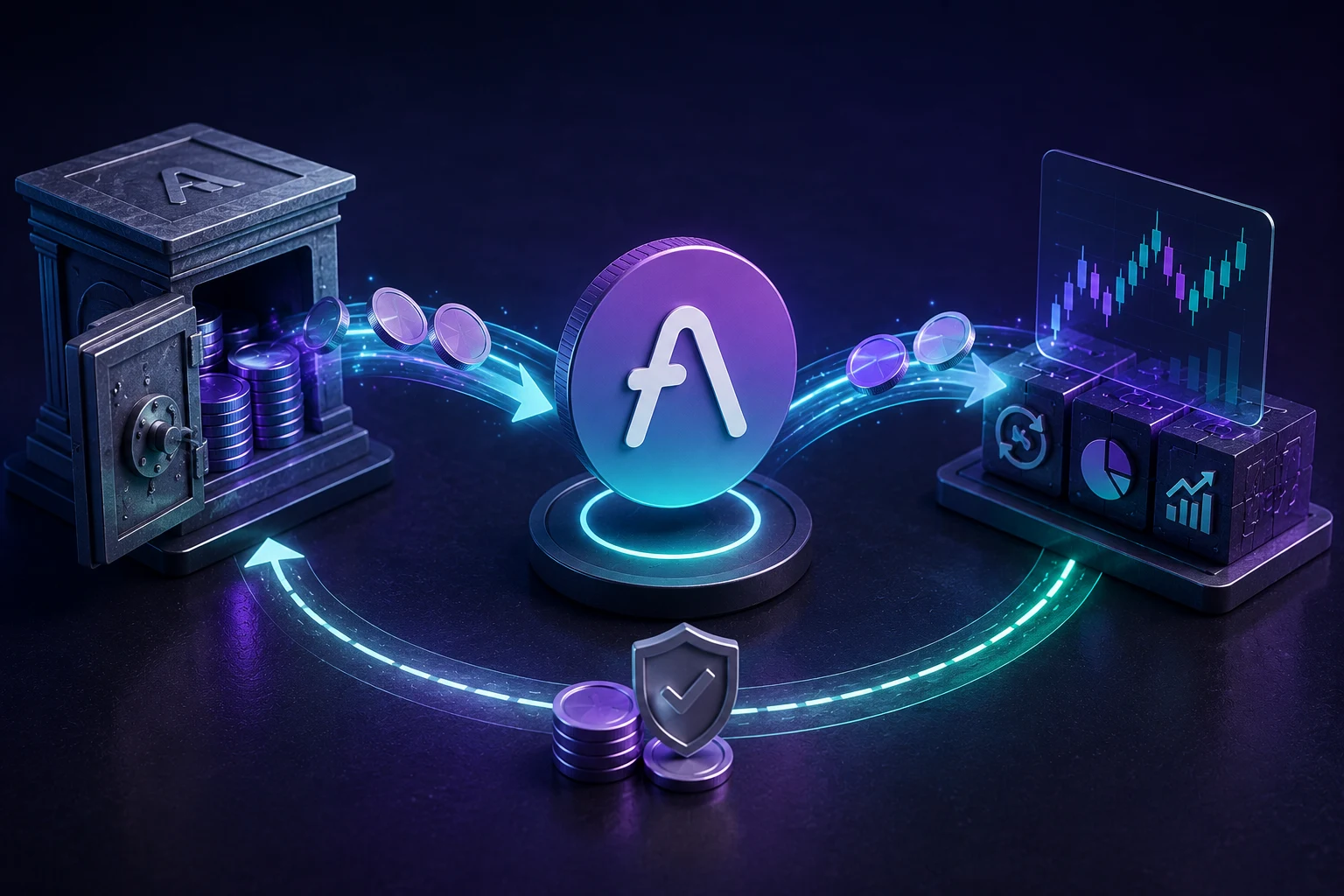
The idea is simple: instead of matching individual lenders with individual borrowers, both sides interact with a shared pool. Lenders deposit assets like USDC, ETH, or wBTC and earn interest paid by borrowers. Borrowers post other assets as collateral and draw the assets they want against it. The pool keeps the books, sets the interest rates, and enforces the rules — no bank, no underwriter, no waiting.
How it works
Three mechanics drive the protocol.
The pool model
For each supported asset, Aave maintains a pool. When you deposit, you receive an aToken — an interest-bearing receipt that increases in value as borrowers pay interest. Withdraw any time the pool has liquidity.
Over-collateralization
Borrowers post collateral — say ETH — and can borrow a fraction of its value in another asset — say USDC. The maximum is set by the asset's loan-to-value ratio. There is no credit check because the collateral does the job. If the value of your collateral falls or the value of your borrow rises so that you cross a liquidation threshold, anyone can step in to pay back part of your loan and seize part of your collateral at a discount. That keeps lenders whole.
Floating interest rates
Interest rates on each asset float with utilization — the share of the pool that is currently borrowed. Low utilization means cheap borrows and small lender yield; near-full utilization spikes both rates to push the pool back into balance. Stable-rate borrowing has also existed historically as a separate mode.
The AAVE token
AAVE is the protocol's governance token. Holders vote on proposals — adding new assets, adjusting risk parameters, deciding on new chain deployments. It also plays a second role: holders can stake AAVE in the safety module, which earns rewards and acts as a backstop. If the protocol ever suffers a shortfall — a bad debt event a liquidation could not cover — staked AAVE can be partially slashed to make depositors whole.
This makes the token economically tied to the protocol's risk, not just a governance ticket. Buying AAVE for the safety-module yield means accepting a tail risk of being slashed in an emergency.
Real use cases
- Earning yield on idle assets. Deposit stablecoins or major assets and earn whatever rate the market sets that day.
- Borrowing without selling. Lock up an asset you want to hold (ETH, wBTC) and borrow stables to spend or redeploy — keeping exposure to the collateral.
- Leverage loops. Sophisticated users borrow against an asset, swap into more of the same, redeposit, and repeat — concentrating exposure. This is high-risk and amplifies liquidation chance.
- Flash loans. Aave pioneered uncollateralized loans that exist only inside a single transaction. They are used for arbitrage, refinancing, and other atomic operations where the borrowed funds are returned by the end of the transaction.
Risks worth knowing
Aave is one of the most-audited and longest-running protocols in DeFi, but lending risk is structural, not just code-level.
- Liquidation. The fastest way to lose money on Aave is to borrow too aggressively, then watch your collateral price drop. A flash crash can liquidate you before you have time to add collateral.
- Oracle risk. The protocol relies on price oracles to value collateral. A bad price feed — manipulation or downtime — can wrongly liquidate users or let bad debt slip through.
- Smart-contract risk. Aave has been audited many times and run for years, but no codebase is unhackable. New features and new asset listings broaden the attack surface.
- Listing-specific risk. Each supported asset has its own risk parameters. A volatile or thinly traded asset is more dangerous as collateral than ETH or USDC, and bad-debt incidents have come from exotic listings before.
- Stablecoin risk. A stablecoin you borrow can de-peg, leaving you with debt valued differently than you assumed. A stablecoin you supply can also de-peg, hitting your principal.
None of this is financial advice. Aave is genuinely useful but it is not a savings account, and a borrow position needs active management — not set-and-forget.
Following Aave with the right lens
Aave headlines move on three vectors: governance votes that change risk parameters or add assets, market events that approach liquidation cascades, and the broader stablecoin landscape it depends on. Each one has different stakes. Zippfeed surfaces Aave-related headlines with sentiment and importance scoring across sources, so you can tell whether a parameter change is shipping or being debated, and whether a stablecoin tremor is the kind that ripples into Aave's pools. This is education, not financial advice — but the holders who manage borrow health calmly are the ones reading the protocol, not just the chart.

 CryptoSlate
 CoinTelegraph
 WatcherGuru
 CoinDesk