








 CoinDesk

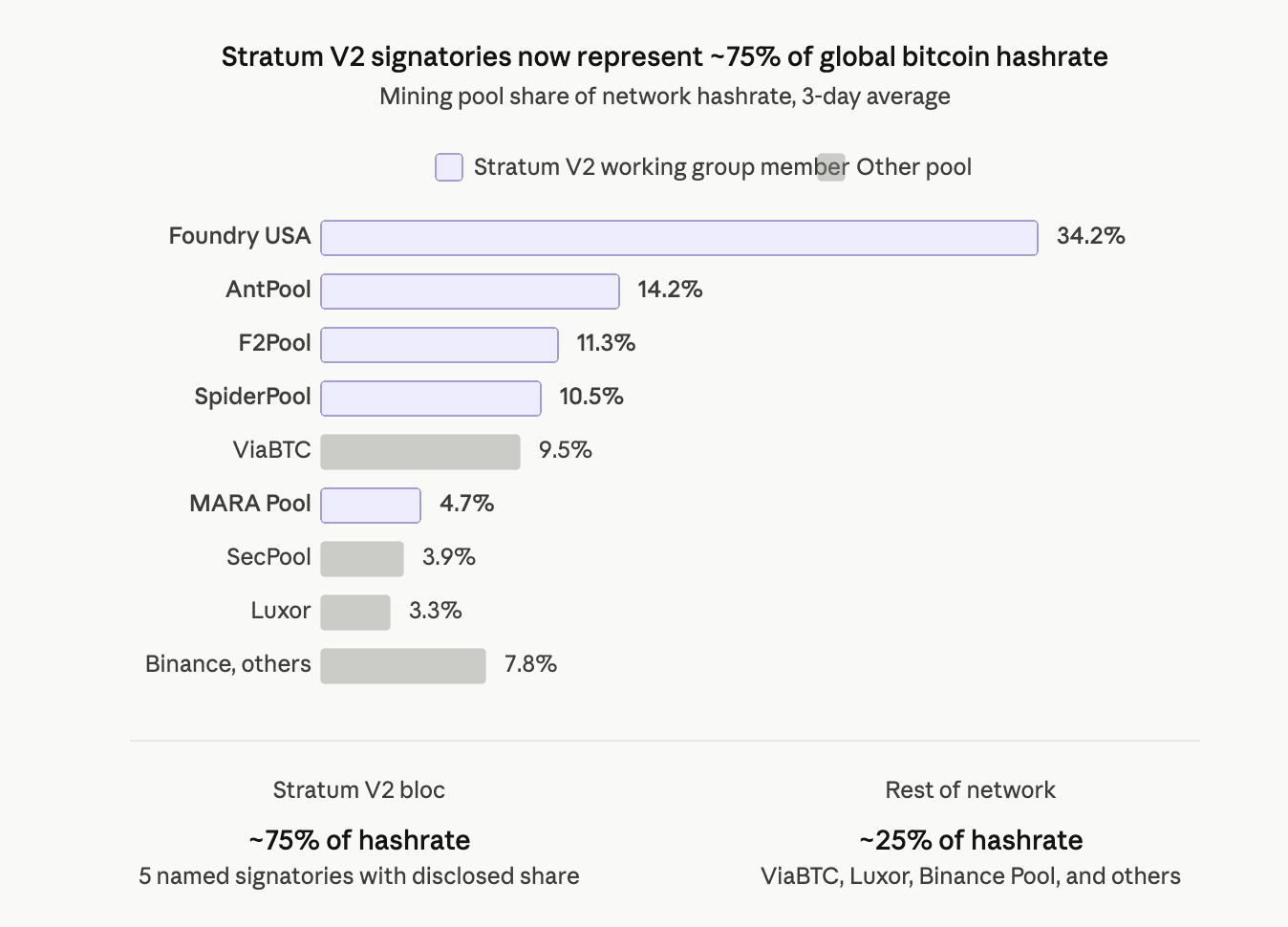
Seven of the world's largest bitcoin mining pools — Foundry, AntPool, F2Pool, SpiderPool, MARA Pool, Block Inc, and DMND — have joined the Stratum V2 working group, putting close to 75% of global hashrate behind a protocol that hands block construction decisions back to individual miners. Foundry alone controls 34.2% of global bitcoin hashrate, AntPool another 14.2%, F2Pool 11.3%, SpiderPool 10.5%, and MARA Pool 4.7%, per Hashrate Index data.
Stratum V2 is an open-source protocol governing how mining pools communicate with the individual miners in those pools. Its biggest practical change is letting miners construct their own block templates — the choice of which transactions get included in each new block sits with the miner, not the pool operator. Under Stratum V1, that decision has sat with pool operators for nearly every new block, the loudest structural complaint about modern mining for the past two years.
Why it matters
The protocol has existed since 2022, when Braiins and Spiral co-founded the working group, but until now it was treated as a niche project with limited adoption. Foundry and AntPool joining gives Stratum V2 real reach for the first time, and the working group is framing this as the start of an accelerated deployment phase rather than another working-group expansion.
The shift doesn't change hashrate concentration — Foundry still controls more than a third of network hashrate — but it changes who decides what goes into each block. That's the distinction bitcoin's developer community has actually been pressing on: a single pool over 30% of hashrate is uncomfortable, but the same pool deciding transaction order for that share of blocks is the actual systemic risk.
Market impact
The timing lands against a strained mining economy. CoinShares estimates up to 20% of miners are currently unprofitable, with hashprice sitting at $38.57 per petahash per second per day — at or near breakeven for mid-generation hardware. Network difficulty is set to rise again on May 15 from 132.47T to 135.64T per CoinWarz, and network hashrate now sits at 998 exahash per second, near all-time highs.

Frequently asked questions
-
What is Stratum V2 and how does it differ from Stratum V1?
Stratum V2 is an open-source protocol for how mining pools communicate with individual miners. Its biggest change is letting miners construct their own block templates — under Stratum V1, pool operators chose which transactions went into nearly every new block, while Stratum V2 returns that decision to the individual…
-
How much bitcoin hashrate is now behind Stratum V2?
Close to 75% of global bitcoin hashrate is now represented by the seven pools that have joined the Stratum V2 working group, per Hashrate Index data: Foundry (34.2%), AntPool (14.2%), F2Pool (11.3%), SpiderPool (10.5%), and MARA Pool (4.7%), with Block Inc and DMND also signing on.
-
Does Stratum V2 reduce hashrate concentration in bitcoin mining?
No. Stratum V2 doesn't redistribute hashrate — Foundry still controls more than a third of global hashrate on its own. What it changes is who decides which transactions get included in each block, shifting that authority from pool operators to individual miners.
-
When was Stratum V2 first developed and why is adoption accelerating now?
Stratum V2 has existed since 2022, when Braiins and Spiral co-founded the working group, but until recently it was treated as a niche project with limited adoption. The working group is framing the addition of Foundry and AntPool as the start of an accelerated deployment phase.
-
How does the current mining economy affect Stratum V2 adoption?
CoinShares estimates up to 20% of bitcoin miners are currently unprofitable, with hashprice at $38.57 per petahash per second per day — near breakeven for mid-generation hardware. The seven pools backing Stratum V2 represent the operators with the most reach during the tightest stretch of the mining cycle.
 Altcoin Daily
 Crypto Capital Venture
 CryptoSlate
 Crypto News
 TheBlock
 Crypto Rank News
 Glassnode