


 CryptoSlate


LlamaRisk’s Oct. 23 pre-listing review says Babylon’s proposed native Bitcoin market for Aave V4 still depends on WBTC for some liquidation payments. A direct keeper route can bypass the Hub’s WBTC funding constraint, but it does not remove the need to repay debt or cover any application fee and borrower-surplus payment. Published addresses checked Oct. 25 still pointed to Sepolia rather than Ethereum mainnet.
Why it matters
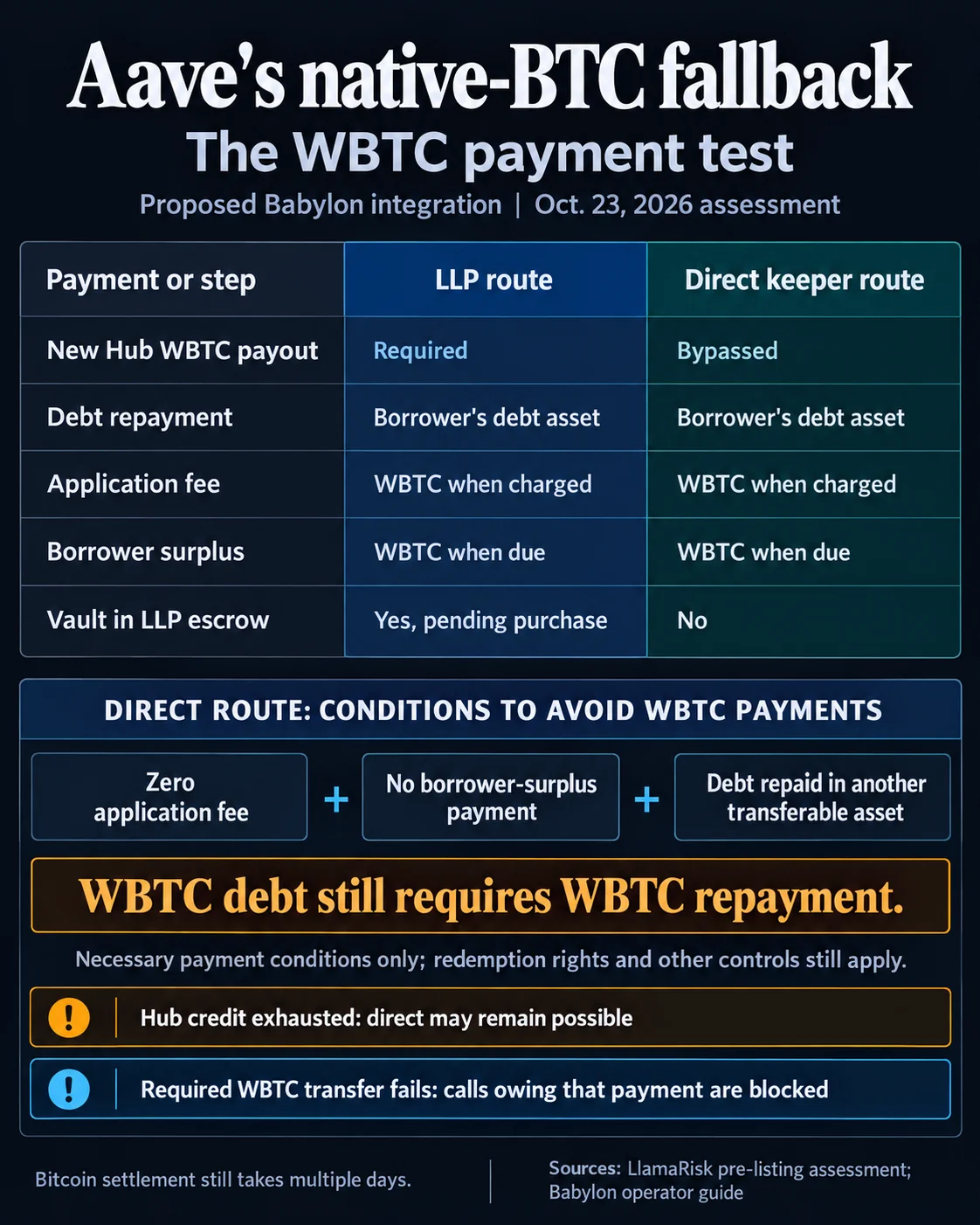
The proposal keeps native BTC in Bitcoin vaults while Aave tracks the collateral through a restricted internal ERC-20 accounting record. Under the Liquidation Liquidity Provider route, an outside liquidator repays the borrower’s debt and receives WBTC from the shared Hub through the BTCVaultSwap settlement component. The seized vault remains in escrow while an eligible buyer handles redemption on Bitcoin.
The direct route is designed for an authorized keeper with the vault’s committed Bitcoin redemption rights. That keeper can fund the debt repayment itself and take the vault into redemption without the Hub-funded payout or escrow step. The trade-off is a narrower pool of eligible operators, each of which must hold the required assets and finance the multi-day Bitcoin proof-and-challenge process.
Market impact
The payment dependency remains even when the application fee is set to zero and no borrower fairness payment is due. A WBTC-denominated loan still requires WBTC repayment. If a whole vault is seized and its value exceeds the debt cleared, the keeper may also owe the borrower a WBTC surplus at the liquidation-bonus discount.
LlamaRisk recommends an initial 100 WBTC Core Hub credit line for BTCVaultSwap, separate from the proposed 300 BTC collateral cap. The rollout described in the assessment would begin with 10 allowlisted borrowers and 50 vaults. Final fee settings, debt assets and vault composition will determine how far the direct fallback can extend, while any fee change would require a time-locked Babylon parameter update.



Frequently asked questions
-
Why does Babylon’s Aave market still need WBTC for liquidations?
WBTC is required to repay a WBTC-denominated loan and may also cover Babylon’s application fee or a borrower-surplus payment. The direct route does not remove those transfer requirements.
-
How does the direct liquidation route differ from the LLP route?
The direct route lets an authorized keeper fund repayment and take the seized vault into Bitcoin redemption without a Hub-funded payout or escrow step. The LLP route uses the shared Hub to pay an outside liquidator in WBTC.
-
What happens when the Aave Hub runs out of WBTC capacity?
A keeper with the required assets and Bitcoin redemption rights can potentially fund the liquidation outside the Hub. That fallback narrows participation to eligible operators able to finance the transaction.
-
Why can a borrower-surplus payment arise during liquidation?
Each Bitcoin vault is indivisible. If a liquidator takes a whole vault and clears the borrower’s debt before consuming the vault’s value, the remaining value can create a WBTC fairness payment to the borrower.
-
Has Babylon’s Aave integration reached Ethereum mainnet?
The assessment said the integration contracts had not been deployed on Ethereum mainnet. Published addresses checked Oct. 25 were identified as Sepolia testnet deployments.
 CoinDesk
 WuBlockchain
 CoinTelegraph
 WatcherGuru
 TheBlock