


 CryptoSlate


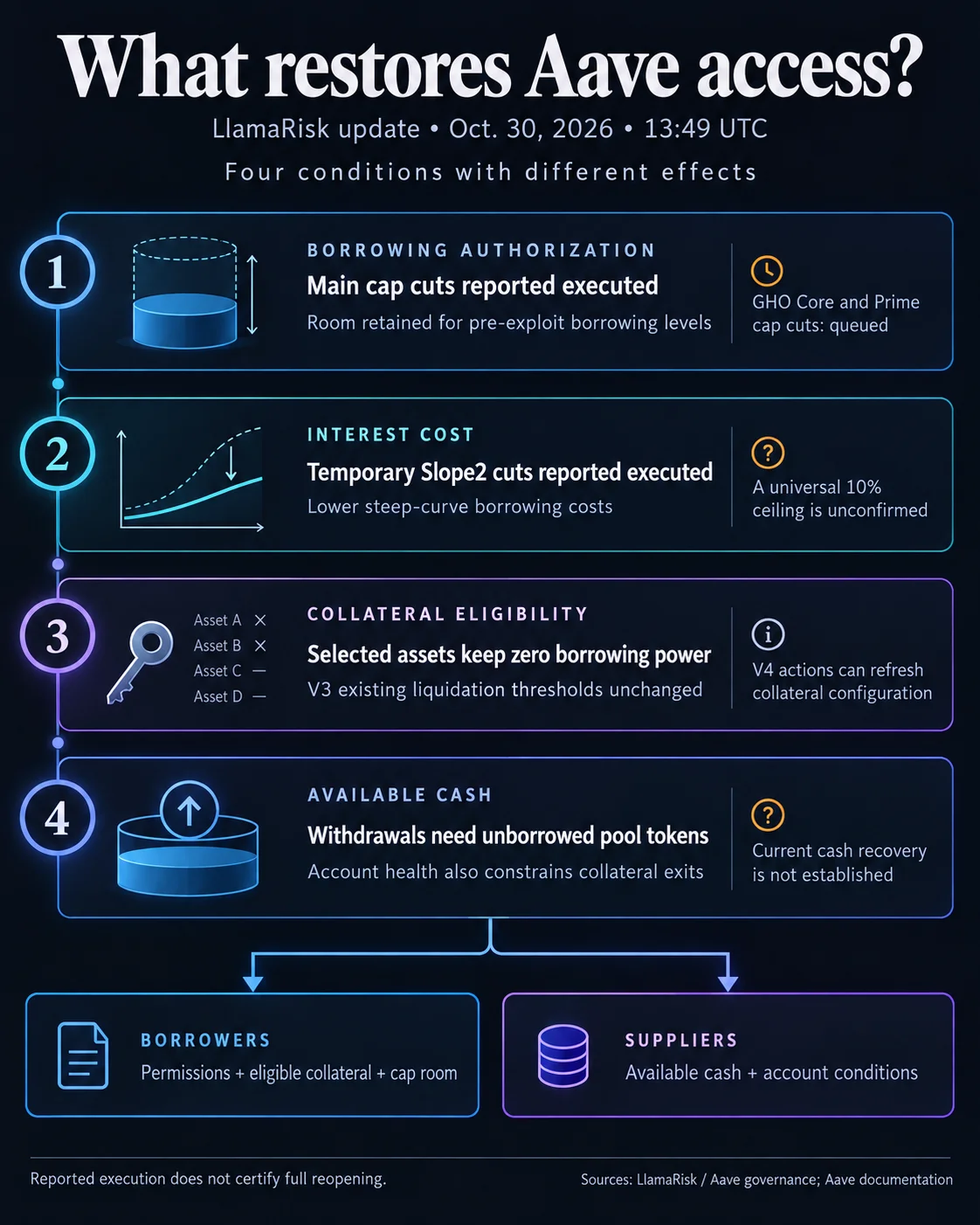

Aave has reopened frozen markets while keeping selected collateral at zero borrowing power, limiting new loans against those assets. LlamaRisk said its main borrowing-cap and interest-rate batches executed, preserving room for earlier borrowing while removing about $3.8 billion of unused capacity. Proposed GHO cap cuts on Aave Core and Prime remained queued.
Why it matters
The caps aim to leave borrowing ceilings above pre-exploit levels without restoring all the spare capacity that existed before the Oct. 29 emergency freeze. For USDT, the listed cap is 2.56 billion, just 55.3 million above borrowing before the exploit. For USDC, the 2.27 billion cap is 54.1 million above that earlier borrowing level. Debt repayments can create more room under the same caps.
The queued GHO changes would lower the Core cap from 150 million to 105 million and the Prime cap from 85 million to 35 million, a combined 95 million reduction. LlamaRisk also reported temporary reductions to the steep section of borrowing-rate curves, but its materials do not establish a verified universal 10% ceiling. Modeled full-utilization rates vary by reserve, and figures for Plasma GHO conflict between the summary and specification.
Market impact
Reopening does not guarantee that suppliers can withdraw or borrowers can access new funds. Withdrawals depend on available, unborrowed pool liquidity, and users securing loans with deposits must keep their accounts healthy. At 00:26 UTC on Oct. 30, LlamaRisk reported Core USDC utilization of 97.8%, while several other reserves were at 100%.
Selected assets, including USDT, USDC, USDT0, POL, WAVAX, sAVAX, XAUt, PAXG and OP, retain zero borrowing power as collateral for new borrowing under the described plan. Existing positions face different treatment: on V3, unchanged liquidation thresholds mean the LTV reduction alone does not alter health factors; on V4, certain position changes move users onto the zero-factor configuration. Reserve-level settings, liquidity and account conditions will shape the practical effect of the reopening.





Frequently asked questions
-
How much unused borrowing capacity did Aave's emergency caps remove?
LlamaRisk estimates the cap cuts removed roughly $3.8 billion of unused capacity while preserving room for earlier borrowing.
-
What borrowing room remains under the listed USDT and USDC caps?
The USDT cap is 2.56 billion, 55.3 million above pre-exploit borrowing. The USDC cap is 2.27 billion, 54.1 million above its pre-exploit level.
-
How would the queued GHO cap changes affect Core and Prime?
The proposed changes lower Core's cap from 150 million to 105 million GHO and Prime's from 85 million to 35 million, a combined reduction of 95 million GHO.
-
Does reopening Aave markets ensure suppliers can withdraw their funds?
No. Withdrawals are limited to available, unborrowed pool liquidity, and suppliers whose deposits secure loans must also maintain healthy positions.
-
Why is a universal 10% borrowing-rate ceiling not confirmed?
LlamaRisk's modeled full-utilization rates vary across reserves, and its Plasma GHO figures conflict between the summary and specification. Its later execution update does not identify which conflicting settings were deployed.
 WuBlockchain
 WatcherGuru
 CoinDesk
 Lookonchain