








 CoinDesk

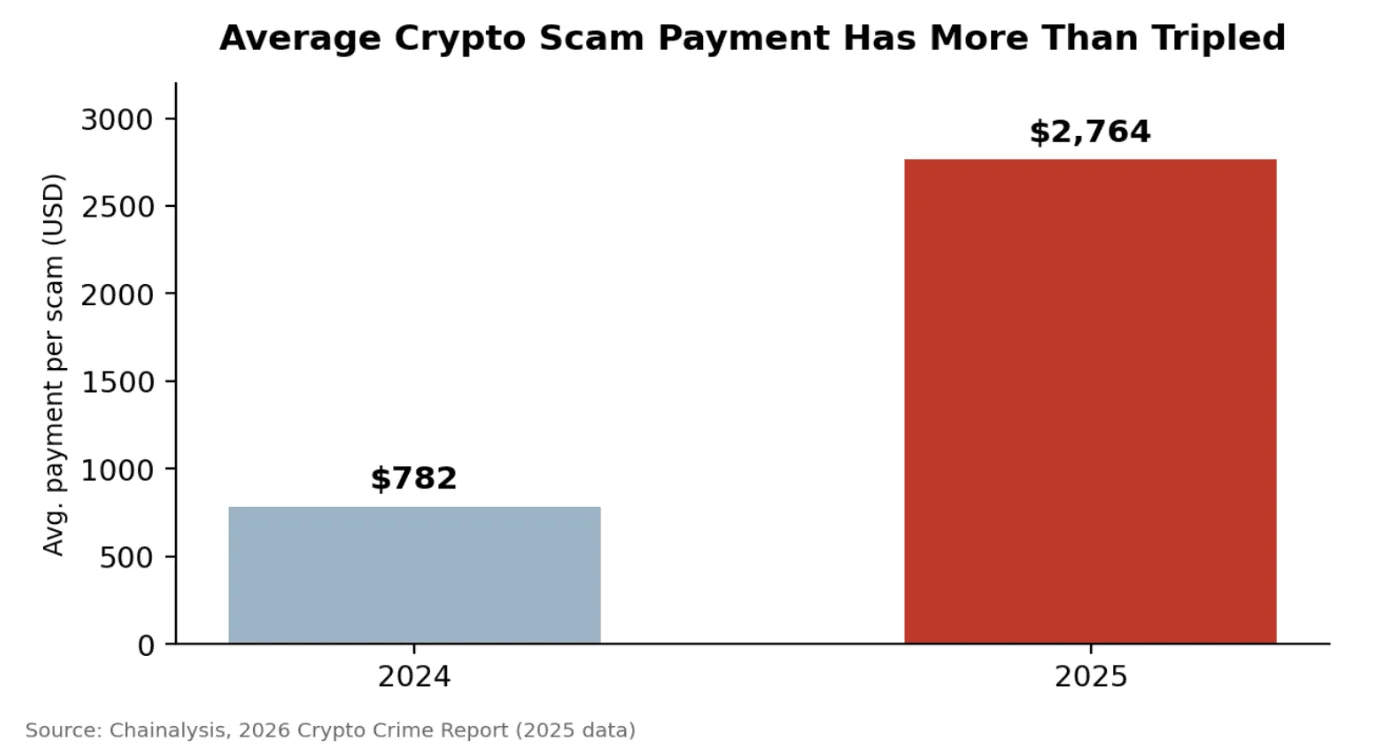

AI has collapsed the cost of convincing fraud, and the crypto sector is paying the bill. Chainalysis data cited in CoinDesk's Crypto for Advisors newsletter shows AI-linked scam operations running roughly 4.5 times more profitable than their non-AI counterparts, with the average crypto scam payment more than tripling year over year to $2,764. The FBI's Internet Crime Complaint Center logged a record $20.9 billion in 2025 cybercrime losses, with cryptocurrency the most common payment channel, and Chainalysis estimates up to $17 billion flowed to crypto scams over the period. Impersonation scams alone rose about 1,400% on Chainalysis's measure, while "pig butchering" relationship-driven scams cost victims $7.2 billion in 2025.
Why it matters
The threat is no longer a sloppy phishing email or a wallet-drainer popup. Real-time face-swap tools, voice cloning and large language models let a bad actor convincingly impersonate an advisor, a fund principal or a support agent on live video. The traditional test of "hopping on a call" to verify a counterparty is no longer sufficient when the voice and face on the other end can be synthesized. The scale shift means identification is now an arms race the defender is structurally losing; verification, separation of duties and reconciliation are the controls that survive even a perfect deepfake.
Market impact
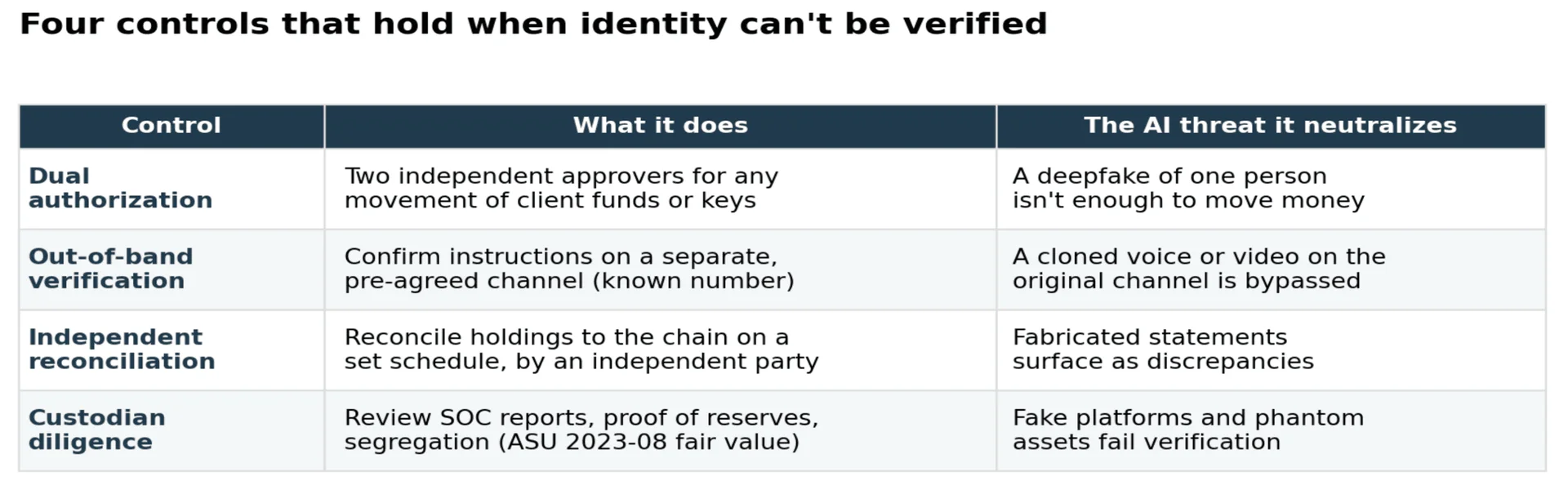
For advisors, the SEC's custody rule under the Investment Advisers Act still holds regardless of how a fraud was executed. Practical controls include dual authorization on any asset movement, out-of-band verification through a separate pre-agreed channel, and independent reconciliation of on-chain balances performed by someone other than the transaction initiator. ASU 2023-08, which requires fair-value reporting of crypto holdings, gives advisors more disclosure to request from custodians, including SOC reports, proof of reserves and segregation practices. Industry voices also point toward programmable smart accounts under ERC-4337 and EIP-7702, where automated guardrails can block risky approvals before funds move, rather than react after.
Frequently asked questions
-
How much more profitable are AI-driven crypto scams than traditional ones?
Per Chainalysis data cited in the CoinDesk newsletter, AI-linked scam operations generate roughly 4.5 times the revenue of non-AI counterparts, with average scam payments tripling year over year to $2,764.
-
What is the total scale of AI-era crypto fraud in 2025?
The FBI's Internet Crime Complaint Center logged a record $20.9 billion in 2025 cybercrime losses with cryptocurrency the top payment rail. Chainalysis estimates up to $17 billion flowed to crypto scams, with impersonation scams rising about 1,400% and pig-butchering schemes alone costing victims $7.2 billion.
-
Why can't visual or audio verification stop deepfake impersonation anymore?
Real-time face-swap tools, voice cloning and LLMs now let attackers convincingly impersonate an advisor, fund principal or support agent on live video. Chainalysis's 1,400% rise in impersonation scams reflects that "hopping on a call" is no longer a reliable control.
-
What control framework do advisors apply to digital-asset workflows under AI fraud?
Dual authorization on any asset movement, out-of-band verification through a separate pre-agreed channel, independent on-chain reconciliation performed away from the transaction initiator, and custodian diligence on SOC reports, proof of reserves and segregation, with ASU 2023-08 providing fair-value disclosure to…
-
Can smart-account automation help automate fraud defense at the wallet level?
Yes. Programmable smart accounts under ERC-4337 and EIP-7702 let managers write automated guardrails directly at the account: warnings before signing, continuous wallet monitoring, instant alerts on abnormal activity, and automatic blocking of risky approvals before funds move, with human escalation for edge cases.
 CryptoSlate
 CoinTelegraph
 WuBlockchain
 TheBlock
 Lookonchain