








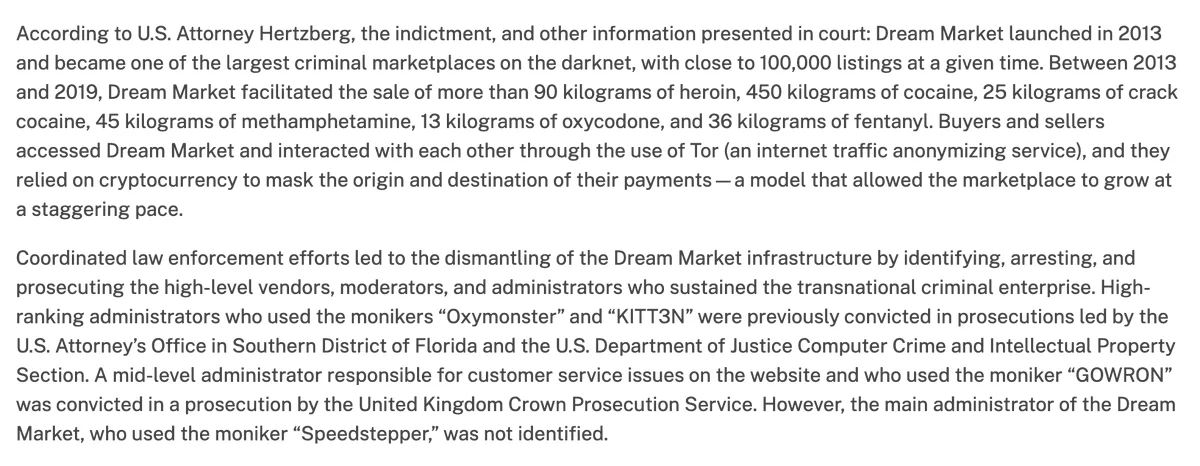

The U.S. Department of Justice charged German citizen Owe Martin Andresen, the alleged main administrator of darknet marketplace Dream Market, with laundering more than $2 million in crypto proceeds. Prosecutors said he moved funds from dormant Dream Market wallets and used the proceeds to purchase gold bars that were shipped to Germany. Authorities seized roughly $1.7 million in gold bars, alongside cash and additional crypto-linked assets.
Why it matters
The case is less about the dollar figure — $2 million is small for a DOJ darknet prosecution — and more about the conversion path it documents. Dormant marketplace wallets had been sitting untouched, then reactivated to fund purchases of physical gold shipped across the Atlantic. That sequence is exactly the kind of off-ramp layering pattern compliance teams and blockchain-analytics firms have been modelling for years, and a successful prosecution gives U.S. and European authorities a clean template to point to in subsequent cases.
Market impact
The case is unlikely to move token prices directly, but it reinforces two long-running pressures on the sector: tighter scrutiny of dormant-wallet movements by exchange compliance teams, and continued U.S.–European coordination on cross-border crypto-to-physical-asset laundering. Expect analytics firms to flag the case as a reference example when marketing tracing tools to regulated venues.
Source: [source](https://www.justice.gov/usao-ndga/pr/german-citizen-charged-laundering-funds-linked-prominent-darknet-marketplace-dream)
Frequently asked questions
-
Who was charged in the Dream Market case?
German citizen Owe Martin Andresen, alleged by the DOJ to be the main administrator of darknet marketplace Dream Market, was charged with laundering more than $2 million in crypto proceeds.
-
How did the alleged laundering work?
Prosecutors say Andresen moved funds from dormant Dream Market wallets and used the crypto proceeds to purchase gold bars that were shipped to Germany, converting digital proceeds into a physical asset across the Atlantic.
-
What did authorities seize?
The DOJ announced the seizure of roughly $1.7 million in gold bars, along with cash and additional crypto-linked assets tied to the alleged scheme.
-
Why does this case matter beyond the dollar figure?
$2 million is small for a DOJ darknet prosecution. The substance is the documented conversion path — dormant marketplace wallets reactivated, then routed into physical gold shipped across borders — giving U.S. and European authorities a clean enforcement template to cite in future cases.
-
What is the likely market or compliance impact?
No direct token-price impact is expected, but the case is likely to tighten scrutiny of long-dormant wallet movements by exchange compliance teams and reinforce U.S.–European coordination on cross-border crypto-to-physical-asset laundering investigations.

 CryptoSlate
 CoinTelegraph
 CoinDesk
 TheBlock
 Crypto News