








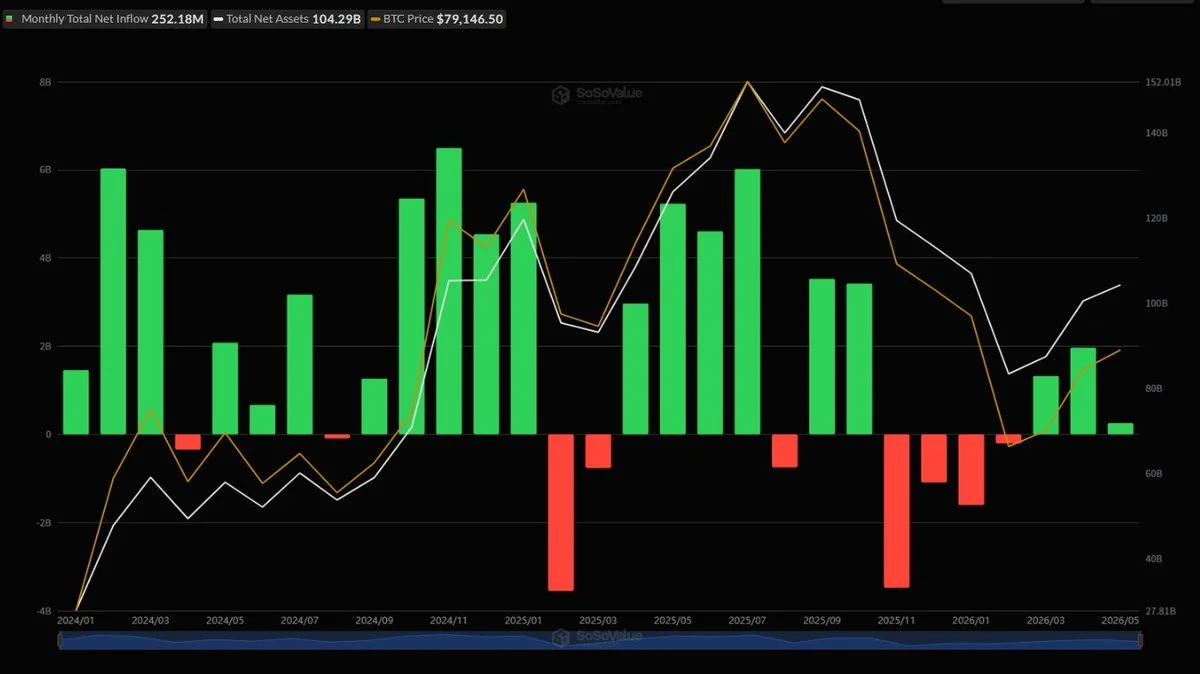

U.S. spot Bitcoin ETFs recorded a total net outflow of $290 million on May 15, according to SoSoValue data, with none of the 12 funds posting net inflows. The print marks a clean risk-off session for the wrapper complex, with the entire cohort bleeding in unison rather than a single name driving the move.
Why it matters
A zero-positive day across all twelve issuers is the kind of tape that signals broad de-risking, not name-specific redemption pressure. When even the most liquid, lowest-fee products print outflows on the same day, the move usually reflects institutional rebalancing or macro deleveraging rather than dissatisfaction with any one vehicle. Spot Bitcoin ETFs had spent the prior several weeks oscillating between modest inflows and small outflows, so a $290M single-day drain stands out as an acceleration.
Market impact
The Bitcoin weakness was mirrored in the Ethereum book: spot Ether ETFs shed $65.65M, the fifth consecutive day of net outflows. A five-day streak in either product tends to weigh on the underlying spot, and the ETH fund complex has been the weaker of the two throughout the current cycle. Watch tomorrow's print — back-to-back zero-positive sessions for spot BTC ETFs would confirm that the bid from the wrapper complex has thinned, while a return to inflows would frame May 15 as a one-day macro shakeout rather than a regime change.


Frequently asked questions
-
How much did spot Bitcoin ETFs lose on May 15?
U.S. spot Bitcoin ETFs recorded a total net outflow of $290 million on May 15, according to SoSoValue data, with none of the 12 funds posting net inflows.
-
Did any spot Bitcoin ETF see inflows that day?
No. All twelve U.S. spot Bitcoin ETFs printed net outflows on May 15, an unusually clean risk-off session for the wrapper complex.
-
How long have spot Ethereum ETFs been in outflow mode?
Spot Ether ETFs posted a $65.65 million net outflow on May 15, marking the fifth consecutive day of outflows for the complex.
-
What does a zero-positive day across all Bitcoin ETFs signal?
When every issuer prints outflows on the same tape, the move typically reflects broad institutional de-risking or macro rebalancing rather than dissatisfaction with any single fund.
-
What would invalidate the bearish ETF-flow read?
A return to net inflows on the next session would frame May 15 as a one-day macro shakeout. Back-to-back zero-positive days would confirm that the wrapper bid has structurally thinned.

 WatcherGuru
 CoinTelegraph
 Altcoin Daily
 Lookonchain
 TheBlock
 CoinDesk
 Crypto Capital Venture
 Crypto News
 CryptoSlate