








 Lookonchain

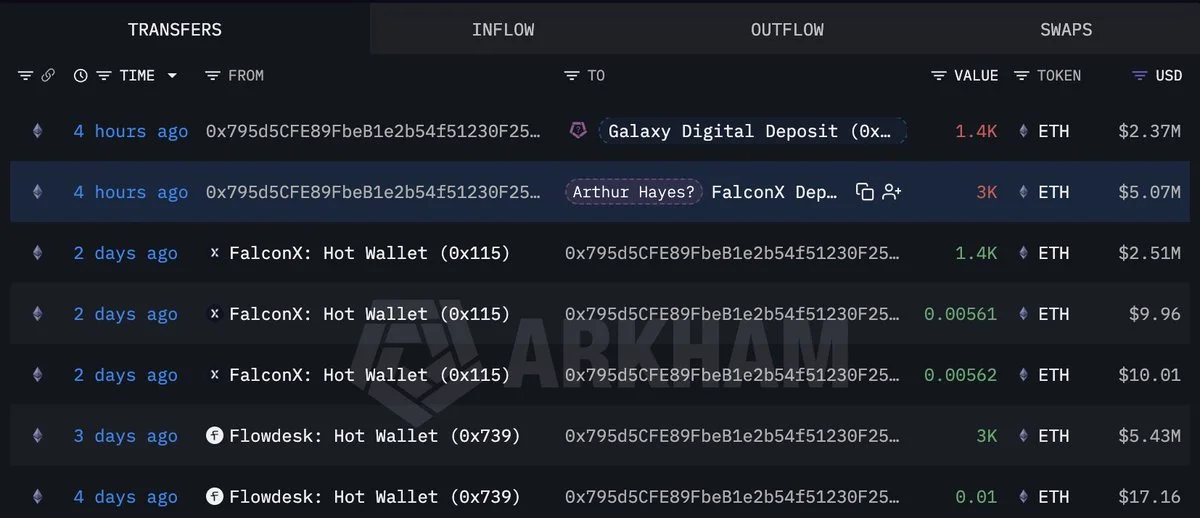
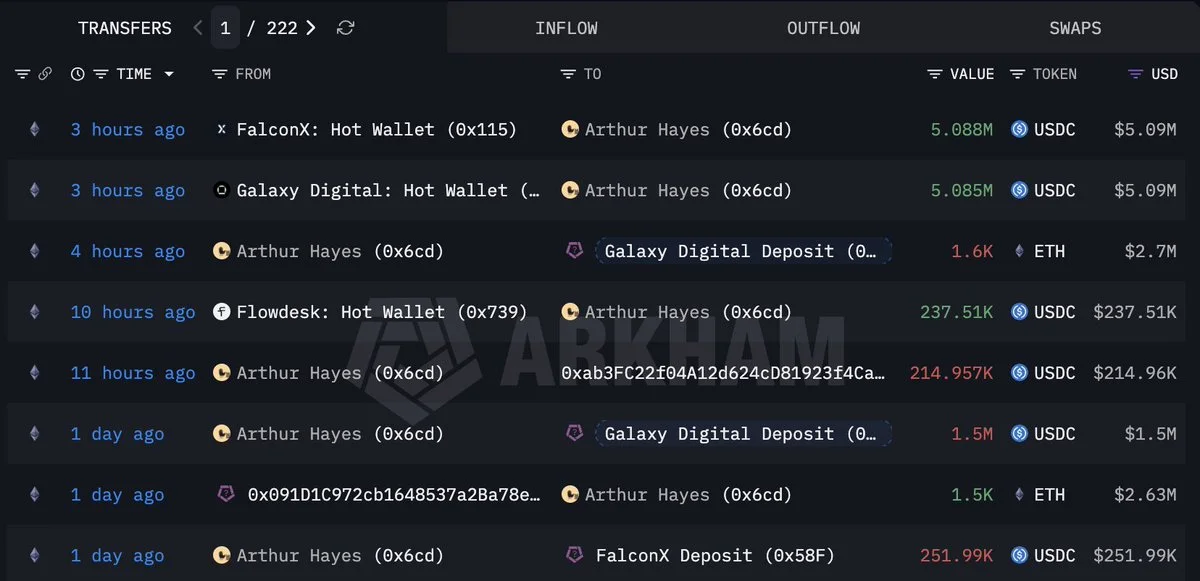
BitMEX co-founder Arthur Hayes accumulated 5,900 ETH ($10.58M) at an average price of $1,793 over the past four days, then sold 6,000 ETH ($10.14M) at $1,690 roughly four hours ago, locking in a $606K loss on the round trip.
Why it matters
Hayes has built a public track record of mistiming ETH entries and exits, and the latest sequence fits the pattern. He added aggressively as price drifted, then cut exposure into a weaker print almost immediately. For followers who treat his wallet as a signal, the read is the opposite of conviction — a forced de-risk or a stop-out, not a directional call.
Market impact
The flow is small relative to ETH's daily turnover, so the trade itself is unlikely to move the tape. The informational value sits with the positioning read: a high-profile whale exiting a freshly built ETH long at a loss in the same four-hour window is the kind of tape-reading signal short-term traders use to fade follow-on bids. Watch whether the wallet reloads on any bounce — that would confirm dip-buying intent rather than capitulation.

Frequently asked questions
-
How much did Arthur Hayes lose on his latest ETH trade?
He locked in a $606K loss after buying 5,900 ETH at an average of $1,793 and selling 6,000 ETH at $1,690 within roughly four hours.
-
Why is this trade notable if the dollar value is small?
The dollar size is modest relative to ETH's daily turnover, but the timing matters: a high-profile whale exited a freshly built long at a loss inside a four-hour window, which short-term traders often read as a forced de-risk rather than a conviction sale.
-
Does Arthur Hayes's ETH trading actually move the market?
Not directly — 6,000 ETH is a small fraction of daily ETH volume. The signal value is the positioning read for traders who follow his wallet as a sentiment indicator.
-
Has Arthur Hayes mistimed ETH positions like this before?
He has a public track record of poor ETH entries and exits, and the latest sequence — buying into a drift, then selling into a weaker print within hours — fits that pattern.
-
What should traders watch next from his wallet?
Whether the same wallet reloads ETH on any bounce. A reload would confirm dip-buying intent; silence would look closer to capitulation.
 CoinDesk
 WatcherGuru
 Whale Alert
 WuBlockchain
 CoinTelegraph
 TheBlock
 Altcoin Daily
 Crypto Capital Venture