








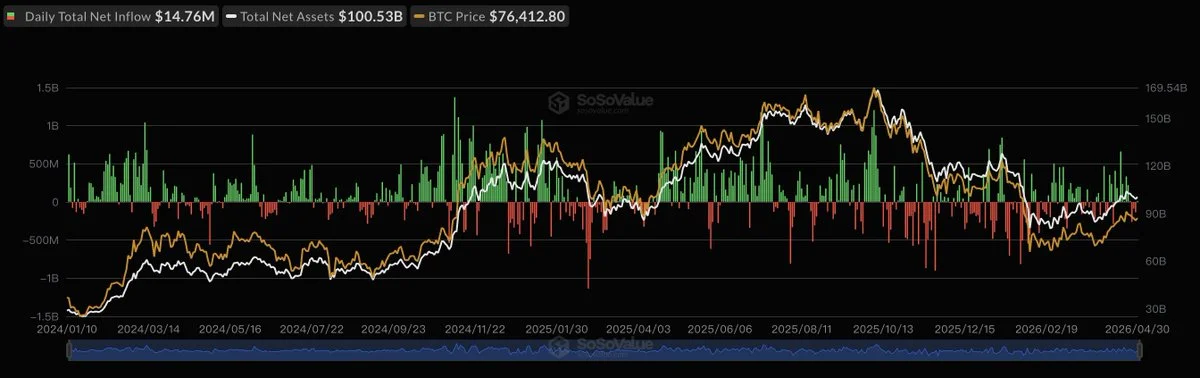
US spot Bitcoin ETFs recorded a total net inflow of $14.76 million on April 30, the first positive session after three consecutive days of net outflows. The single-day figure is modest, but the directional flip is the data point: the redemption pressure that built through the back half of last week has, for now, paused.
Spot Ethereum ETFs told the opposite story. The complex saw $23.64 million in net outflows on April 30, extending the losing streak to four straight sessions. Cumulative redemptions over that window have been steady rather than disorderly, suggesting positioning unwinds rather than forced selling.
The split matters: for most of Q1 the two complexes moved roughly in the same direction, both reacting to the same risk-on / risk-off tape. Two sessions of divergent flows — $BTC back to net positive while $ETH extends its outflow run — is a different setup, and one worth watching for the next several prints before treating it as a durable rotation signal.


Frequently asked questions
-
How much flowed into US spot Bitcoin ETFs on April 30?
Spot Bitcoin ETFs recorded $14.76 million in net inflows on April 30, the first positive session after three consecutive days of net outflows, according to daily flow data.
-
How much flowed out of US spot Ethereum ETFs on April 30?
Spot Ethereum ETFs saw $23.64 million in net outflows on April 30, extending the net outflow streak to four consecutive sessions.
-
Why does the Bitcoin vs. Ethereum flow split matter?
The two complexes had moved roughly in sync for most of Q1, both reacting to the same risk-on / risk-off tape. Two sessions of divergent flows — $BTC back to positive while $ETH keeps bleeding — is a different setup and a potential early signal of a rotation.
-
Is $14.76M a large inflow for spot Bitcoin ETFs?
In absolute terms, no — single-day prints of several hundred million are common. The data point that matters is the directional flip after three straight outflow days, not the size of the single session.
-
What would invalidate the rotation read?
A return to synchronized flows — both complexes positive or both negative on the same tape — would suggest the April 30 split was noise rather than the start of a $BTC-rotation / $ETH-underperformance pattern.

 Glassnode
 CoinDesk
 Lookonchain
 CoinTelegraph