









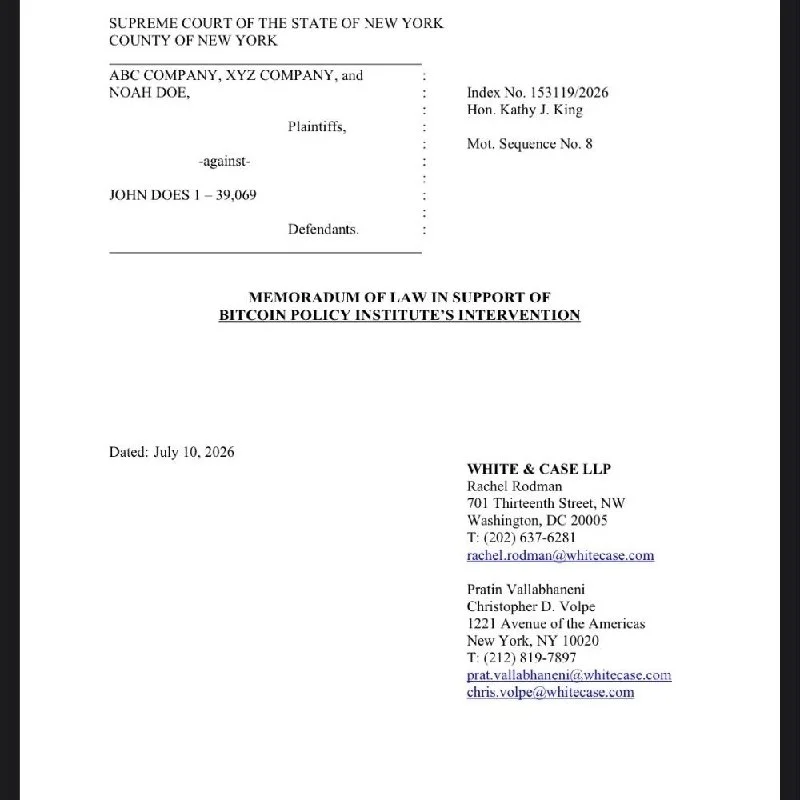
The Bitcoin Policy Institute has joined the legal challenge to a New York City ordinance that would classify self-custodied Bitcoin as abandoned after five years without movement, filing an amicus brief arguing the rule criminalizes ordinary long-term holding.
Why it matters
Under the ordinance, coins untouched in a personal wallet for half a decade could be seized by the city as unclaimed property, regardless of whether the owner is still active or simply HODLing. The Institute's filing frames the rule as a direct conflict with established property-rights doctrine, which already protects digital assets held in self-custody. A ruling in the city's favor would set a precedent that ripples well past NYC, giving any jurisdiction a template for converting dormant wallets into public funds.
Market impact
The self-custody base case for Bitcoin rests on the assumption that a private key is sovereign. A five-year abandonment trigger breaks that assumption, raising the legal risk profile of every cold-storage setup in the country. Watch for the amicus to pull in additional industry voices, and for the case to surface as a talking point at the next state-level Bitcoin policy hearing.

Frequently asked questions
-
What is the NYC Bitcoin ordinance being challenged?
A New York City ordinance that would classify self-custodied Bitcoin held without movement for five years as abandoned property, allowing the city to seize it as unclaimed funds.
-
Why did the Bitcoin Policy Institute get involved?
The Institute filed an amicus brief arguing the rule criminalizes ordinary long-term holding and conflicts with existing property-rights doctrine that protects digital assets held in self-custody.
-
Could the rule affect Bitcoin holders outside NYC?
Yes. A ruling in the city's favor would set a precedent giving any US jurisdiction a template to treat dormant self-custodied wallets as abandoned property subject to seizure.
-
What is the core legal argument against the ordinance?
That an untouched wallet is not evidence of abandonment. Holders may be active investors simply practicing long-term storage, and property law already protects their digital assets held in self-custody.
-
How does this case connect to broader self-custody rights?
The self-custody thesis assumes a private key is sovereign over the underlying Bitcoin. A five-year abandonment trigger breaks that assumption and raises the legal risk profile of every cold-storage setup in the country.

 CoinDesk
 CryptoSlate
 WuBlockchain
 TheBlock
 Altcoin Daily