








 CoinDesk

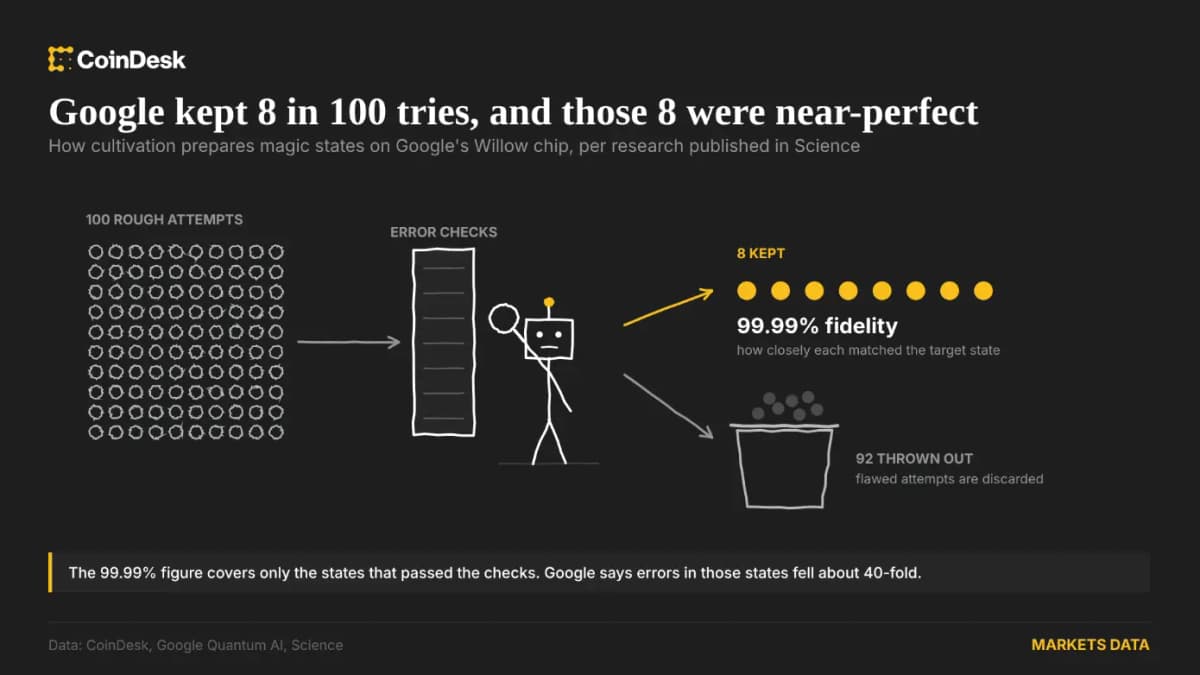

Google's Willow quantum chip cut errors about 40-fold while preparing the special states needed for advanced quantum calculations, a step that could eventually threaten Bitcoin wallets. The experiment reached about 99.99% fidelity among states that passed inspection, but only about 8% of preparation attempts succeeded. The result does not make a Bitcoin attack 40 times cheaper.
Why it matters
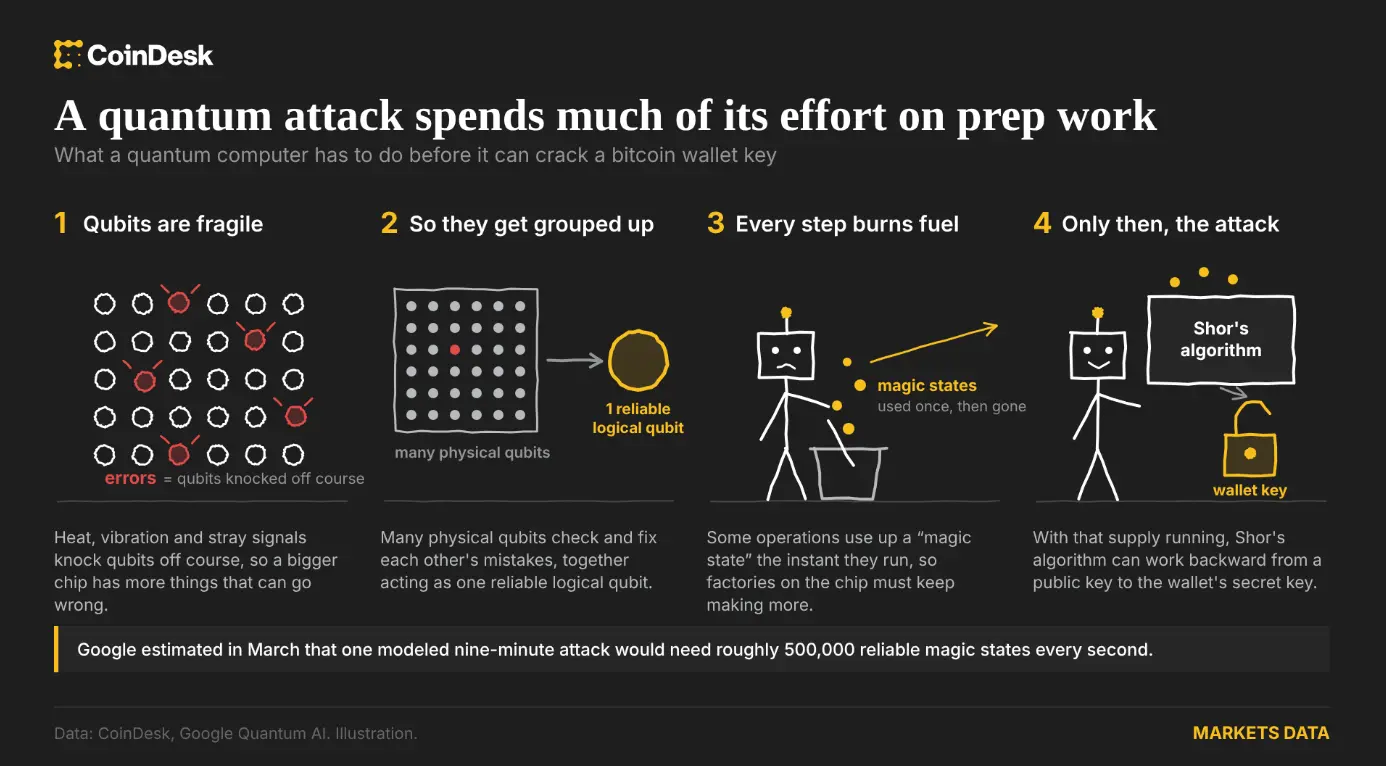
Bitcoin's wallet security depends on the difficulty of deriving a private key from a public key. A sufficiently capable quantum computer running Shor's algorithm could theoretically recover that secret and sign transactions as the owner. Some payment formats hide public keys until coins are spent, but many of Bitcoin's oldest holdings have exposed keys dating back to their mining.
Willow's cultivation method addresses the cost of producing quantum “magic states,” which are consumed during certain calculations. Hardware producing those states cannot be used for other parts of the attack. Under one model, a quantum computer would need roughly 500,000 reliable magic states per second to attack a wallet after its public key becomes available, with the modeled calculation lasting about nine minutes.
Market impact
The immediate market effect is limited because Willow remains far from a demonstrated Bitcoin attack. Scaling the process, operating it in real time and integrating it with stronger error-correction systems remain major challenges. Earlier Google research estimated that a future superconducting quantum computer with fewer than 500,000 physical qubits could break Bitcoin and Ethereum wallet cryptography under specific assumptions, but this experiment tests only part of that engineering path.
The issue is most acute for exposed, inactive coins. A 100.02 BTC holding untouched since 2010 moved after more than 16 years, while six wallets inactive since 2011–2014 moved 553.59 BTC in August. Those transfers do not prove a response to quantum risk, but they show why old public keys remain a live security concern.


Frequently asked questions
-
How does Google's Willow breakthrough relate to Bitcoin security?
Willow reduced errors while preparing quantum magic states, a resource needed for calculations that could eventually derive Bitcoin private keys from exposed public keys.
-
Does Willow make a Bitcoin wallet attack 40 times cheaper?
No. The 40-fold improvement concerns error reduction in one preparation step, not the total cost of attacking Bitcoin wallets.
-
Why are Satoshi-era Bitcoin holdings especially exposed?
Many early Bitcoin holdings have public keys exposed on the blockchain. An attacker with a sufficiently capable quantum computer could theoretically use that information to recover the corresponding private keys.
-
What does the 8% success rate mean in Google's experiment?
About 8% of preparation attempts remained after inspection and measurement. The reported 99.99% fidelity applies only to the states that passed those checks.
-
How much quantum capacity would one modeled Bitcoin attack need?
One model estimated that an attack would require roughly 500,000 reliable magic states per second and could take about nine minutes after a public key becomes available.
 WuBlockchain
 TheBlock
 Crypto News
 CoinTelegraph
 CryptoSlate
 WatcherGuru