


 CoinDesk


Bitcoin recovered to around $74,700 after dropping to roughly $72,700 on Tuesday, as hotter-than-forecast U.S. inflation rattled markets. Consumer prices rose 0.4% last month, and traders priced in a 90% chance of a quarter-point Federal Reserve rate increase, according to CME FedWatch. Crypto futures liquidations jumped 288% to $725 million, CoinGlass data showed.
Why it matters
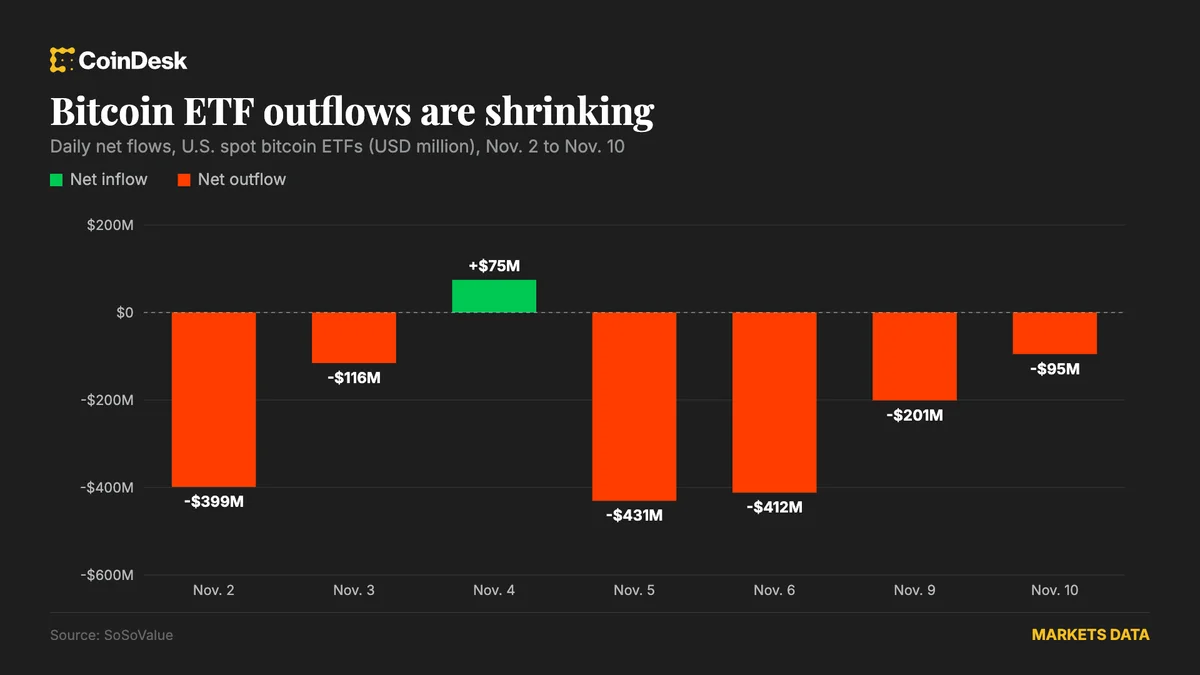
Selling through U.S. spot Bitcoin ETFs slowed, even as the funds recorded a fourth straight day of net outflows. Investors pulled $95 million on Tuesday, down from $201 million on Monday, $412 million on Friday and $430 million on Thursday.
Liquidity indicators remain under pressure. Tether's USDT market capitalization fell $6.6 billion over 60 days, the largest such contraction in CryptoQuant data going back to 2022. The Coinbase Premium, a gauge of U.S. demand for Bitcoin, has been negative for 30 straight days.
Market impact
Bitcoin was hovering around its 200-day moving average near $73,200, which CryptoQuant says separates a shallow correction from a deeper one. The cryptocurrency remained below its 365-day average of $76,400, a level the firm says must be reclaimed to restore a bullish structure.
CryptoQuant's Bull Score Index fell to 20 from 90 on Oct. 13, matching a reading seen before the April 2025 market bottom. The firm cautioned that similar signals can also precede a deeper correction.
Options traders are buying downside protection: eight of the 10 most active Bitcoin contracts on Deribit expiring through Nov. 27 are puts with strikes from $69,000 to $74,000. Implied volatility stood around 36% to 38%.


Frequently asked questions
-
How did inflation affect expectations for Fed interest rates?
After consumer prices rose 0.4% last month, traders priced in a 90% chance of a quarter-point Federal Reserve rate increase, according to CME FedWatch.
-
Are investors still pulling money from spot Bitcoin ETFs?
U.S. spot Bitcoin ETFs posted a fourth straight day of net outflows on Tuesday, losing $95 million. That was less than the $201 million withdrawn on Monday.
-
What does the USDT contraction show about crypto liquidity?
Tether's USDT market capitalization fell $6.6 billion over 60 days, the largest such contraction in CryptoQuant data going back to 2022.
-
Which Bitcoin moving averages is CryptoQuant watching?
CryptoQuant puts the 200-day average near $73,200 and the 365-day average at $76,400. It says reclaiming the latter is necessary to restore a bullish structure.
-
How are Bitcoin options traders positioning for downside risk?
Eight of the 10 most active Bitcoin options on Deribit expiring through Nov. 27 are puts with strikes between $69,000 and $74,000. Implied volatility was around 36% to 38%.
 CryptoSlate
 Crypto News
 Crypto Rank News
 WatcherGuru
 WuBlockchain
 CoinTelegraph