








 CoinDesk
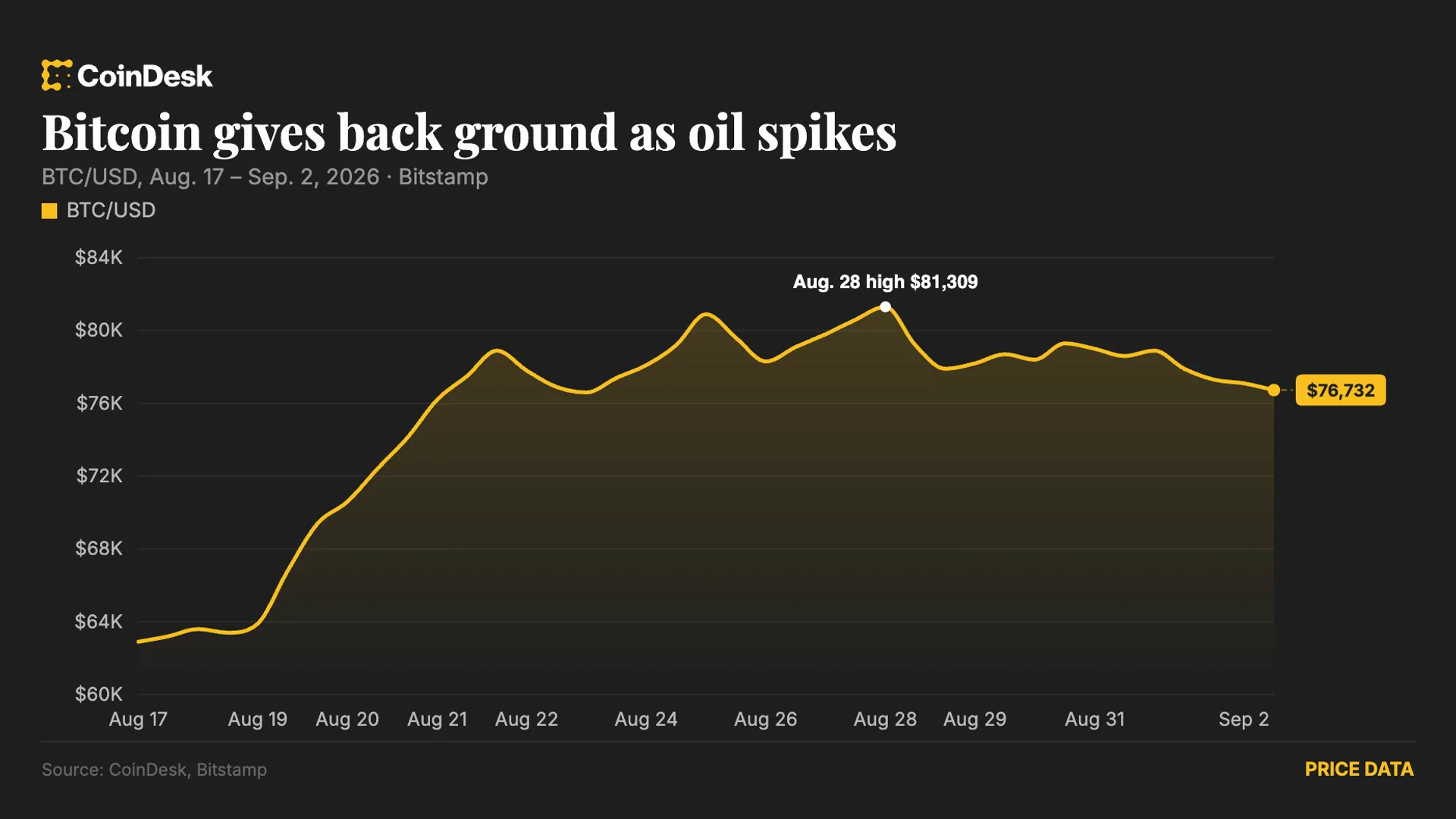


Bitcoin fell below $76,500 on Tuesday, down more than 1% since midnight UTC and 3% over the past seven days, after renewed U.S. strikes on Iranian targets pushed Brent crude past $93 a barrel and West Texas Intermediate toward $90. Higher energy costs lifted the 10-year Treasury yield toward 4.8%, with Nasdaq 100 futures down 0.31% and the Dollar Index up 0.13% since midnight, a textbook risk-off tilt that weighed on BTC alongside equities.
Why it matters
The macro leg is the headline. Brent above $93 has direct implications for imported inflation, which is why the 10-year is grinding toward 4.8% and why the dollar is firming. For Bitcoin, that combination of higher real rates and a stronger dollar usually tightens global liquidity conditions, and BTC is responding in the expected direction.
But the derivatives tape reads calmer than the price action suggests. The 24-hour long-short taker volume ratio has flipped bearish, with shorts accounting for 51.5% of flow according to Coinglass, yet BTC futures open interest has sat unchanged near 700,000 BTC for a second day, well below this year's 801,000 BTC peak. Traders are not leaning into the move with leverage, and 30-day implied volatility on both BTC and ETH has already erased the mid-August pop.
Market impact
Ether is the asymmetry worth watching. ETH open interest ticked up to 13.72 million tokens, the highest since Aug. 18, even as price declined, a textbook read of shorts building. Deribit flow confirms it: the $2,200 ETH put expiring Sept. 11 is the most-traded contract, with most of the top five also puts.
BTC options tell the opposite story. The $70,000 put expiring Sept. 25 leads 24-hour volume on Deribit, but four of the top five contracts are calls. UNI extended its rally to a seven-month high of $6.37 with funding rates still below an annualized 10%, a setup that looks bullish without the overcrowding that usually precedes a long squeeze. TRX funding at around minus 85% is the one crowded bearish trade.




Frequently asked questions
-
Why is Bitcoin falling below $76,500?
Renewed U.S. strikes on Iranian targets pushed Brent crude past $93 a barrel and the 10-year Treasury yield toward 4.8%, a textbook risk-off combination that lifted the Dollar Index and pressured BTC alongside equities.
-
What does the BTC derivatives data show?
Coinglass data shows shorts at 51.5% of 24-hour taker volume, but BTC futures open interest has sat unchanged near 700,000 BTC for two days, well below this year's 801,000 BTC peak. 30-day implied vol has already faded the mid-August spike.
-
Why is Ether positioned differently from Bitcoin?
ETH open interest ticked up to 13.72 million tokens, the highest since Aug. 18, even as price declined, a textbook signal of shorts building. Deribit confirms it: the $2,200 ETH put expiring Sept. 11 is the most-traded contract, with most of the top five also puts.
-
What does BTC options flow on Deribit show?
The $70,000 BTC put expiring Sept. 25 leads 24-hour Deribit volume, but four of the top five BTC contracts are calls. Despite the price slide, traders are still buying upside exposure rather than crowding into puts.
-
Which tokens are bucking the broader market weakness?
UNI hit a seven-month high of $6.37 with annualized funding still below 10%, while XMR and ZEC continue their multi-week run largely detached from BTC. ETHFI climbed 4.63% since midnight and ARB extended its surge with Robinhood Chain revenue flowing to the Arbitrum DAO.
 CoinTelegraph
 WatcherGuru
 Crypto Capital Venture
 Crypto Rank News
 WuBlockchain
 CryptoSlate