








 CoinDesk
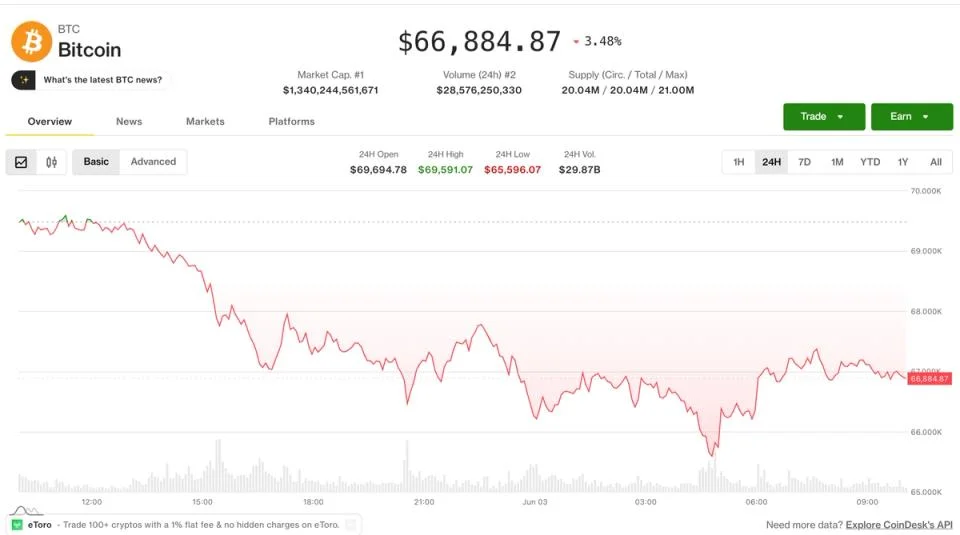



Bitcoin steadied near $67,000 on Wednesday after a failed breakout attempt above $81,000 last month pulled it back into the same $60K-$70K corridor that held between February and April. The 0.7% intraday bounce is cosmetic against a 9.5% seven-day decline, with Ether sliding in tandem to $1,870 — its weakest level since February — even as U.S. equities pushed to fresh record highs. The divergence is rattling crypto investors who have historically seen BTC and the S&P 500 move in the same direction.
Why it matters
The tape is showing classic late-stage leverage unwind: more than $1.7B in crypto futures positions were liquidated in the past 24 hours, roughly double the prior day's pace, and the majority were bullish longs caught when BTC tagged $65,500. Bitcoin futures open interest, by contrast, just printed a record above 800K BTC for the third straight day, meaning new short exposure is being put on even as spot drifts lower — a clean signature of bear-led price discovery, not liquidation-driven noise.
Implied volatility tells the same story from a different angle. The 30-day BTC and ETH volatility indices (BVIV, EVIV) jumped on Tuesday by their largest single-day margin since the February 5 crash, and Deribit's one-week put-call skew climbed to nearly 20% as traders paid up for downside protection. The two most-traded options in 24 hours were the $70K June 5 put and the $55K June 26 put — a market positioning for further pain, not for a base.
Market impact
The $60K level is now the line in the sand. A break there likely triggers a fresh liquidation cascade that drags BTC toward $54K — a 2021 and 2024 support zone — and prediction markets are pricing it in: 66% odds of sub-$55K BTC before year-end, with a coin-flip chance of a sub-$50K print. Major altcoins (ETH, ADA, SUI, XRP, SOL) all carry negative seven-day and 24-hour cumulative volume deltas, with funding rates still only mildly negative — meaning the bearish side isn't crowded and there's room for more downside if spot gives way.
It isn't all risk-off.




Frequently asked questions
-
Why is Bitcoin diverging from U.S. stocks right now?
Bitcoin has dropped 9.5% in seven days even as U.S. equities pushed to record highs, breaking the historical pattern in which BTC and the S&P 500 move in the same direction. Heavy ETF outflows and a rotation into AI stocks are pressuring BTC, while the stock rally is driven by a different set of catalysts.
-
What would happen if Bitcoin breaks below $60,000?
A break of $60,000 would likely trigger a fresh wave of liquidations in leveraged futures positions and open the door to a slide toward $54,000, a support level that held in both 2021 and 2024. Prediction markets currently price a 66% chance of sub-$55K BTC before year-end.
-
What does the derivatives data say about the current selloff?
More than $1.7B in leveraged futures positions were liquidated in 24 hours, mostly bullish longs, while BTC futures open interest hit a record above 800K BTC. That combination — falling spot, record OI, negative cumulative volume delta — signals new short positioning, not just forced de-leveraging.
-
How are options traders positioning for further downside?
Deribit's one-week put-call skew climbed to nearly 20%, and the two most-traded options in the past 24 hours were the $70K June 5 put and the $55K June 26 put. The 30-day BTC and ETH implied volatility indices also posted their largest single-day jump since the February 5 crash.
-
Are any altcoins holding up while Bitcoin sells off?
Ethena (ENA) jumped more than 20% in 24 hours after Coinbase said it would integrate the protocol into a new savings product, and zcash (ZEC) gained 6-12% on rising futures open interest. The broader Altcoin Season index climbed to 53/100, its highest since early March.
 CoinTelegraph
 CryptoSlate
 Crypto News
 WatcherGuru
 Lookonchain
 TheBlock