








 CoinDesk
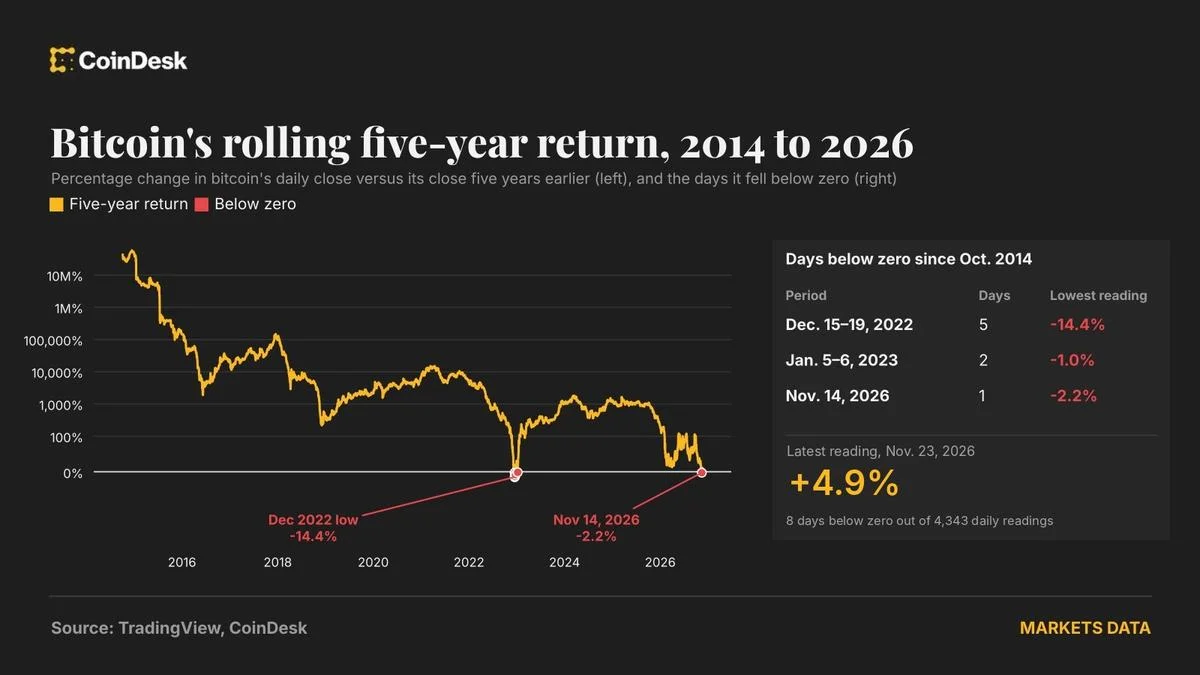


Bitcoin traded around $61,500, less than 10% above its roughly $58,600 price five years earlier, before inflation. A dollar invested on Nov. 18, 2021 was worth about $1.10 at the time of the analysis. Bitcoin was also about 49% below its Oct. 6, 2025 record above $126,000.
The rolling five-year return had briefly turned negative a few days earlier, something that last happened in December 2022. Bitcoin subsequently rallied from about $16,000 to its 2025 high, though the analysis argues that future cycles may deliver smaller gains.
Why it matters
Successive Bitcoin peaks have produced diminishing multiples: the 2013 peak was about 42 times the 2011 peak, while the 2025 peak was only 1.8 times the 2021 high. The analysis also questions Bitcoin's safe-haven credentials: its 90-day annualized volatility was 39%, versus 5% for EUR/USD.
Institutional adoption brought spot Bitcoin ETFs and a U.S. Strategic Bitcoin Reserve, but neither prevented a sharp retreat from the 2025 high. The reserve was created to hold Bitcoin forfeited in criminal and civil cases, rather than to buy large quantities of the asset.
Market impact
Cumulative spot Bitcoin ETF net inflows fell to $54 billion on Nov. 18 from a peak of $62.77 billion on Oct. 9, 2025, a net outflow of $8.77 billion, according to SoSoValue data cited in the analysis.
The column argues that Bitcoin remains exposed to investor risk appetite and dollar liquidity. Analysts cited by CoinDesk pointed to Federal Reserve interest rates as a major factor for Bitcoin, even as Bitcoin-backed lending expands.

Frequently asked questions
-
How much was a five-year Bitcoin investment worth in the analysis?
A dollar invested on Nov. 18, 2021 was worth about $1.10 at the time of the analysis, before inflation.
-
When were rolling five-year Bitcoin returns last negative?
Before briefly turning negative in the period covered by the analysis, they last did so in December 2022. Bitcoin subsequently rallied from about $16,000 to its 2025 high above $126,000.
-
How have Bitcoin's peak-to-peak gains changed across cycles?
The 2013 peak was about 42 times the 2011 peak. By contrast, the 2025 peak was about 1.8 times the 2021 peak.
-
How much did cumulative spot Bitcoin ETF inflows retreat?
Cumulative net inflows fell by $8.77 billion, from a peak of $62.77 billion on Oct. 9, 2025 to $54 billion on Nov. 18, according to SoSoValue data cited in the analysis.
-
How was the U.S. Strategic Bitcoin Reserve funded?
The reserve was created to hold Bitcoin forfeited in criminal and civil cases, rather than to buy large quantities of Bitcoin.
 CoinTelegraph
 TheBlock
 CryptoSlate
 Altcoin Daily
 WatcherGuru
 Whale Alert