








 CoinDesk
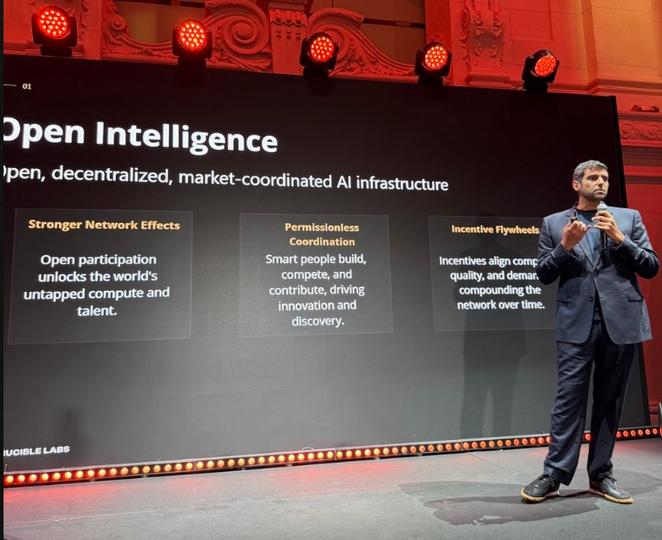



Speaking at the Proof of Talk summit in Paris, Bittensor co-founder and Crucible Labs partner Ala Shaabana told the audience that Bitcoin's network hash rate exceeds the combined power of the world's top 100 supercomputers by more than 600,000 times. He used the figure to argue that decentralized networks have already overtaken corporate data centers as the substrate of global computing — and that the same incentive playbook can now be redirected at artificial intelligence.
Why it matters
Shaabana's core logic is that coordination plus code built the most powerful financial computing engine in history, and the same blueprint can be applied to AI. Bittensor is a Layer 1 protocol that mirrors Bitcoin's design: a 21 million TAO hard cap, programmed halvings, no pre-mine, no venture capital. Where Bitcoin miners chase hash puzzles, Bittensor miners run and validate AI models, organised across 128 specialised subnets that each define a problem and reward miners in TAO for solving it. "Show me the subnet, and I'll tell you what the miners are optimizing for," Shaabana said, adapting a famous market quote. Reward raw compute speed and miners optimise for speed; reward storage and they optimise for storage. The network's intelligence is shaped entirely by what it chooses to pay for.
Market impact
The implication for AI infrastructure is that the bottleneck is no longer access to GPUs but how compute is mobilised. Shaabana framed the long-term bull case as macroeconomic rather than purely technical — "driven by debt, liquidity, and declining trust in traditional sovereign systems" — with subnets creating open markets for intelligence that any developer can plug into. The same logic is already being commercialised elsewhere: Titan Network, which aggregates unused consumer-device compute into a decentralised cloud, says it has signed Tencent, Alibaba, and Kling AI as clients, claiming up to 75% lower AI infrastructure costs.

Frequently asked questions
-
Are decentralised AI networks actually being used by big tech?
Titan Network says it has signed Tencent, Alibaba, and Kling AI as clients by aggregating unused consumer-device compute into a decentralised cloud, claiming up to 75% lower AI infrastructure costs than traditional providers.
 WuBlockchain
 CoinTelegraph
 CryptoSlate
 TheBlock
 Crypto News