








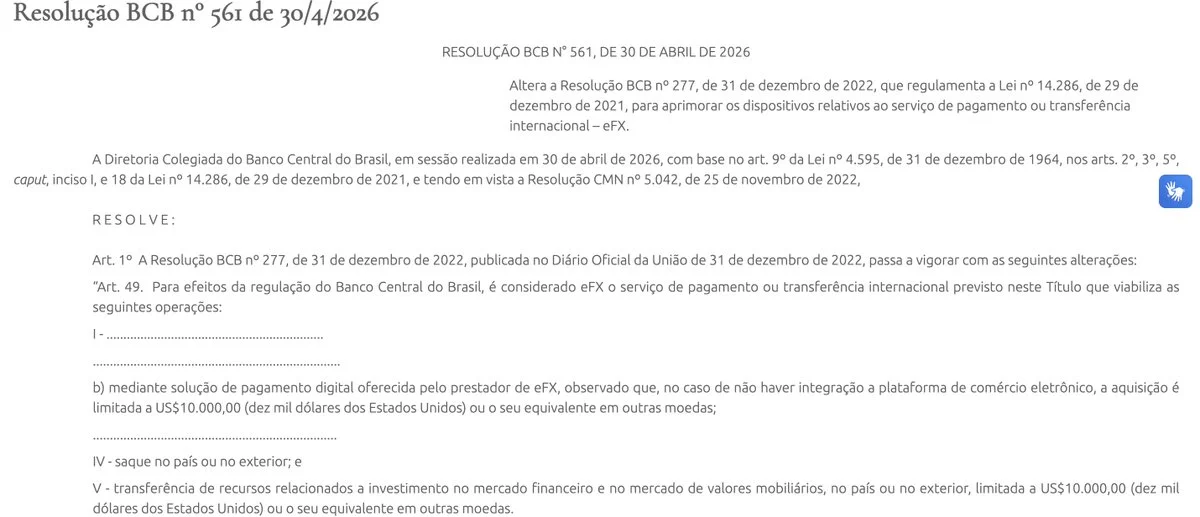
Brazil's central bank has issued Resolution BCB No. 561, revising rules for international payment and transfer services (eFX) and explicitly prohibiting the use of crypto assets in cross-border transactions. All payments must now be conducted via FX operations or regulated accounts.
The regulation also tightens compliance: it sets transaction limits, mandates reporting and KYC procedures, and requires data retention for up to 10 years. The new rules take effect on October 1, 2026.
Why it matters
Brazil has been one of the more crypto-active emerging markets, with stablecoins widely used to settle cross-border flows that the local FX market handles poorly. By routing every cross-border transfer through FX operations or regulated accounts, the central bank closes the door on stablecoin rails that have effectively operated as a parallel FX corridor — particularly relevant for BRL trading pairs that have historically been thin offshore.
Market impact
For payment service providers, the immediate cost is operational: 10-year data retention, tightened KYC, and transaction caps raise the compliance burden on any PSP still routing flows through crypto. The October 1, 2026 effective date gives incumbents time to migrate, but a hard ban on crypto in cross-border transfers means stablecoin-rail startups lose the addressable market outright rather than compete on price.
Frequently asked questions
-
What does Resolution BCB No. 561 actually ban?
The resolution prohibits using crypto assets in cross-border payment and transfer services in Brazil. All international payments must go through FX operations or regulated accounts. The rules take effect October 1, 2026.
-
Does this ban crypto trading inside Brazil?
No. The restriction is specifically on cross-border transfers and eFX services. Domestic crypto trading and holdings are not addressed by this resolution.
-
What compliance requirements does the new rule impose?
The regulation mandates KYC procedures, transaction limits, reporting obligations, and data retention for up to 10 years for licensed payment service providers handling international transfers.
-
Why is this significant for stablecoins?
Stablecoins have been used as a parallel FX corridor in Brazil, particularly for BRL pairs that were thin offshore. Routing every cross-border transfer through regulated accounts effectively removes stablecoin rails from the addressable PSP market.
-
When do the new rules take effect?
Resolution BCB No. 561 takes effect on October 1, 2026, giving payment service providers roughly that window to migrate cross-border flows off crypto rails.

 CoinTelegraph
 WatcherGuru
 CoinDesk
 CryptoSlate
 TheBlock