








 CoinDesk



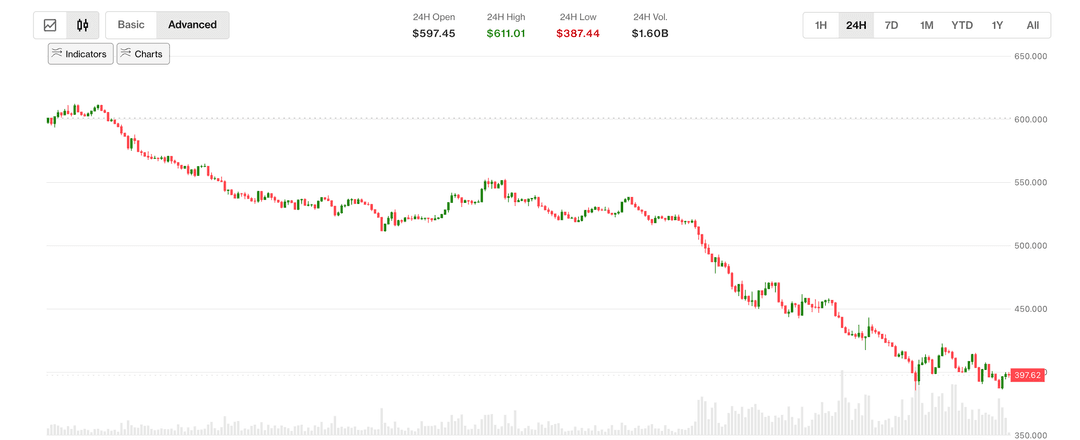
Bitcoin is trading inside a $60,000-to-$67,000 band that now functions as the cost basis for a wide swath of institutional buyers — spot ETF allocators, large holders and short-term speculators who entered over the past year, according to Jean-David Péquignot, chief commercial officer at Deribit. With BTC already near break-even for that cohort, a decisive slip below $60,000 would push them into unrealized losses and raise the opportunity cost of holding against a still-rallying AI-equity tape, he said. Strategy executive chairman Michael Saylor has separately pointed to capital rotation out of crypto and into AI names as the driver of recent losses.
Why it matters
The $60,000 line is not just a round-number psychological level. It is also the strike price on more than $1.2 billion in notional open interest of put options on Deribit — protection that institutional and professional buyers have paid for against a deeper selloff. Those puts mean market makers on the other side of the trade are now structurally short puts, or "short gamma," at exactly the level BTC is approaching. As price undercuts $60,000, those dealers are forced to sell spot BTC or futures to keep their books delta-neutral, converting an orderly decline into a self-reinforcing one. Péquignot's framing: the level matters less as a chart line and more as a mechanical tripwire the derivatives book has built into the market.
Market impact
The second-order risk is the leverage still sitting on top of the structure. Péquignot warned that leveraged longs have not been fully flushed, so a break of $60,000 could rapidly worsen collateral metrics and trigger a cascading wave of automated long liquidations. Billions of dollars of bullish BTC and altcoin positioning have already been wiped out this week, and the move comes alongside a broader risk-off shift led by semiconductor stocks, Asian equities and a softer Nasdaq after a disappointing Broadcom AI-chip outlook. If $60,000 gives way, the path of least resistance is mechanical selling into thin liquidity, with the next meaningful support likely determined by where the remaining put open interest clusters below the strike.

Frequently asked questions
-
Why is the $60,000 level so important for bitcoin right now?
According to Deribit CCO Jean-David Péquignot, $60,000 is a primary cost basis for institutional and short-term buyers who entered between $60K and $67K over the past year. It is also the strike on more than $1.2 billion in notional put open interest, meaning market makers are short gamma right at the level.
-
What happens to market makers if bitcoin breaks below $60,000?
Dealers on the opposite side of the $60K puts are short gamma. As BTC undercuts the strike, they must sell spot or futures to keep their books delta-neutral, a mechanical flow that can accelerate the selloff rather than absorb it.
-
How much leveraged long exposure is still in the system?
Péquignot said leverage has not been fully flushed and warned that a break of $60K could worsen collateral metrics and trigger a cascading wave of automated long liquidations on top of the billions already liquidated this week.
-
Is this selloff being driven by crypto-specific news?
Partly. Strategy's Michael Saylor blamed capital rotation out of crypto and into AI equities, and the drawdown came alongside a soft Nasdaq session after a disappointing Broadcom AI-chip outlook that also dragged semiconductors and Asian equities lower.
-
What would confirm that $60,000 has broken as support?
The body flags a decisive break below $60K combined with forced dealer selling and a fresh wave of long liquidations as the trigger that would convert an orderly decline into a self-reinforcing one, with the next support likely set by remaining put open interest below the strike.
 WatcherGuru
 Lookonchain
 Glassnode
 Crypto Rank News
 Crypto News
 Crypto Capital Venture
 Benjamin Cowen